
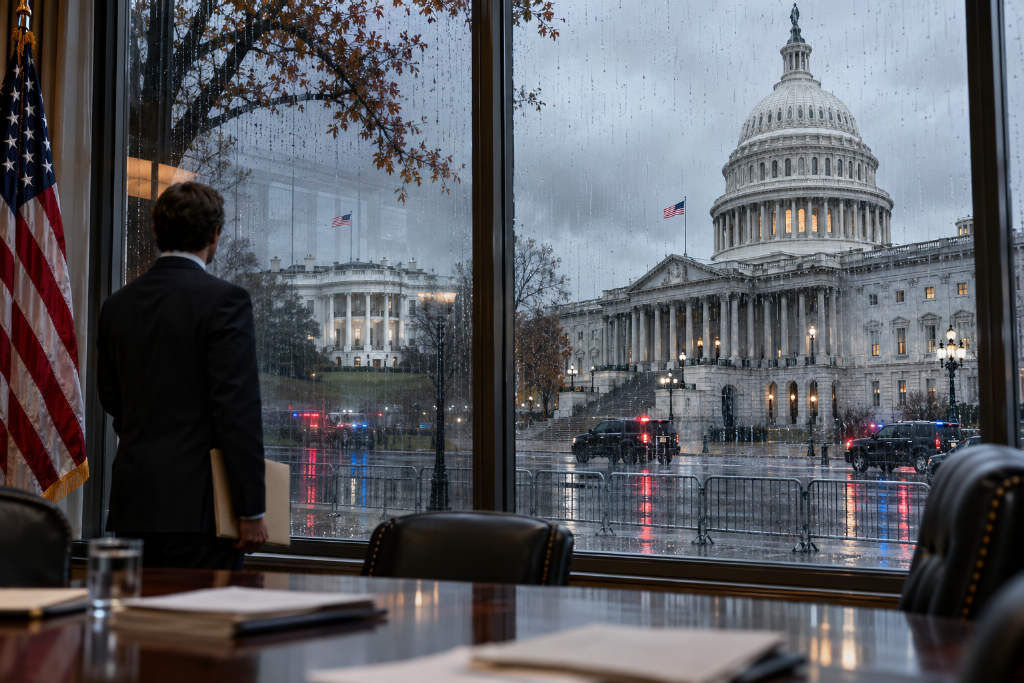
Vote counting from the 2026 U.S. midterm elections shows Democrats winning control of both chambers of Congress, setting up a divided government with Republicans still holding the White House. The report says that outcome is likely to increase political uncertainty in Washington.
In a report by Jiemian News reporter Liu Ting, analysts said the Democratic victory would affect U.S. policy in four main ways.
First, major legislation could grind to a halt. Democrats would control the congressional agenda, but President Donald Trump would retain veto power, leaving both sides prone to deadlock on key issues.
Second, congressional oversight and investigations could intensify. The report says impeachment proceedings cannot be ruled out, although conviction in the Senate faces a very high threshold, making removal unlikely.
Third, personnel appointments and budget matters may face more concrete constraints. The Senate could delay or block key Trump nominations, while clashes over a government shutdown and the debt ceiling may become more severe.
Fourth, foreign military policy could turn into another point of confrontation. Analysts cited in the report said Democrats may use their authority over defense spending approvals to pressure the administration to end the conflict with Iran.
Final results still await state certification
The report describes midterm elections as the congressional and local elections held between two presidential elections, often treated as a referendum on the sitting president’s performance.
It says the Republican setback was broadly in line with pre-election polling. Trump’s approval rating had fallen from about 50% early in his term to about 39% in October 2026, with high prices and high oil costs cited as the main reasons for the loss of support.
Formal results still need to be counted, checked and certified by each state. Certification usually runs from the second half of November into December, and closely contested races could be delayed by recounts or legal disputes. The new Congress will be sworn in on Jan. 3 next year, meaning the election outcome will only formally take effect about two months later.
Budget and legislative fights may get tougher
The report says analysts expect the political struggle during the rest of Trump’s term to run mainly along three lines once Democrats control both chambers and Trump keeps his veto power.
The first is legislation and the budget. Passing bills will become harder, compromise will depend more on political bargaining, and the risk of a government shutdown will rise.
Under the U.S. Constitution, tax and appropriations bills must originate in the House of Representatives. With Democrats controlling the House, they would hold the starting point for federal funding. The timetable is tight: the fiscal 2027 budget has not yet passed, the federal government is operating under temporary funding through Dec. 11, and the $41.1 trillion debt ceiling is only about two months away from the current borrowing level.
The report says Democrats would not need to push sweeping legislation to create pressure. They could attach conditions Trump cannot accept to appropriations bills, such as extending health insurance subsidies, restoring welfare spending that had been cut, or limiting the president’s unilateral power to raise tariffs, increasing the risk of a shutdown.
Luo Zhiheng, chief economist at Yuekai Securities, told Jiemian News that shutdown and debt ceiling fights may escalate, but a meaningful fiscal tightening would still be difficult. In his view, a new round of Republican tax cuts may struggle to pass a Democratic Congress, while Democratic proposals for tax increases and broader welfare spending could be vetoed by Trump. That would likely leave the current revenue and spending framework largely intact, making a clear drop in the U.S. deficit ratio hard to achieve.
Luo also said that after IEEPA tariffs were ruled illegal, the government was forced to refund tariffs to companies. That would reduce tariff revenue and place additional pressure on U.S. fiscal space.
Oversight pressure and personnel friction
The second line is oversight and personnel. The report says that once Democrats control the House, committee chairs would all be Democrats. Subpoena power would no longer require coordination with the majority leadership or bipartisan consent, allowing committee chairs to compel government officials, presidential allies and the Trump family’s business partners to appear at hearings and submit documents.
According to Politico, Garcia and Raskin, who are expected to lead the House Oversight Committee and the Judiciary Committee, have already drafted a list of investigations. The input text cuts off at that point and does not provide the full scope of those inquiries.



