
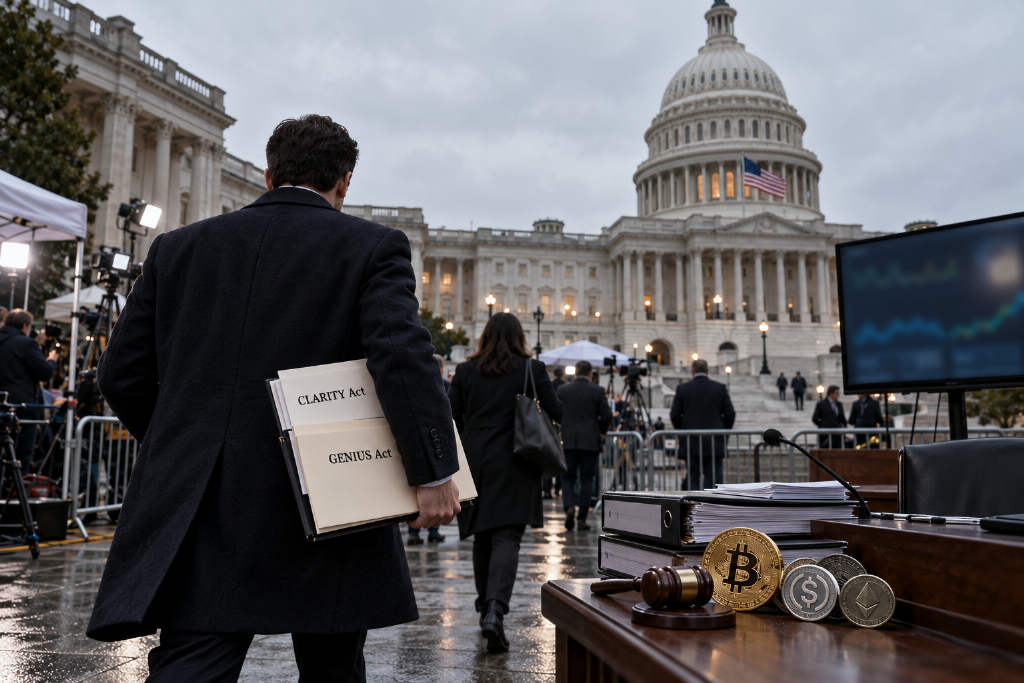
A CoinW Research Institute report says the Nov. 3, 2026 U.S. midterm elections could become a major variable for crypto regulation over the next two years, even though the vote will not change Donald Trump’s status as president. What could change is control of Congress, and that matters for how quickly crypto legislation moves, how regulators are overseen, and how markets price the odds of policy follow-through.

The report’s central point is narrow but important: the midterms are not presented as a direct trigger for a crypto bull or bear market. Their main effect would be on the speed and stability of regulatory reform. A continued Republican hold on both chambers would support policy continuity. A divided Congress, or Democratic control of both chambers, could add friction. Even then, the impact would not be uniform across assets. BTC is described as more dependent on macro liquidity and spot ETF flows, while DeFi, stablecoins and trading platforms are seen as more exposed to regulatory shifts.
Why the midterms matter for crypto policy
The report notes that all 435 seats in the House of Representatives and 35 Senate seats will be contested on Nov. 3, 2026. Unlike a presidential election, the midterms do not replace the president. They can, however, change which party controls Congress, and major U.S. crypto bills generally need approval from both the House and the Senate before reaching the president’s desk.
The House handles review, amendments and floor votes. The Senate then takes up its own review and vote. CoinW points to the CLARITY Act as the clearest example. The bill passed the House in July 2025, but in September 2026 it failed to clear a procedural hurdle in the Senate. In other words, presidential support for crypto is not enough if Congress cannot assemble the votes needed to move legislation.
The two chambers also matter in different ways. A shift in House control could affect the legislative calendar for crypto bills, budget decisions and the intensity of investigations into regulators. A shift in Senate control could shape the path of legislation and influence appointments of senior officials at agencies including the Securities and Exchange Commission, or SEC, and the Commodity Futures Trading Commission, or CFTC.
CoinW also highlights a structural constraint in the Senate. Most ordinary legislation usually needs 60 votes to end debate, not just a simple majority. Republicans currently control both chambers, with 53 seats in the Senate. If the midterms flip one chamber or both, the balance of negotiations and the broader legislative agenda could change with it.
GENIUS is law, CLARITY is still stuck
To frame the election’s impact, the report separates U.S. crypto regulation into two buckets: laws that are already in force and reforms still being negotiated in Congress. The first group mainly faces implementation questions. The second is more directly exposed to changes in congressional control. The GENIUS Act and the CLARITY Act sit on opposite sides of that divide.
Trump signed the GENIUS Act in July 2025, creating a federal regulatory framework for payment stablecoins in the United States. The law requires compliant issuers to hold at least 1:1 qualified reserve assets, including U.S. dollar cash and short-term U.S. Treasuries, and it sets rules on redemption, disclosures and supervision. CoinW says that gave stablecoin issuers, banks and payment firms a clearer legal basis for related business lines.
Because the GENIUS Act is already law, the midterms will not automatically undo it. A new Congress could still influence the direction of policy through oversight, hearings or amendments. The report says several disputes remain unresolved, including whether stablecoins can offer yield to users through third-party platforms, whether those products could divert deposits from traditional banks, and how banks should participate in the business. Much of the detailed implementation will be written by regulators acting under statutory authority, while changes in congressional control could affect oversight priorities and the room for later policy adjustments.

The broader digital asset market still lacks a unified U.S. framework. The CLARITY Act is meant to define which tokens are securities, which are digital commodities, how authority is split between the SEC and the CFTC, and what compliance rules apply to trading platforms, DeFi protocols and developers.
Unlike GENIUS, CLARITY has not completed the legislative process, which makes it more vulnerable to the election outcome. On Sept. 15, 2026, the Senate held a procedural vote on a motion to end debate and move toward later consideration. The result was 49 in favor and 50 against, below the 60 votes usually needed. CoinW stresses that this was not the final vote on the CLARITY Act itself. It was a cloture-related procedural vote. Still, it exposed the political resistance facing market-structure reform.
That resistance comes from several directions. Some Democratic lawmakers want stronger consumer protection, anti-money laundering measures and tighter limits on conflicts of interest involving government officials and their family members in crypto business. Some Republicans also disagree on parts of the package. At the same time, the banking industry is concerned that stablecoin yield products could pull funds away from traditional deposits and weaken banks’ funding base.
CoinW says the hard part of CLARITY now goes beyond drawing a line between SEC and CFTC authority. It also involves balancing the interests of crypto firms, traditional banks and different political groups. Whether Congress can rebuild enough support after the midterms will directly shape the bill’s prospects.
Even if legislation stalls, the Trump administration could still use agencies such as the SEC and the CFTC to adjust interpretations, enforcement priorities and supervisory approaches within existing legal authority. That could provide a more workable operating environment for crypto businesses. The report adds a caution: administrative policy can face court challenges, and it can change when future administrations or agency leadership change. For that reason, it is usually less durable than a clear statutory framework.
Crypto money in politics is growing, but it cannot guarantee votes
The report says the CLARITY setback has pushed crypto firms to treat congressional politics as a core part of their strategy. Support from the White House or regulators is not enough if there are not enough lawmakers willing to move legislation. That has helped drive a larger flow of industry money into U.S. elections.
According to Public Citizen’s analysis of Federal Election Commission and related data, crypto companies had provided about $206 million to relevant political committees in the current election cycle as of the second quarter of 2026. CoinW says that is above the roughly $170 million in corporate political donations recorded in the 2024 election cycle.
Coinbase, Ripple and Andreessen Horowitz, or a16z, are listed as major participants. Fairshake is described as one of the industry’s main political funding vehicles. CoinW notes that Fairshake is a Super PAC, which means it can raise large sums and spend independently on advertising to support or oppose candidates, but it cannot make unlimited direct donations to candidates or coordinate those independent expenditures with campaign teams.
The report says crypto firms are willing to spend because congressional rules can directly shape what business they are allowed to run. Exchanges want clearer listing and trading rules. Stablecoin companies care about the room to expand payment and yield products. DeFi projects want more clarity on developers’ legal responsibilities. The higher the regulatory uncertainty, the greater the friction for expansion, fundraising and product development.
CoinW also says the industry has not placed all of its political bets on Republicans. It has tried to back pro-crypto lawmakers in both parties, reflecting the reality that major reforms in the U.S. often still need bipartisan cooperation no matter which party controls Congress. Political spending can increase the industry’s ability to make its case. It cannot guarantee that candidates win, and it cannot directly determine whether a bill passes.
How election politics could feed into BTC and other crypto prices
For investors, the practical question is whether the midterms can move BTC, ETH and other digital assets. CoinW’s answer is indirect. Election results do not change crypto supply and demand on their own, but they can affect valuations through policy expectations, institutional capital and broader risk appetite.
The clearest transmission channel is regulation. If Congress can make progress on market-structure legislation after the election, legal uncertainty for exchanges, DeFi projects and institutional investors could fall, and markets may begin pricing that in before the policy is fully delivered. If reform remains stuck, businesses that depend on U.S. market access and compliant expansion could face more operating pressure, which may weigh on how investors value related assets.
The report says the effect would not be evenly distributed. BTC already has mature institutional access through spot ETFs and other channels, so macro liquidity, rate expectations and capital flows often matter more than any single crypto bill. Some DeFi tokens, exchange-linked equities and financial-services assets could be more sensitive to changes in regulatory rules. A positive policy read for one part of the industry does not automatically mean the whole crypto market rises together.
CoinW also reviews prior election years. In 2014, 2018 and 2022, BTC fell about 56%, 73% and 64% for the full year, respectively. Looking roughly 12 months after those midterm elections, some historical tallies show gains of about 24.5%, 44.9% and 92.3%.
The report warns against reading that as proof that midterms cause BTC bull markets. BTC was still in an early stage in 2014. The 2018 market was shaped by the collapse of the prior crypto bubble. In 2022, the backdrop included aggressive Federal Reserve rate hikes and the collapse of FTX. Price action after each election was influenced by monetary policy, industry cycles and market liquidity. CoinW singles out 2018 in particular, noting that BTC still saw a clear decline after the election, which undercuts any claim of a stable short-term post-election rally pattern.
The report adds that the 2026 market is not the same as earlier cycles. Spot ETFs are more established, institutional participation channels are broader, and policy changes can now pass through listed companies, fund products and crypto financial services into a wider capital market. Investors also adjust positions ahead of the vote based on polling, policy statements and market expectations. For that reason, CoinW says it is not enough to ask who controls Congress. The more important question is whether the result differs from what markets had already priced in, and whether the macro backdrop supports risk assets.
Three election scenarios and what each could mean
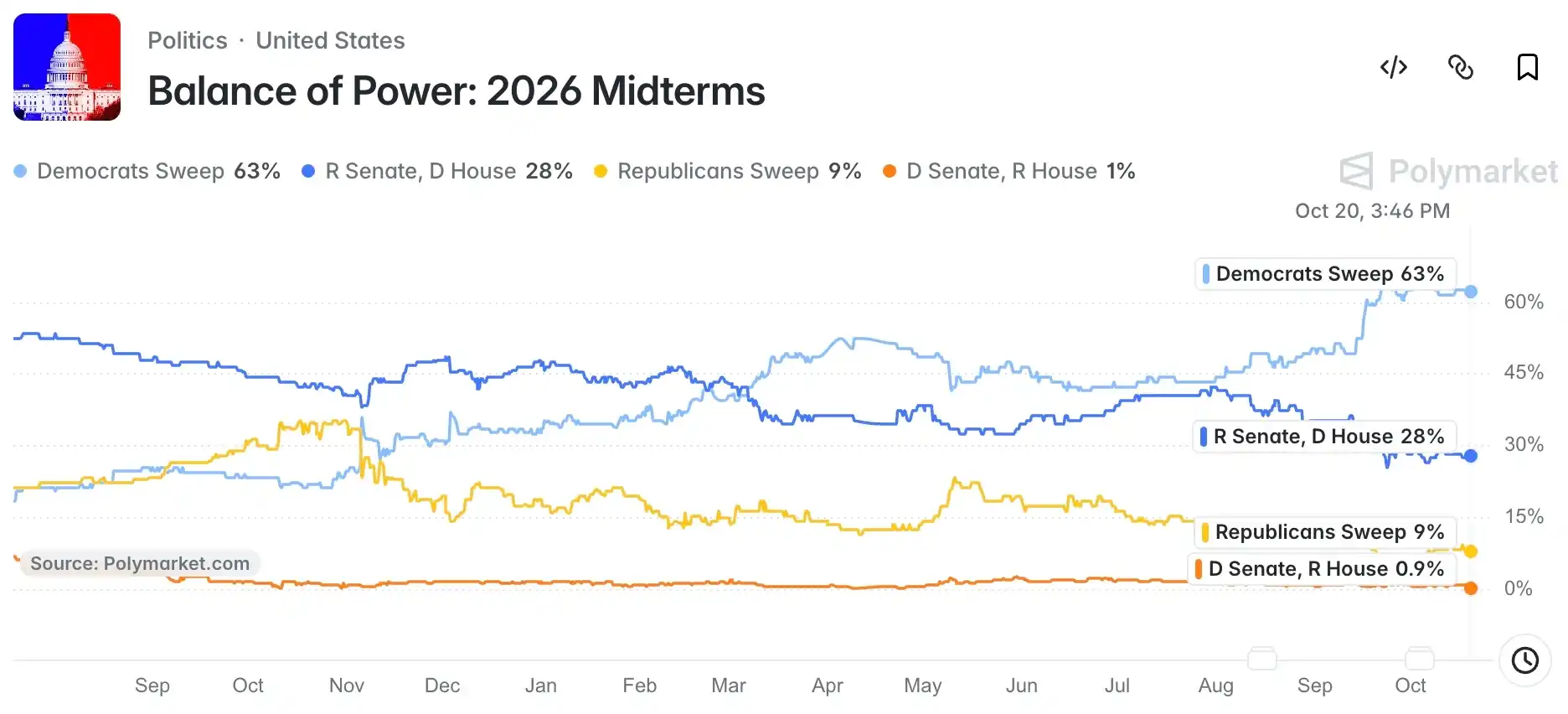
CoinW lays out three possible post-election configurations and says the exercise is meant to map policy and asset implications, not predict the final result. Based on Polymarket data as of Oct. 20, 2026, Beijing time, the implied probability of Democrats controlling both chambers was about 63%. The probability of Democrats controlling the House while Republicans held the Senate was about 28%. The probability of Republicans keeping both chambers was about 9%. The probability of Republicans controlling the House while Democrats held the Senate was about 1%.

Those figures reflect market pricing of possible congressional outcomes, not the final election result. CoinW says the gap between actual results and market expectations could become an important driver of short-term crypto volatility.
Scenario 1: Republicans keep both chambers
If Republicans retain the House and Senate, CoinW says the Trump administration’s current crypto policy line would likely keep a stronger degree of continuity. The CLARITY Act could regain momentum, and implementation of stablecoin rules and institutional crypto-finance business could continue along the current path. For trading platforms, stablecoin issuers and crypto financial-services firms, that continuity could reduce long-term operating uncertainty.
Even so, the report says a Republican hold does not mean every crypto bill passes smoothly. The bipartisan disagreements that blocked CLARITY earlier would still be there, and key provisions could still need renegotiation. On the market side, policy continuity may help businesses that depend on clearer rules, but prices may not keep rising if investors had already fully priced in that outcome.
Scenario 2: Democrats control at least one chamber
If Democrats win back either the House or the Senate, Congress would move into divided government. CoinW says that would likely make it harder for the Trump administration to push new crypto legislation. Relevant committees could also step up scrutiny of trading platforms, stablecoin businesses and the crypto interests of government officials. Bills such as CLARITY would face more bipartisan bargaining, and the legislative timetable could slip further.
In that setting, markets could mark down some businesses that depend on looser regulation and rapid expansion, especially where product access, token classification and compliance costs feed directly into profitability. Still, the report says divided government does not automatically mean crypto falls. BTC remains tied to ETF flows, dollar liquidity and global risk appetite, so its path could diverge from assets that are more regulation-sensitive.
Scenario 3: Democrats control both chambers
If Democrats take both the House and Senate, CoinW says the congressional agenda on crypto could shift more noticeably. Consumer protection, anti-money laundering, financial stability and conflicts of interest involving government officials could receive more attention in bill negotiations and oversight work. Exchanges and DeFi projects hoping to expand product scope quickly could face a longer wait for policy clarity.
That scenario still does not mean an immediate across-the-board tightening of U.S. crypto regulation. The GENIUS Act would remain in force. Trump would still hold presidential authority. The SEC and the CFTC would continue operating under existing law. CoinW also notes that Democrats are not internally uniform on crypto innovation or regulatory design, so the policy outcome would still depend on bill language and cross-party negotiations. The report says markets need to distinguish between slower legislation and an actual change to rules already in effect.
Which assets look most sensitive
CoinW says the sectors most exposed to congressional change are those that rely most heavily on U.S. regulatory approval, product access and business expansion. It also draws a line between a business model benefiting from policy and a token price rising. The two are not the same thing.
BTC’s direct sensitivity to congressional regulation is described as moderate. Its main pricing drivers remain spot ETF flows, dollar liquidity and broad risk appetite. ETH and DeFi are seen as more policy-sensitive because staking services, token classification, protocol liability and rules for institutional participation can all affect how the ecosystem develops. Even if regulation improves, CoinW says investors still need to watch whether protocol usage and revenue grow with it.

Stablecoins and real-world assets, or RWA, are also highlighted. Stablecoins touch issuance rules, reserve assets, bank access and payment business. RWA involves issuance, custody and trading rules for tokenized securities. Clearer regulation could attract more traditional financial institutions, but growth in stablecoin supply does not automatically mean a specific blockchain or RWA token captures that value. CoinW says the key remains fee income and the mechanism for value capture.
Exchanges and related listed companies could feel the business impact more directly. Regulation affects what products they can offer, what custody services they can run, what compliance costs they bear and where revenue comes from, so their equity valuations may react more sharply to policy changes. Prediction markets are another area to watch, especially rules for political event contracts, safeguards against market manipulation and the scope of CFTC authority.
By contrast, meme coins and other highly volatile tokens usually lack a direct channel to benefit from policy changes. Their prices are described as more dependent on sentiment, leverage and liquidity. CoinW says these sensitivity rankings are qualitative judgments based on business models, not fixed rules derived from historical backtesting.
Why markets can still trade the other way
The report flags another risk in election trading. Even if the political outcome matches expectations, prices do not have to move in the expected direction. A Republican hold on both chambers, for example, could be read as supportive of policy continuity. But if investors had already built large positions ahead of the vote, the result could trigger profit-taking instead.
CoinW says traders should watch whether implied volatility in options rises before the election, whether futures open interest and funding rates point to concentrated leverage, and whether ETF inflows remain steady. After the result, the focus shifts to the gap between expectations and reality, and to changes in liquidity. The report’s point is simple: election results shape policy expectations, but asset prices still depend on expectation gaps, capital flows and how sensitive each asset is to regulation.
What to watch after the vote
Once the 2026 U.S. midterms are over, CoinW says market attention is likely to move from the election itself to policy delivery. In the short term, the report says investors should watch BTC and ETH price action, spot ETF net inflows, implied volatility in options, futures open interest and funding rates to judge whether moves are being driven by short-term leverage and sentiment.
In the medium term, the key question is whether the new Congress can produce real progress on regulatory reform. CoinW points to several markers: whether CLARITY returns to the legislative agenda, personnel changes on congressional financial committees, rulemaking by the SEC and the CFTC, and follow-up implementation details under the GENIUS Act. Those developments will determine whether policy expectations begin to translate into a better operating environment for businesses.
Over a longer horizon, the report says the real test is whether institutional capital and underlying business activity keep growing. It lists ETF holdings and fund flows, stablecoin supply, RWA market size, exchange business data and actual DeFi revenue as indicators worth tracking. CoinW’s conclusion is that the U.S. midterms may affect the pace of crypto policy over the next two years, but they will not directly decide whether the market enters a bull or bear phase. The more durable drivers are regulatory certainty, sustained institutional inflows and whether macro liquidity remains supportive.


