
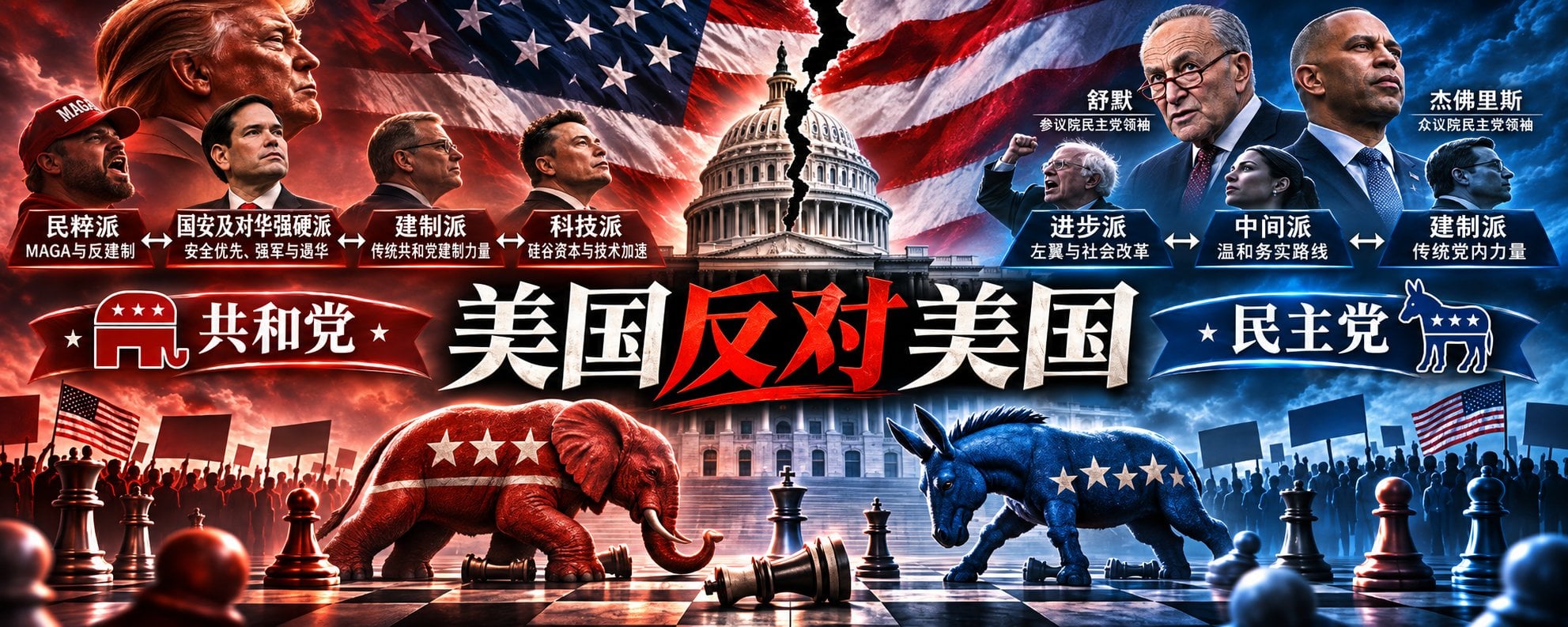
US political leaders share a stated interest in winning the next technology contest and restraining their principal strategic rival, but the two parties are divided internally over who should benefit, who should bear the costs and how much power the government should exercise, according to an analysis by PANews author qinbafrank.
The author argues that individual policies offer a better guide to these divisions than fixed political camps. Republican strategist Steve Bannon can align with Marco Rubio on restrictions on chip exports to China, stand closer to Vice President JD Vance in opposing a prolonged Middle East war, and appear alongside Senator Bernie Sanders to demand tighter oversight of artificial intelligence (AI) giants. Among Democrats, Senate leader Chuck Schumer is preparing to investigate President Donald Trump while facing a challenge to his leadership from a fellow party member over the Jensen Huang affair.
The analysis draws on America Against America, a book written by a Fudan University scholar after a visit to the United States around 40 years ago. Its central proposition, as the author describes it, is that the country is not a homogeneous whole but a complex society with structural contradictions and forces working against one another.
Four sources of influence inside the Republican Party
The author identifies four broad Republican forces, treating presidential power centered on Trump as a category of its own. The first is the Make America Great Again (MAGA) economic populist camp, represented by Bannon and his media and grassroots organizing network. Bannon can shape how supporters understand a policy, but he does not have authority to sign administrative orders. His camp wants US resources to serve domestic workers first, opposes prolonged spending of troops and money in the Middle East, and objects to technology companies collecting gains while workers shoulder the risk of job losses. It also favors strict limits on advanced chip supplies to China.
A second camp focuses on national security and a hard line toward China. It includes Rubio, Scott Bessent and Republican chairs of the House committees dealing with China, foreign affairs and intelligence. Their influence comes through executive security assessments, congressional investigations and export-control legislation. Their priority is to prevent US technology from strengthening China’s strategic capabilities. They scrutinize the customers and third countries through which chips move, as well as remote access to cloud computing capacity. Their views on military action in the Middle East depend on how each assesses the threat.
A third group wants faster AI development and a larger market for US technology. David Sacks represents this position, while Vance overlaps with it on open-weight models. Commerce Secretary Howard Lutnick controls licensing and trade-policy tools. The group worries that restrictions that are too sweeping could push overseas customers toward alternatives such as Huawei. Sacks has defended conditional sales of Nvidia’s H200, in part to preserve the market position of US platforms. The author distinguishes conditional exports of one generation of products from giving China access to the most advanced products.
Trump’s presidential authority forms the fourth category. He controls executive appointments and negotiating priorities and can speak directly to supporters, but he also bears political consequences from the stock market, war and prices. The author argues that Trump wants discretion to decide cases individually: he can adopt hard-line export restrictions at one point and personally push for Huang’s return at another, citing industrial competition and market confidence. If Congress writes fixed restrictions into law, the president’s room to strike deals would narrow.
Bannon and Vance bridge different alliances
Bannon’s opposition to war, concern about AI-related job losses and support for limiting China’s access to computing power are not contradictory, the author argues. His consistent test is whether a policy strengthens ordinary American workers or expands the power of Washington and large companies. In his political account, prolonged war in the Middle East consumes US resources, automation may weaken workers’ bargaining power and sales of advanced computing capacity to China may help a competitor. All three positions can follow from economic nationalism. Military restraint can coexist with a technology blockade.
Bannon’s cooperation with Sanders on AI does not mean they endorse the same policy package. The two appeared together in September to call for stronger AI oversight. Sanders and Representative Alexandria Ocasio-Cortez, known as AOC, have a separate federal legislative proposal to pause construction of new AI data centers until safeguards are in place. Concern about technology oligarchs and employment crosses the left-right divide, but agreement on a construction pause, labor rules and redistribution is a separate question.
The author describes Vance as a link between the MAGA base and technology capital, with the Iran war exposing the difficulty of that position. Vance favors AI development but is skeptical of prolonged foreign wars. After the midterm elections, he publicly linked Republican losses to the Iran war. On November 20, appearing with Trump before reporters, Vance declined to answer directly whether he would order the strikes again if the decision were his. He said Trump had made the decision and that the vice president’s duty was to support the president. In October, he had also demanded that Iran substantially reduce its nuclear enrichment capacity as a condition for ending the war.
Vance also actively pushed for Huang to return. Reuters reported that Trump and Vance were concerned that US open-weight models would lose a key figure who was willing to support them and had the computing power and industrial resources to do so. The author sees Vance as trying to keep technology investment and economic nationalism within one coalition. The two can coexist when AI is viewed as a tool in US competition with China; they can clash if local voters associate it with higher electricity bills, job cuts or subsidies for wealthy people. For someone interested in seeking the 2028 presidential nomination, the author argues, that is a harder problem than whether he is close to Silicon Valley.
Business leaders should also be distinguished from White House officials. Entrepreneurs such as Elon Musk and Huang have interests involving customers, shareholders, supply chains and product plans. Vance faces electoral and party-succession constraints, while the commerce secretary is responsible for licensing and enforcement procedures. They may agree on Huang’s return without agreeing on which chip models may be exported or which customers belong on a blacklist.
Huang’s return and the Republican struggle over control
In an earlier article about Huang’s departure, the author examined the actions of Republican factions and argued that Trump had previously used his standing to suppress dissent inside the party. According to this analysis, the election defeat weakened Trump’s influence and amplified criticism over inflation, household costs and the data-center construction boom associated with AI. Republican politicians with differing positions became more active and assertive.
The author attributes Huang’s return to a market plunge that made his importance apparent, arguing that Trump used the pressure created by the decline to restrain party hard-liners and personally pressed and persuaded Nvidia’s board. Each faction gained something from the episode. Trump and Vance prevailed on the personnel decision; the national-security camp obtained some controls, including rules restricting remote computing access.
The author says a Commerce Department document expressly stated that the Treasury Department and National Security Council led the drafting of the rules, and that Nvidia’s board established a national-security committee. The author expects stricter compliance requirements for Nvidia chip sales. Democrats, meanwhile, gained an investigative line that could reach the Commerce Department and the White House. In the author’s assessment, Huang’s return did not remove any faction from the dispute.
Democratic factions: establishment does not mean centrist
The Democratic Party contains overlapping groups rather than one bloc. The author distinguishes the establishment, which describes control over caucus, fundraising and agenda-setting resources, from centrists, whose label describes the policy and electoral compromises they are willing to accept. Hakeem Jeffries can be an establishment figure and move closer to the left on healthcare; a moderate who wins a seat in a Republican-leaning state can still support replacing Schumer.
Congressional leaders and party organizations. Schumer and Jeffries are responsible for maintaining a majority spanning Democratic-leaning states, swing states and newly won Republican-leaning states. They tend to prioritize measures that can pass, including health-insurance subsidies, living costs and government accountability. The left wants to turn electoral victory into structural reform, while ordinary members and committees may demand more control over the legislative agenda.
Centrists, pro-growth Democrats and pragmatic governors. The House has a formal New Democrat Coalition whose agenda covers housing, healthcare, energy, care and everyday goods. Pennsylvania Governor Josh Shapiro represents a local-governance approach that welcomes industrial investment while imposing conditions such as requiring developers to pay their own electricity costs. This group differs sharply from the left on a blanket pause in data-center construction, expanding direct government provision and how much to constrain businesses.
Economic progressives and the democratic socialist left. The progressive camp is broad. AOC and Sanders, an independent senator allied with Democrats, represent its democratic socialist wing. Economic progressives such as Representative Ro Khanna emphasize universal healthcare, a wealth tax and a higher minimum wage. Their shared concerns include corporate concentration, political donations and workers’ bargaining power. They question both the pace of reform under party leaders and whether investment-led growth and market competition alone can improve distribution. The Congressional Progressive Caucus has its own cost-of-living plan, the author notes, rather than only a protest agenda.
Labor and local industry alliances. These cross factional lines. Construction and electrical unions care whether projects break ground and contracts bring local union jobs. Communities hosting data centers pay more attention to electricity prices, water use and developers’ commitments. Both sides may claim to represent workers yet vote differently on the same project. The author cites an alliance supporting data-center construction that includes an electrical workers’ union, OpenAI and Blackstone.
National-security Democrats. This group also crosses party factions. Michigan Senator Elissa Slotkin, a former intelligence analyst, emphasized national security and lawful oversight in criticizing Trump’s intervention involving Nvidia. Shapiro focused on institutions favoring people at the top, while Khanna, whose district includes Silicon Valley, argued that a company’s share price should not exempt it from export accountability. All three support scrutiny. The author says opposition to Trump can unite them quickly, but differences may return when they decide what legislation to pursue.
Investigations and a contest for Democratic leadership
The author argues that Democrats want investigations to pressure Republicans and build an advantage for 2028, but says voters’ demand for oversight is a more immediate reason. An Associated Press survey found that about 70% of voters believed Congress was not doing enough to check Trump, including about 40% of Republican voters. At the same time, roughly one in five people who voted for Democratic candidates still viewed the party negatively overall.
For some voters, the author writes, support for investigating the White House does not mean they have decided to put Democrats in charge of it. Treating oversight solely as a 2028 campaign tactic would miss demands for due process and clean government. The author also argues that Democrats attribute their midterm victory to dissatisfaction with Trump and Republican policies and want to use their congressional majority to investigate the preceding two years of policy, corruption and insider conduct, thereby consolidating electoral support.
The author regards a statement issued by Jeffries as speaker-designate as a declaration of the party’s investigative priorities. On November 19, House Democrats wrote to Lutnick to investigate whether Nvidia had influenced Commerce Department enforcement involving Megaspeed. On November 23, after Huang’s return, Jeffries called for an investigation and export legislation. Schumer promised to investigate possible misconduct once Democrats secured a majority. In a separate Venezuelan oil-license matter, Senator Maggie Hassan sought information from Vance.
There is a leadership contest inside the party as well. The author says Senator Chris Van Hollen used the Nvidia affair that same day to argue for changes to Senate agenda-setting and is due to challenge Schumer on December 1. The investigation of Trump has thus also become material for Democrats competing over party leadership.
Oversight can unite national-security, anti-corruption and anti-technology-monopoly factions, but it cannot make policy choices for them. A healthcare vote must still determine coverage and spending; a data-center project requires a decision on approval and who pays. The author warns that if months of hearings bring executives and ministers before Congress without visible improvements in household insurance premiums, electricity bills or housing costs, Republicans can ask what Democrats accomplished after gaining control of both chambers.
Democrats have proposals, but not one governing plan
On November 22, a CBS host asked Jeffries what bill he would seek to pass first after taking charge of the House. He did not name an initial bill with votes secured and a number assigned. Instead, he listed five early tasks: work to end the Iran war, reverse Medicaid cuts, restore Supplemental Nutrition Assistance Program (SNAP) food aid, address Trump’s tariffs and extend Affordable Care Act premium tax credits.
The author links the first two categories of concerns to oil prices and living costs, and to healthcare and food expenses for low-income households. Democratic leaders can identify policies they want to change. Whether the president signs a bill, how spending is financed and which measure is traded first remain separate questions.
These plans were not all assembled after the election. The New Democrat Coalition proposed a plan in February to reduce five categories of household costs and released a governing agenda in May. The House Progressive Caucus introduced its own cost-of-living plan in April. Democrats also have the formal foundation of their 2024 national platform. The author’s assessment is that factions have produced answers but have not combined them into one plan.
Reducing living costs can unite Democrats because the factions agree that a problem exists. It is not yet a complete economic governing framework, the author argues, because they diagnose high prices differently. On electricity, a centrist governor may blame slow grid expansion and large customers not paying their own connection costs. A left-wing lawmaker may see excessive technology-company power over site selection and bargaining and favor pausing new demand. The first approach could bring more electricity investment; the second could delay some computing-capacity construction. Both promise to protect household bills, but their implications for industry differ.
The challenge from 2026 to 2028
For Republicans, the author says, the central task is keeping technology capital and economic-populist voters committed to the same growth strategy. Vance can simultaneously seek faster US AI development and less spending on Middle East wars; those positions are compatible at the level of national strategy. The distance between Bannon and Sacks on those questions is harder to bridge than their shared view of China as a competitor.
Democrats must turn congressional victories won separately across states into a governing program that national voters will entrust to them. In 2026, Democratic candidates in Texas and Kansas can appeal through faith, local identity and moderate language, while progressives can win elsewhere with sharper economic demands. In 2028, the party will have only one presidential and vice-presidential ticket.
A Washington Post model of voting districts in 13 states estimated that roughly 70% of Democrats’ gains relative to 2024 came from changes in the composition of voters, while about 20% came from voters switching parties. The author argues that Democrats cannot treat their mobilization advantage as a permanent national majority. They have a shared agenda sufficient to begin the next Congress and several concrete proposals, but have not decided which governing approach their 2028 national candidates must defend.
The author cautions that saying Democrats only investigate Trump understates their policy preparation, while claiming the midterm victory settled their internal direction overstates what the result can show. The tests ahead are which household-focused bill Democrats put first, whom they compromise with to pass it, and whether an investigation can produce rules they would accept even under a future Democratic administration. Those choices will test their priorities, their ability to form an internal majority and whether their commitment to accountability extends beyond pursuing opponents.



