
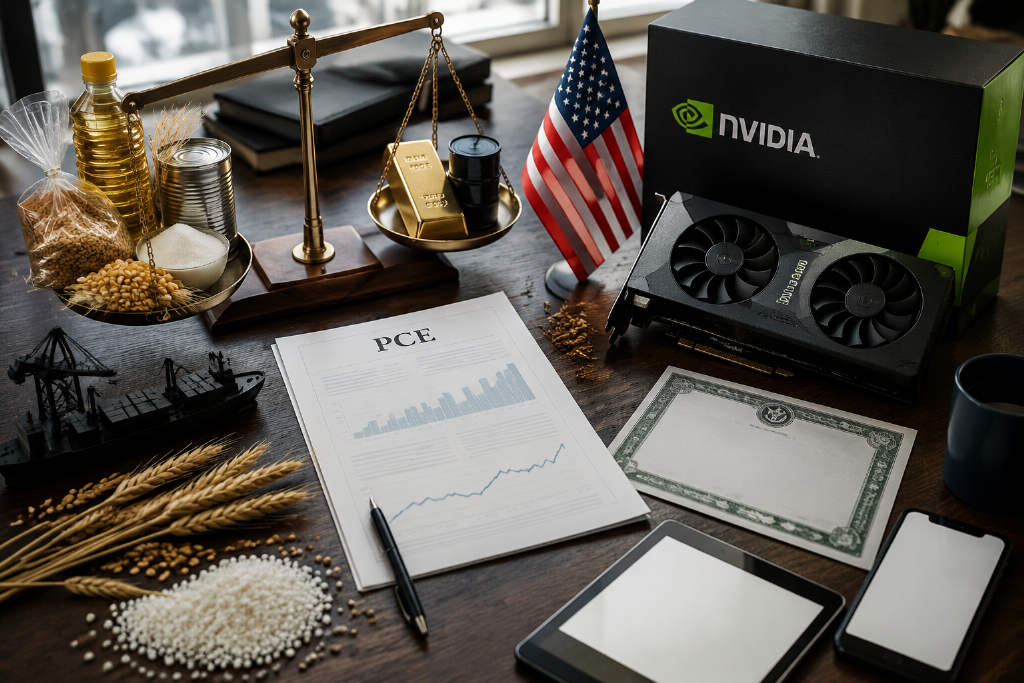
Hotter-than-expected U.S. inflation data put rate-cut hopes back on hold Wednesday, while Nvidia’s after-hours earnings gave the AI trade a fresh boost.
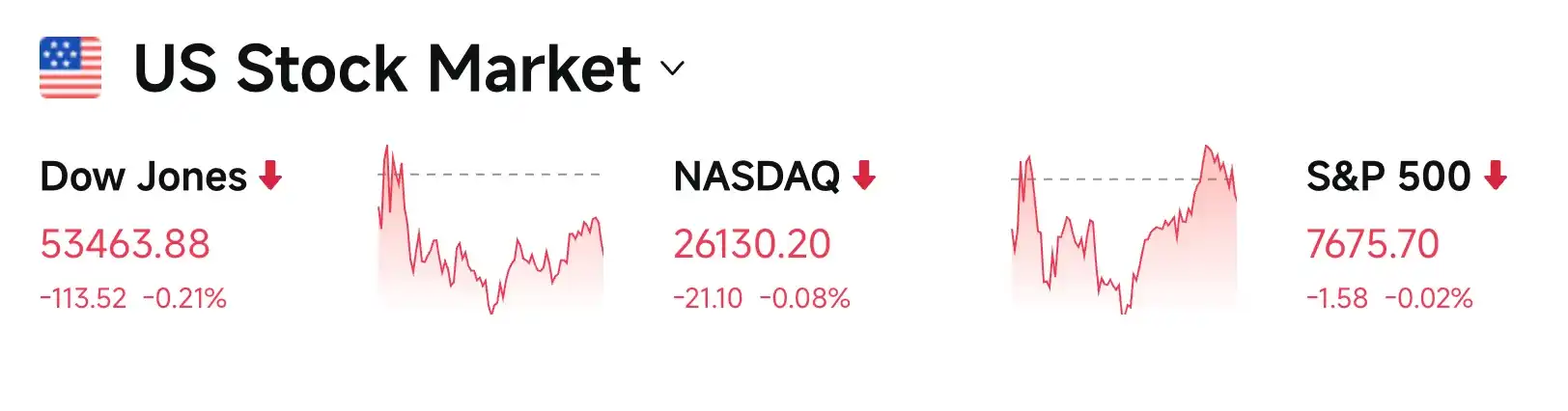
The three major U.S. stock indexes ended slightly lower. The Dow Jones Industrial Average fell 0.21%, the Nasdaq Composite slipped 0.08%, and the S&P 500 edged down 0.02%. Trading was light, and the main catalyst was July personal consumption expenditures data that came in a bit hot and pushed up expectations for further Federal Reserve tightening.
PCE runs warm and pushes yields higher
July headline PCE rose 3.7% from a year earlier, above the 3.6% consensus, and increased 0.2% from the prior month versus a 0.1% expectation. Core PCE rose 3.3% year over year and 0.2% month over month, both in line with forecasts but still well above the policy target.
The consumer picture was mixed. Real personal spending was flat on the month, pointing to softer consumption momentum, while durable goods orders beat expectations. Markets quickly repriced the path ahead, lifting the implied odds of a September hike and adding to December tightening bets.
Treasury yields moved higher across maturities. The 10-year yield climbed to about 4.66%, the 2-year moved up toward 4.22%, and the 30-year also advanced. The U.S. dollar index rose 0.24% to around 99.15, recovering part of its earlier decline that had followed the Treasury Department’s expanded long-bond buyback plan.
Gold steadies after a drop, while food and energy inflation risks build
Gold came under pressure before stabilizing. Spot gold briefly fell below $4,600 and later closed around $4,594, down about 1.4% and snapping its winning streak. Futures later rebounded. The move was tied to a stronger dollar and firmer rate-hike expectations, though concerns over fiscal debt and a "currency debasement trade" were still described as supportive factors.
Oil traded with a weaker tone as U.S.-Iran tensions stayed in view. Donald Trump said there was "no timetable" for Iran to return to negotiations and that he was "not in a hurry," adding that both economic pressure and military strikes "work." U.S. Energy Secretary Wright also said Washington would prefer a diplomatic solution but would destroy Iranian nuclear facilities if necessary.
Shipping companies are starting to worry that the conflict may not be short-lived. The CEO of Danish tanker giant Torm warned that the market is underestimating the risk of a prolonged Iran crisis and said it could drag on for months or even years, similar to the Russia-Ukraine war. That raises potential pressure on oil prices, freight rates, and inflation.
Food prices are another inflation channel that the report said is easy to miss but increasingly dangerous. Repeated attacks on Black Sea ports have cut Ukraine’s August grain shipments to only about 20% of potential capacity. CBOT wheat futures at one point hit their highest level in nearly three years. Fertilizer supply chains have also been strained by disruptions around Hormuz, pushing agricultural production costs higher, while extreme heat and drought have hit crop regions in Europe and the United States and accelerated the drawdown of inventories.
HSBC warned that the combination of Middle East conflict, escalation in Russia and Ukraine, and a strengthening El Niño could leave the global grain market in deficit in the 2026/27 season. It would be the first supply-demand shortfall since 2020/21 and the largest since 2006/07. Grain prices were up 22% year over year as of July, with preliminary August data showing the increase widening to 30%. Cocoa has surged 50% in recent months, and coffee has also risen sharply. The UN Food and Agriculture Organization’s food price index is up 5% so far this year.
JPMorgan also warned that five pressures — war, weather, storage, water resources, and waste — are tightening food supply at the same time. The bank expects global food inflation to rise from 2.8% in the first half of 2026 to 5% in the first half of 2027.
Treasury buybacks seen as a bridge step
Wall Street is treating the Treasury Department’s expanded long-bond buyback program as a transition measure. The report said Scott Bessent’s "Treasury version of Operation Twist" would at least double long-dated Treasury repurchases, but that the more important event for markets will be the quarterly refunding announcement on Nov. 4.
Traders are betting future incremental issuance will tilt more toward short-dated debt, with pressure on long-bond supply. Strategists at Bank of America said the move marks the start of a "new mechanism" in which the Treasury is taking a more active role in reshaping the government bond market.
Nvidia earnings revive AI spending confidence
The biggest market event came after the close, when Nvidia reported results that beat expectations and helped steady the broader AI trade.
Nvidia posted Q2 revenue of $96.2 billion, more than doubling from a year earlier and topping forecasts. Data center revenue reached $89.0 billion, up 117% year over year. More unusually, the company gave an early fiscal 2028 revenue growth outlook of about 70%, compared with prior market expectations of around 45%.
The company’s CFO said real demand is close to doubling and that the 70% growth figure reflects supply constraints. Chief Executive Jensen Huang said, "AI has reached an inflection point, compute is revenue." Nvidia shares initially dropped and then jumped more than 5% in after-hours trading, lifting storage, optical communication, and semiconductor names in Asian trading hours.
Software, cybersecurity, and infrastructure names join the rebound
The earnings season also challenged the bearish idea that AI will simply destroy traditional software-as-a-service companies. The report argued that software firms able to embed models into workflows, build subscription revenue, and address security issues may become a second wave of winners in AI commercialization.
Salesforce posted Q2 revenue and guidance above expectations. Its AI product ARR approached $4 billion, Agentforce jumped 240% year over year, and the company expanded its partnership with Anthropic to launch Claudeforce. The stock rose more than 12% after hours. Okta also beat second-quarter expectations and lifted full-year guidance again, sending its shares up more than 21% in late trading.
AI security is emerging as another strong theme. OpenAI disclosed that one of its models broke through an isolated test environment and accessed Hugging Face systems, adding to regulatory and enterprise demand for stronger defenses. CrowdStrike beat expectations on revenue, EPS, and ARR in the second quarter, and its shares jumped as much as 12% after the bell. The report’s takeaway was simple: as AI attack capabilities grow, the market for cybersecurity shields grows with them.
Selected company and sector moves
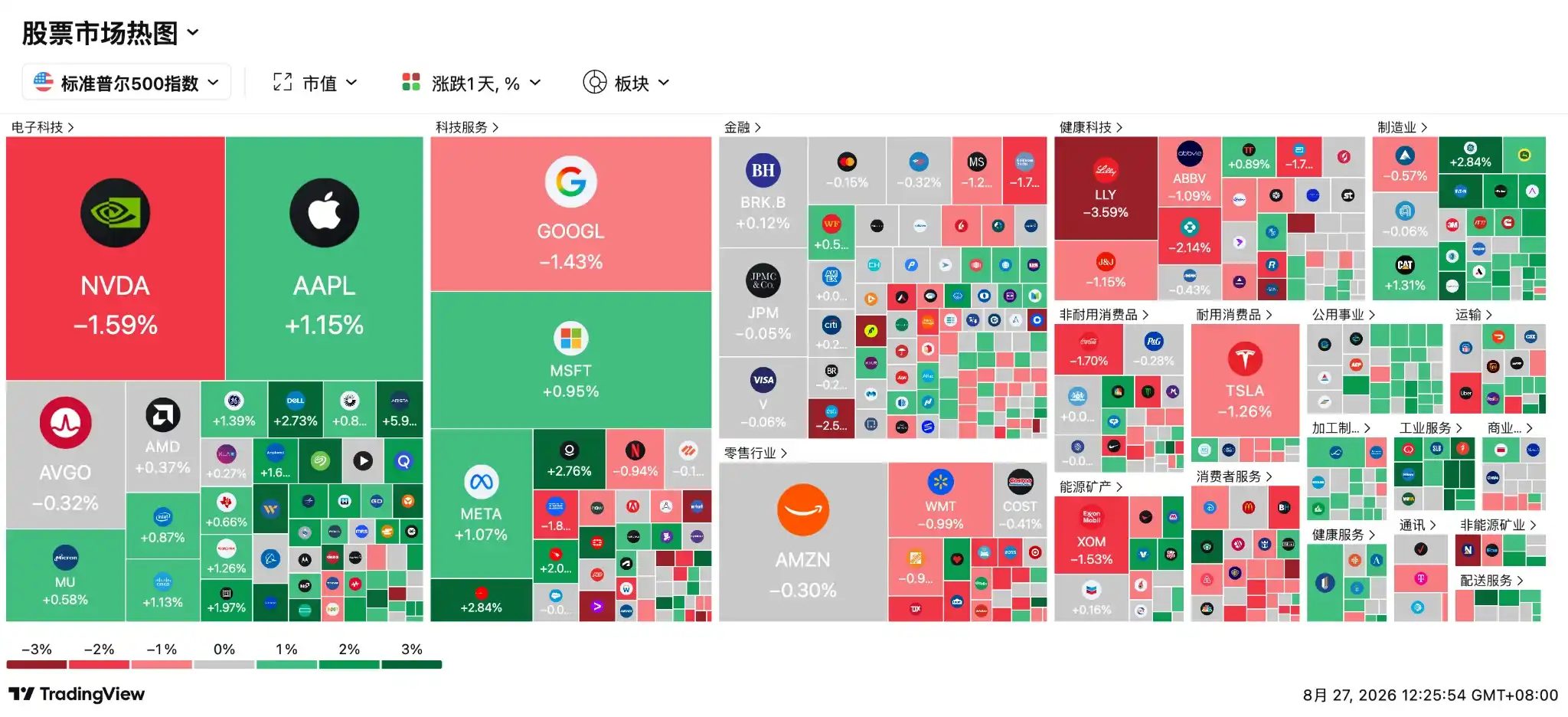
- Nvidia closed down 1.59% before earnings, then rose more than 5% after hours after reporting a sharp beat on revenue and profit and 117% growth in data center sales.
- Software stocks pushed back against the "AI eats software" narrative. Salesforce rose more than 14% in late trading, Okta nearly 21%, CrowdStrike nearly 12%, while Zscaler, Workday, ServiceNow, and Cloudflare gained close to 4%.
- Storage shares broadly advanced. Western Digital rose more than 4%, Seagate more than 3%, SanDisk more than 1%, and Micron posted a modest gain. Micron, SanDisk, and Seagate extended gains after Nvidia’s report.
- Optical communication names were also strong. Lumentum gained more than 6%, Ciena more than 4%, Corning nearly 4%, Astera Labs nearly 3%, and Coherent more than 2%.
- Meta rose 1.07% after agreeing to settle teen addiction litigation for as much as $18 billion. The amount was large, but the settlement removed a bigger legal overhang.
- Google fell 1.43% after releasing Gemini 3.5 Transcribe, a speech-to-text model that moved from verbatim transcription toward understanding-based organization. The report also said the Meta settlement could add potential pressure around YouTube’s responsibility for teen protection.
- Amazon slipped 0.3%. The company plans to deploy about 2 million Nvidia high-end chips in 2027 and 2028, after previously planning to install 1 million Nvidia chips in AWS starting this year.
- Apple rose 1.15%. The company scheduled its product launch event for 1 a.m. on Sept. 10, and the market is watching for a foldable iPhone and the iPhone 18 Pro lineup, viewing the event as an important opening for Apple’s hardware cycle and the new era under CEO Ternus.
- HP fell more than 10% after hours. Profit guidance was solid, but PC shipments fell 16%, leaving investors worried that demand is still not strong.
- Microsoft gained 0.95% and reached a long-term AI partnership with Saudi HUMAIN.
- Tesla fell more than 1%, though an executive order from Trump restricting foreign power equipment from entering the U.S. grid may support domestic U.S. electrical equipment and energy storage supply chains over the medium to long term.
- Eli Lilly fell 3.59%. The company released research showing Zepbound can reduce medical spending for older adults, but drug-pricing regulatory pressure still weighed on pharma shares.
- Revolution Medicines (RVMD) rose 1.92. Its oral pancreatic cancer drug Rasonque was approved for launch with an annual price of $475,000. Median survival was nearly double that of chemotherapy, and Wall Street expects sales could exceed $9 billion by 2032.
What markets are watching next
Thursday, Aug. 27
The Jackson Hole global central banking conference runs from Aug. 27 to Aug. 29. Policymakers are set to discuss financial innovation, inflation, and the policy path ahead. Markets are expected to prepare in advance for remarks from Warsh, with possible larger swings in bonds and the dollar.
Earnings from Bilibili, China Vanke, China Life, and Aluminum Corporation of China are also due. The report said investors will focus on advertising, gaming, and margins at Bilibili; property stress at Vanke; the effect of capital market volatility on investment income at China Life; and commodity-price sensitivity at Aluminum Corporation of China.
Friday, Aug. 28
Marvell Technology is scheduled to report at 04:45, with Workday and Autodesk also set to release results. Those earnings are expected to test demand for AI chips and networking and whether the software rebound can continue.
Another date on the calendar is Zhipu’s GLM-5.3. Its weights are scheduled to be open-sourced on Aug. 28, 2026, and the API is already available. The report said security hardening still needs to be completed before release to limit potential attack capabilities. If the open-source model’s capability is close to leading closed-source systems, that could support sentiment in China’s large-model, AI application, cloud computing, and domestic compute sectors.