
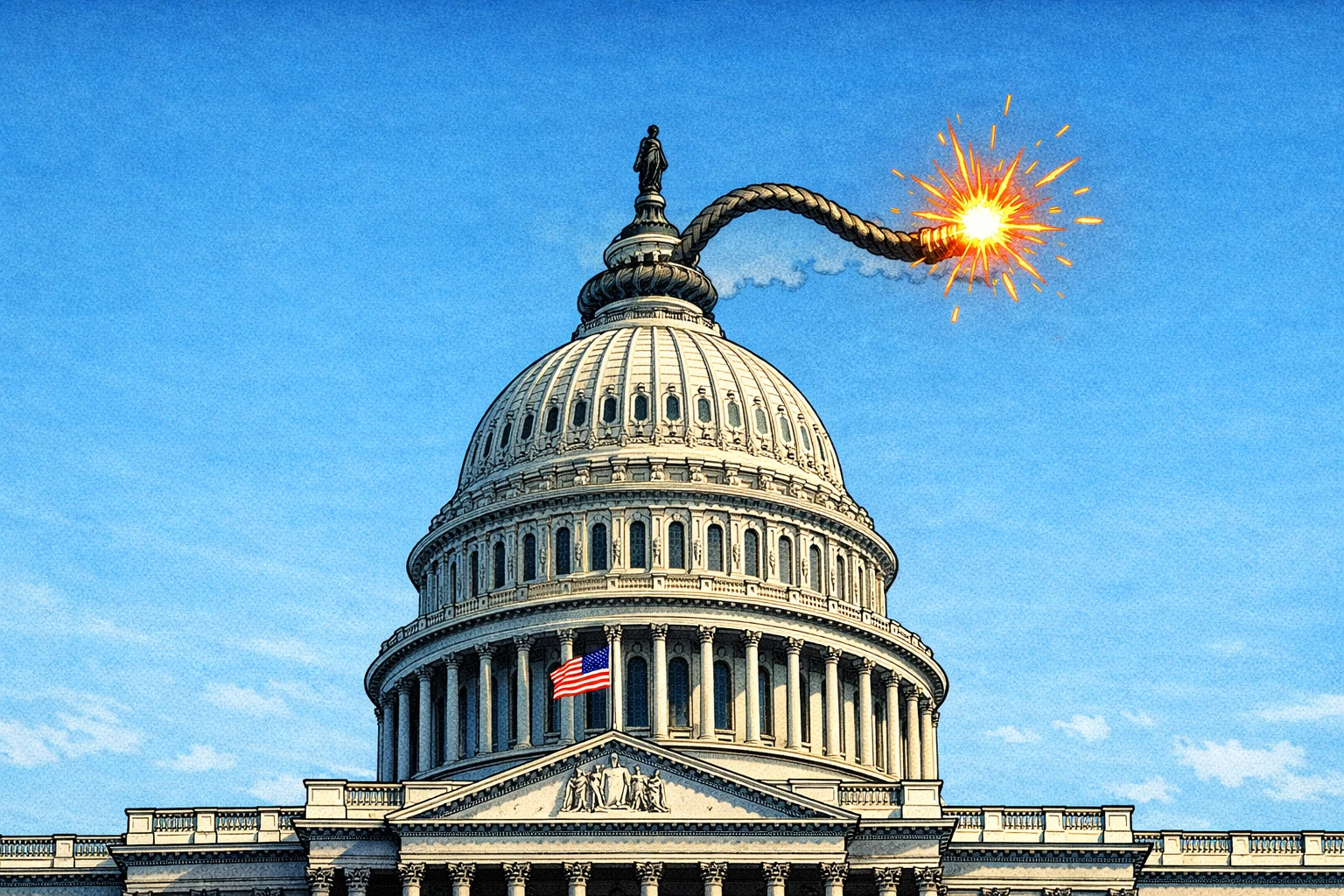
With less than 24 hours until the Friday midnight deadline, Senate Democrats and the White House finalized a key bipartisan spending deal: funding for most federal agencies—including the Pentagon, Education Department, and Labor Department—through the end of September, largely removing market uncertainty over a government shutdown.
However, the deal specifically excludes the Department of Homeland Security (DHS) from long-term funding, granting only a two-week short-term extension. Adding to the complexity, the House is currently in recess, meaning Washington still faces a brief "technical shutdown" that could extend the political standoff into next week.
Trump Unlikely Peacemaker
The most striking shift in these negotiations is President Trump's departure from his combative past. In a rare warning on Truth Social, he stated that a prolonged shutdown would be "the only factor that could slow down America's progress," urging Congress to fully fund the government. This is a stark contrast to his first term, when he often used shutdown threats as bargaining chips.
The change likely reflects the realities of Trump's second term. Rather than stoking political chaos to energize his base, the White House now urgently needs stable economic data to support its policy record. Any extended shutdown would directly hit employment figures, consumer confidence, and even stock market performance.
Minneapolis Tragedy Sparks Stalemate
The main sticking point that nearly derailed talks was Democrats' insistence on specific reforms to Immigration and Customs Enforcement (ICE). The controversy stems from a January 2026 enforcement operation in Minneapolis that resulted in the deaths of two U.S. citizens, sparking nationwide protests.
In response, Democrats proposed reforms including mandatory body cameras for ICE agents and restrictions on masked enforcement. The Senate earlier rejected a bill that included full DHS funding due to these disputes.
The eventual compromise split DHS off into a separate two-week extension—not a solution, but a delay to the battle over border enforcement and civil liberties until mid-February.
Weekend Technical Shutdown Likely
Even if the Senate passes the deal tonight, the House is not expected to reconvene until Monday, February 2. This creates a funding gap from Friday midnight through Monday.
Because it falls over a weekend when most federal offices are already closed, the "technical shutdown" is expected to have minimal impact on financial markets and government services. Markets largely view it as a harmless procedural hiccup.
The real wild card is how House Speaker Mike Johnson manages discontent from the Freedom Caucus. This conservative bloc opposes splitting DHS off, viewing it as a concession to Democrats on border security. Monday's vote will likely pass, but some uncertainty remains.
Washington has once again staged its familiar cliffhanger. On the surface, the long-term funding deal eliminates most tail risks, keeping major departments running through the fiscal year. But by isolating the toughest immigration enforcement issue and giving DHS only two weeks of cash, the next clash is already set for mid-February. Democrats will again push ICE reforms, while Republicans hold the line on border enforcement. For markets, this means a fresh wave of political uncertainty is just two weeks away—the core confrontation is unresolved, merely postponed.