

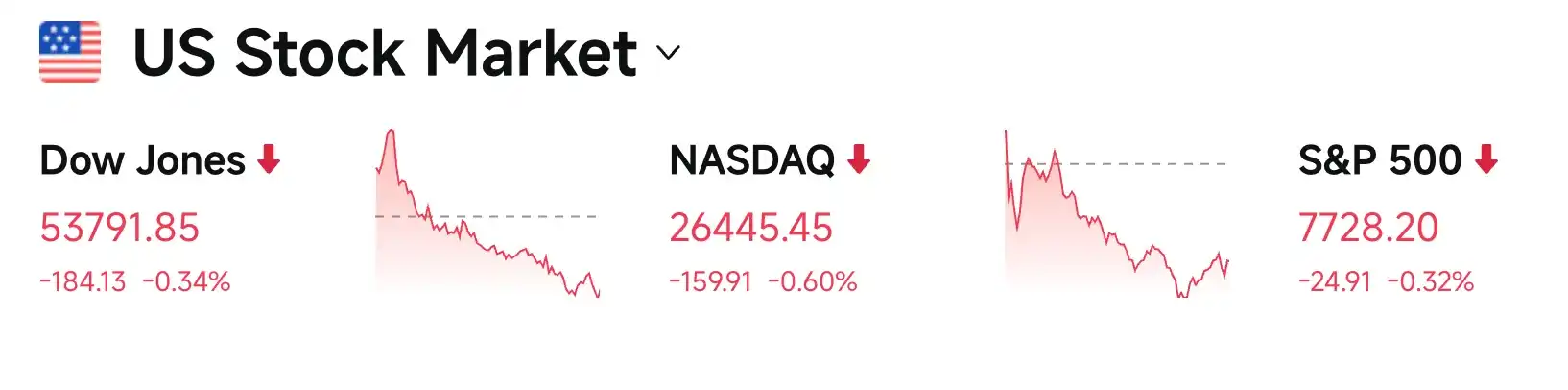
Wall Street turned cautious ahead of the U.S. July consumer price index report, and major indexes finished lower for a second consecutive day. The Dow Jones Industrial Average fell 0.34% to 53,791.85, the S&P 500 lost 0.32% to 7,728.20, and the Nasdaq declined 0.6% to 26,445.45. Large technology stocks broadly weighed on the tape, with Google dropping nearly 4%, while the S&P 500 logged a fourth straight session of unusually narrow trading range.
Sentiment and positioning are no longer moving together
Market sentiment has diverged sharply from index performance. The S&P 500 has kept setting fresh highs, yet bears outnumbered bulls in 20 of the past 25 weeks, and institutional positioning has lagged underlying fundamentals. 22V Research said that kind of excessive pessimism has historically pointed to rebounds, with attractive return prospects over the next one to six months.
Wells Fargo offered a very different read. Its sentiment gauge is nearing the strongest sell signal since 2018, and the bank recommended adding hedges ahead of the CPI release. Citadel Securities, meanwhile, said the deleveraging phase appears close to ending, with systematic funds, hedge funds, and corporate buybacks preparing to add exposure again.
Hormuz deadlock keeps pressure on oil markets
The standoff around the Strait of Hormuz continued to support crude prices. On Tuesday, Rezaei, secretary of Iran’s Supreme National Security Council, and Mokhber, an adviser to Iran’s supreme leader, said the strait would not reopen unless the United States unfreezes assets, ends regional hostilities, and accepts all conditions.
On the same day, the U.S. military fired missiles in the Gulf of Oman at a Panama-flagged cargo vessel that was trying to break the blockade, forcing 55 merchant ships to reroute. Houthi forces also attacked Saudi and Egyptian vessels in the Bab-el-Mandeb Strait, causing the first crew deaths since the Iran war began.
The U.S. Energy Information Administration raised its forecasts for WTI and Brent crude prices for this year and next year, and said Middle East oil supply disruptions are likely to last at least through 2027. Crude has now risen for three straight sessions, Brent is approaching $90, and diesel crack spreads remain elevated, pushing near-term supply premiums higher.
Fed officials turn hawkish again as bond traders focus on CPI
Federal Reserve speakers added to the tension. Chicago Fed President Austan Goolsbee said that 「the biggest problem is that prices are rising too fast」, while Cleveland Fed President Hammack said it may take multiple rate increases to bring inflation back to 2%. Market pricing is now roughly split between a September rate increase and no change.
Even with oil moving higher, the 10-year Treasury yield fell 2 basis points to 4.69%, largely because weak existing home sales data strengthened bets on the easing side. One pressure point sits in systematic positioning: by the end of July, CTAs had expanded global bond short exposure to about three times the level seen over the prior two weeks. For every 1 basis point move in the 10-year Treasury yield, related CTA profit-and-loss exposure is about $300 million, one of the highest readings since 1990. A softer-than-expected CPI print could trigger a bond rally and force crowded short covering, magnifying volatility.
AI infrastructure and optical names outperform while mega-caps lag
Technology shares split into two very different groups. Mega-cap names dragged on the major indexes, but semiconductors, storage, optical networking, AI cloud companies, and alternative asset managers performed well. The Philadelphia Semiconductor Index rose 0.87%, with 24 of its 30 components advancing. SK Hynix gained 4.7%, SanDisk climbed 2.68%, CRDO rose 3.23%, and Lumentum added 0.87%. Cloud providers including CoreWeave also moved higher and accelerated after hours on earnings.
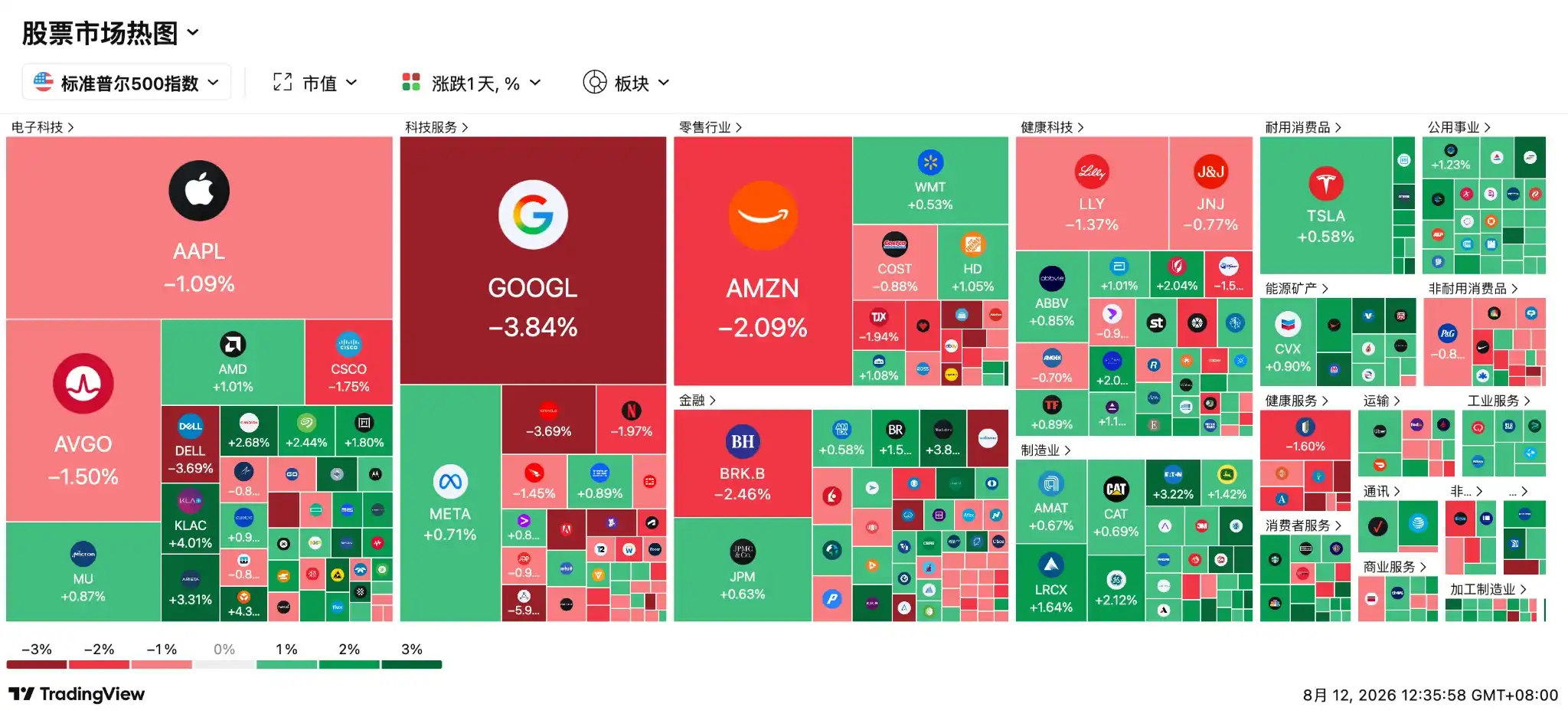
By contrast, most of the so-called Magnificent Seven declined. Google dropped 3.84%, its biggest one-day loss in nearly six months. Amazon fell 2.09%, Apple lost 1.09%, Microsoft slipped 0.44%, and Nvidia was nearly unchanged. Investors were still questioning Nvidia’s newly announced $500 billion compute financing platform, especially around the risk of circular financing. Jensen Huang said his own exposure would not exceed 25% and described the backing as limited, and credit default swap spreads narrowed afterward.
The same financing framework lifted alternative asset managers. KKR gained 6.88%, Apollo rose 6.26%, Brookfield added 4.77%, and Blackstone climbed 3.89%. The market view is straightforward: AI data center buildouts require huge pools of capital, and private credit and infrastructure funds stand to benefit directly.
GPU compute futures are coming as AI regulation heats up
The financialization of GPU computing is moving ahead. CME will launch H100 and B200 GPU compute futures on Oct. 5, tracking hourly GPU rental costs. That would allow companies to hedge compute costs in the same way they hedge oil and electricity prices.
Political pressure on AI development also intensified. Senator Sanders sent letters to the CEOs of OpenAI, Anthropic, and Meta, demanding a pause in AI development or congressional intervention would follow. House Democrats also pressed Speaker Johnson to arrange hearings with major AI company CEOs. That added another layer of uncertainty to technology sentiment.
CoreWeave, Lumentum, and Super Micro drew the strongest post-market attention
CoreWeave
CoreWeave closed up 2.42% and jumped more than 16% after hours. Second-quarter revenue reached $2.575 billion, up 112% from a year earlier and above expectations. Backlog stood at $104 billion, and the company added more than $25 billion in new commitments at the start of the third quarter. Its CEO said margins on the new contracts are 5 to 10 percentage points higher. Other AI cloud names moved with it: NEBIUS rose nearly 5% ahead of its earnings release before Wednesday’s open, while RIOT, Hut 8, and IREN each gained more than 2.5%.
Lumentum
Lumentum rose 0.87% in the regular session and about 7% in late trading. Fourth-quarter revenue came in at $1.01 billion, up 109% year over year, while non-GAAP earnings per share surged 267% to $3.23. A one-time non-cash loss of $7.8 billion tied to debt extinguishment pushed GAAP net loss to $7.2 billion. For the next quarter, the midpoint of revenue guidance reached $1.255 billion, 8% above expectations. The company’s CEO said pump lasers were 「completely sold out」 and that demand for 1.6T and CPO/NPO remains strong.
The broader optical communications group also advanced. CRDO gained 3.23%, Marvell Technology rose 1.80%, AAOI added 1.14%, Coherent climbed 1.05%, and Corning gained 0.91%.
Super Micro and Nvidia
Super Micro Computer ended the session up 0.45% and rose more than 10% after hours. Its fiscal fourth-quarter sales were $11.12 billion, slightly below expectations, but gross margin nearly doubled. The midpoint of first-quarter sales guidance topped consensus by 25%, and the company’s fiscal 2027 outlook was also well above market estimates.
Nvidia slipped 0.02%. The company is reportedly developing the trillion-parameter open-source model Nemotron 4, aiming to compete with the top global open-source large language models and lock in more GPU demand. After Huang clarified the financing plan, worries eased and the stock steadied.
Memory, Intel, and Google
Memory stocks rebounded after a Micron executive warned that tight supply could last beyond 2027. Micron rose 0.87%, SK Hynix gained 4.70%, SanDisk climbed 2.68%, and Seagate advanced 2.44%.
Intel added 0.19%. Its planned $20 billion share sale received tacit approval from the Commerce Department, though the government will not participate in the offering, giving the company more capital for AI expansion.
Google posted one of the sharpest declines of the day, down 3.84%. CEO Sundar Pichai said Gemini monthly active users have officially surpassed 1 billion, making it Google’s 14th product to enter the company’s “billion users club.” Even so, concerns around internal restructuring and the broader pullback in major tech names pushed the stock to its biggest one-day drop in nearly six months.
Other names in focus
Apple’s plan for a major glass redesign tied to the 20th anniversary iPhone in 2027 remains unchanged, countering reports from some analysts that the project had been canceled. Oracle fell 3.71% on reports of a new round of layoffs, prompting investors to reassess the cost-control pressure behind its fast-growing cloud business. SpaceX fell nearly 4%.
What markets are watching next
Wednesday, Aug. 12
- EIA, OPEC, and IEA monthly reports: Investors will examine global oil supply and demand, inventories, OPEC+ production discipline, and demand outlook. If the reports point to tighter supply or worsening Hormuz risk, oil could extend gains and lift inflation expectations again. If demand forecasts are revised lower, the rebound in crude may lose momentum.
- 8:30 p.m. U.S. July CPI: The market expects headline CPI to slow to 3.4% year over year from 3.5%, and core CPI to ease to 2.5% from 2.6%. A cooler print could further reduce September rate-hike pricing, pulling Treasury yields and the dollar lower while helping the Nasdaq, gold, long-duration bonds, and richly valued growth stocks. A hotter reading could force a repricing of tightening risk and pressure equity valuations, especially in AI-linked technology shares.
- 8:00 p.m. Tencent Holdings second-quarter earnings call: Key areas include the recovery in gaming, monetization of video account advertising, fintech margins, AI capital expenditure, the Hunyuan model, Yuanbao, and WeChat AI features.
- Unitree Technology IPO subscription payment: As a closely watched humanoid robotics listing, payment levels and investor enthusiasm may keep influencing robot-related sentiment.
Thursday, Aug. 13
- After-hours earnings from Cisco, Coherent, and Cerebras: Cisco will be watched for AI networking demand, while Coherent will test appetite for high-speed optical communications and 800G/1.6T optical modules. Strong orders, margins, and guidance could keep the bullish optical trade going. A miss could trigger profit-taking in a group that has already rallied sharply.
- 6:00 a.m. Google product event: The company is expected to unveil the Pixel 11 lineup, Pixel Watch 5, and Pixel Buds Pro. Investors will focus on Tensor G6 and how deeply Gemini is integrated into the ecosystem. A stronger-than-expected on-device AI experience could benefit AI smartphones, edge models, sensors, and the Android supply chain.