
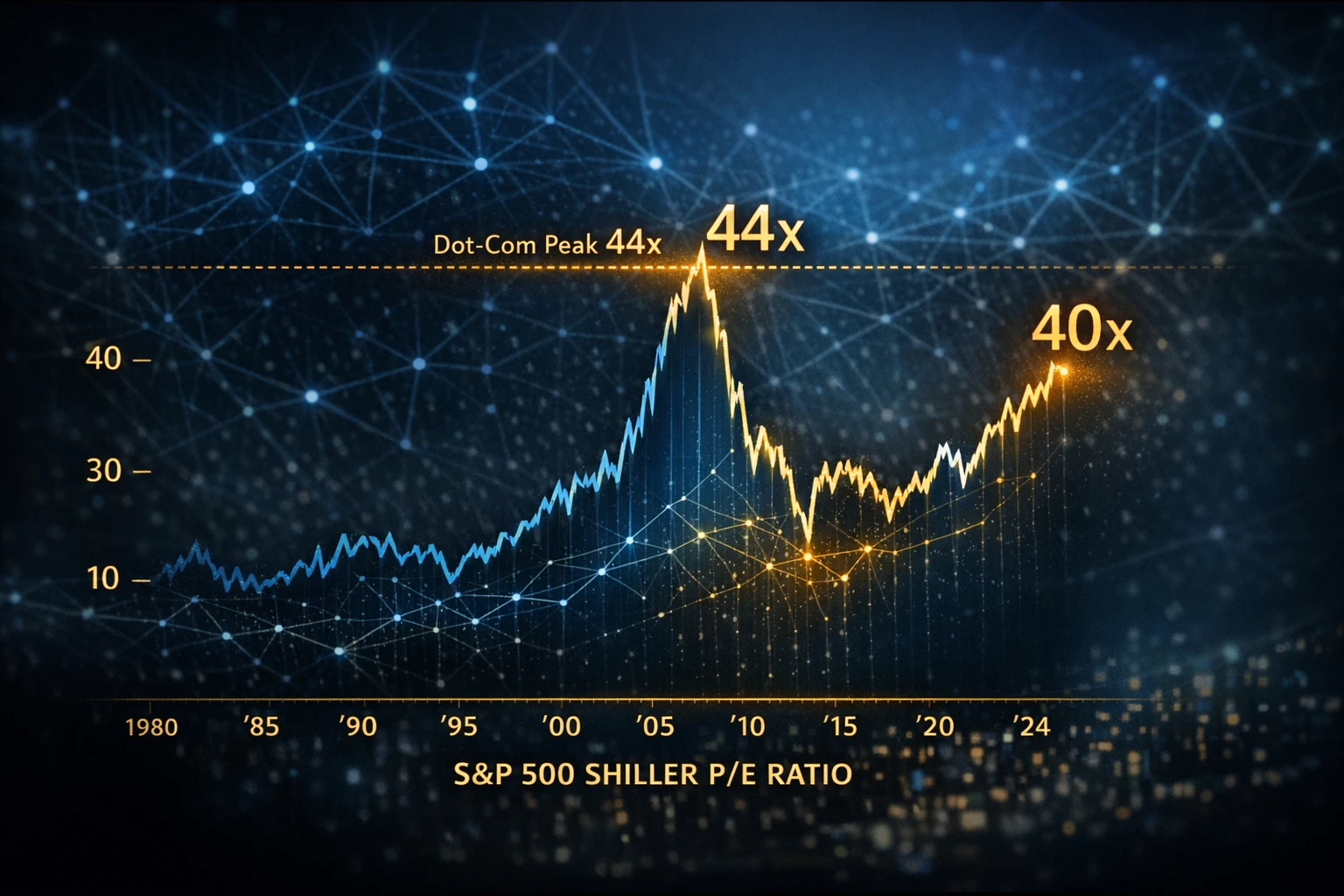
Valuation concerns are resurfacing in the US equity market as the Shiller P/E ratio (CAPE) rises to around 39.5 to 41.7, its highest range in roughly 25 years and just below the 44x peak reached during the 1999 dot-com bubble. On a historical basis, that places the S&P 500 in territory widely viewed as richly valued.
AI has become the market’s main repricing engine
This time, the rally is not being driven by speculative “.com” dreams, but by a broad repricing around artificial intelligence. Tech leaders such as NVIDIA, Microsoft, Amazon, and Meta have led gains across semiconductors, cloud computing, and AI infrastructure. A relatively small group of mega-cap stocks has accounted for a large share of the index’s advance, reinforcing the market’s belief that AI can reshape productivity and earnings power.
Still, the current setup is not a simple repeat of 1999. According to the source material, today’s AI leaders are backed by much stronger fundamentals: stronger free cash flow, more mature business models, and higher profitability. NVIDIA’s annual free cash flow has exceeded $80 billion, while Microsoft’s cloud business is nearing $300 billion in annual revenue. The combined operating margin of the Magnificent Seven is generally in the 30% to 35% range, far above the roughly 17% seen in the Nasdaq 100 during the late-1990s era.
Better fundamentals do not remove valuation risk
Even so, expensive markets come with clear vulnerabilities. One is concentration risk. Strip out the Magnificent Seven, and the remaining S&P 500 companies have delivered far less impressive performance. That means the broader index is increasingly sensitive to any reversal in a handful of dominant names.
Another issue is interest rates and commercialization uncertainty. With the Fed funds rate around 4% to 4.25%, a renewed move above 4.5% could force investors to reassess returns on massive AI infrastructure spending. At the same time, if enterprise AI adoption slows or return on investment takes longer to materialize, current valuations could come under pressure.
High CAPE has historically meant lower future returns
History also offers a sobering signal. When the CAPE ratio moves above 30, future 10-year real returns for US equities have often fallen into the 1% to 3% range. In other words, markets do not need to crash for investors to be disappointed; elevated valuations alone can compress long-term returns.
That leaves investors with a more nuanced conclusion. This market may not fit the classic definition of a bubble, especially given the earnings strength of AI leaders. But with valuations approaching 40 times cyclically adjusted earnings, the key question is no longer whether “this time is different,” but whether AI-driven productivity gains can truly justify prices at these levels.