
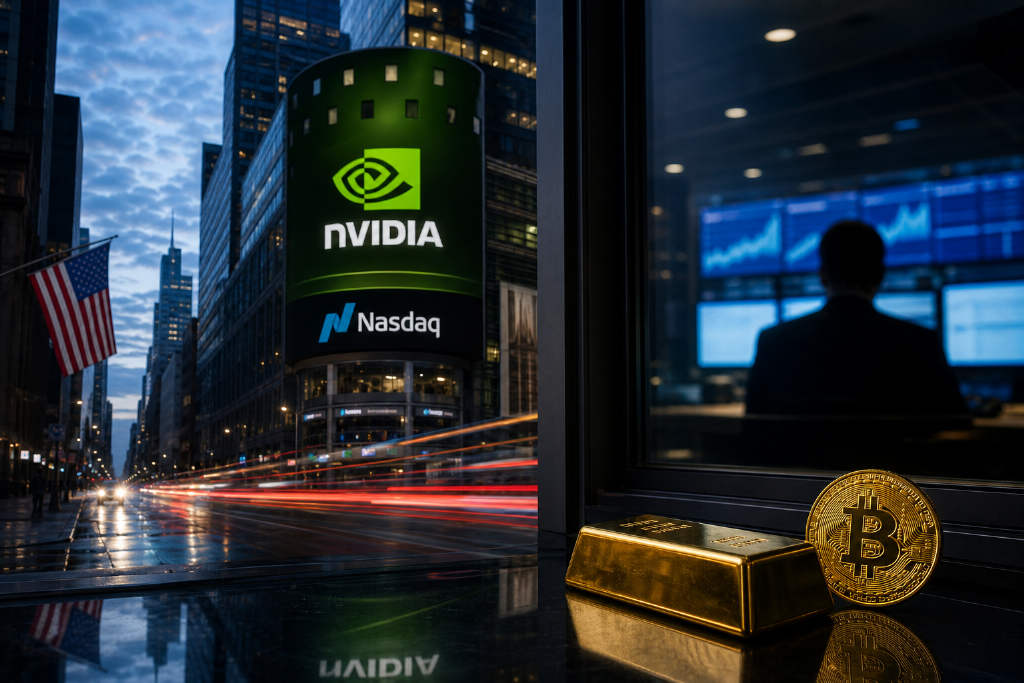
U.S. stocks finished higher on Tuesday, with lower Treasury yields giving technology names a valuation boost and helping the Nasdaq outperform. The Dow Jones Industrial Average rose 0.30% to 53,577.40, the S&P 500 added 0.32% to 7,677.28, and the Nasdaq gained 0.66% to 26,151.30. The CBOE Volatility Index fell 1.77% to 16.13. The 10-year Treasury yield declined to 4.625%, the Philadelphia Semiconductor Index rose 1.44%, and Nvidia ended a seven-session losing streak. Oil prices fell for a second straight day after Iran and Oman said they planned to establish a secure passage in the Strait of Hormuz. Bitcoin briefly touched $80,000, while gold hit a three-month high. Nvidia is scheduled to report earnings after the close on Wednesday.

Lower long-end yields opened a window for valuation recovery
The main market driver on Tuesday was another leg lower in rates. The 10-year U.S. Treasury yield fell 7.13 basis points to 4.625%, the 2-year yield dropped 6.39 basis points to 4.170%, and the 30-year yield declined 6.05 basis points to 5.164%. That extended the move from around 4.70% on Monday to 4.625% on Tuesday in the 10-year note.
The article said the effect of Bessent’s policy of using nearly $1 trillion from the Treasury General Account, or TGA, to buy back long-dated bonds continued to work through the market on Tuesday. Lower long-end yields reduced the discount rate applied to future cash flows and eased valuation pressure on high-multiple technology shares. The Nasdaq rose 0.66%, ending its earlier stretch of underperformance.
Whether that setup can last now depends on two things cited in the report: whether long-end yields can stay below 4.60%, and whether Nvidia’s earnings guidance on Wednesday is strong enough to support current valuations.
Hormuz de-escalation signals weighed on oil
Iran and Oman issued a joint statement saying they planned to establish a secure maritime passage in the Strait of Hormuz based on terms agreed by both sides. Oman’s foreign minister said the two countries could soon announce detailed arrangements covering a temporary route in the strait and the restoration of safe navigation.
The report described this as the first clear sign of easing since tensions rose around the Strait of Hormuz. The specific structure of the route has not yet been finalized, but the joint statement itself suggests that Iran has at least shown a willingness to negotiate in public.
Oil prices fell sharply for a second consecutive day. WTI crude futures dropped 2.4% on Tuesday to $85.01 a barrel. According to the article, the main driver was a decline in geopolitical risk premium, reinforced by signals that the U.S. approach toward Iran was shifting from military strikes to sanctions.
U.S. Secretary of State Marco Rubio told foreign counterparts that, 「for now,」 the United States is not expected to launch new strikes on Iran. The article said that comment added to the view that the U.S.-Iran conflict was moving in a less confrontational direction.
Storage and optical communications stocks rebounded, Nvidia rose 2.19%
Chip stocks led the rebound. The Philadelphia Semiconductor Index climbed 1.44%, ending its previous losing run.
Storage and optical communications names moved higher across the board. AMD rose 4.91%, Marvell Technology gained 4.84%, and Micron Technology added 2.48%. Storage chip shares that had been under pressure also recovered, with SanDisk and Western Digital both posting gains.
Nvidia closed up 2.19% at $213.05, ending its seven-session slide. The article said earlier pressure on the stock had come from concerns around Nvidia’s earnings, the spread of AI financing risk, and rising long-end yields. Tuesday’s drop in rates provided the trigger for a valuation rebound.
The so-called Magnificent Seven were mixed. Meta rose 1.66%, Amazon gained 1.33%, Microsoft added 0.84%, Google rose 0.83%, Apple edged up 0.32%, and Nvidia climbed 2.19%. Tesla fell 3.83%, making it the only decliner in the group. The report said stock selection inside the technology sector remained strict, with dispersion still in place.
Bitcoin touched $80,000 as gold climbed in tandem
Crypto assets stayed strong. Bitcoin briefly touched $80,000 intraday, its first move to that level since May, and has gained more than 27% this month. Gold also advanced, with spot prices rising as much as 1.7% intraday to break above $4,680. The world’s largest gold ETF attracted $1.3 billion of inflows in a single day.
The article said Bitcoin and gold were being driven by the same logic seen on Monday: with long-end yields falling, capital was trading both improved liquidity expectations and concerns about U.S. dollar credit.
Attention turns to Nvidia earnings
Nvidia is due to release earnings after Wednesday’s close. Coming just after the stock ended a seven-session losing streak, the report is set to be the market’s first major test of whether fundamentals and forward guidance can support the recent rebound. The key items in focus are Blackwell shipments, data center revenue guidance, and signals around AI capital spending.
According to the article, any flaw in that guidance could trigger a chain reaction across the AI hardware supply chain.