
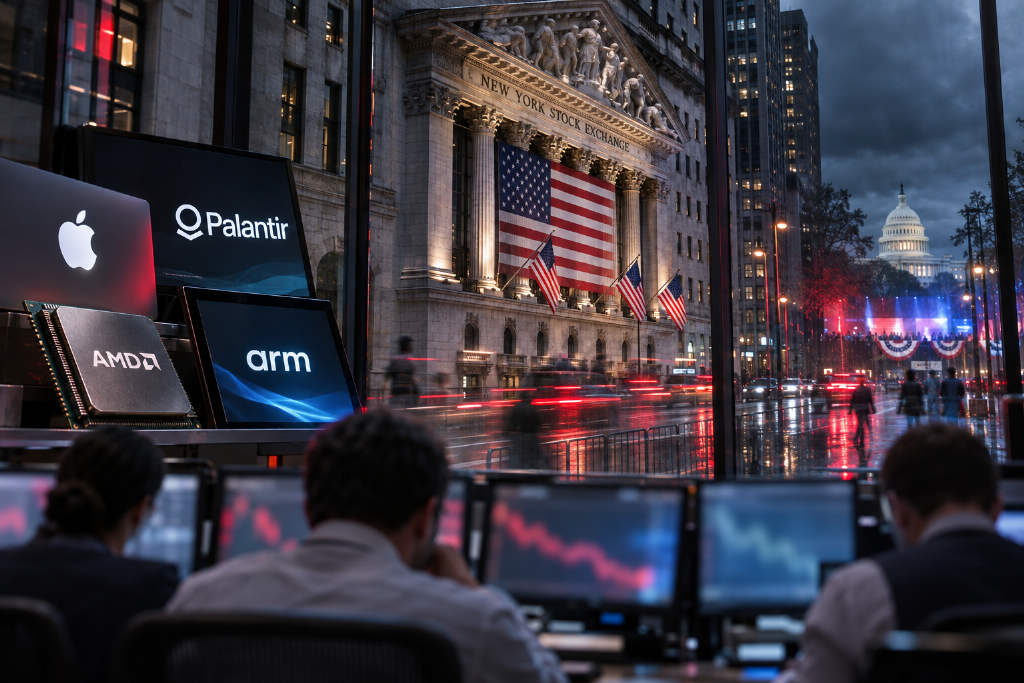
US stocks are heading into what could be an even more volatile week after earnings from Alphabet, Amazon and Intel rattled the market. More technology companies are due to report in the days ahead, while the US midterm elections and the October nonfarm payrolls report are also on the calendar.
The article was written by Cailian Press.
Technology shares just came through a rough week
A series of earnings reports failed to deliver the strong signals investors had been looking for, leaving the US technology sector under pressure last week.
Alphabet fell 12.64% in a single session last Thursday after both revenue and profit missed expectations. Amazon dropped 4.25% the same day. Intel then plunged 28.58% on Friday after its guidance came in below expectations.
The Nasdaq Composite sank 2.86% on Friday, Oct. 30, its worst one-day performance in months. After a string of disappointments from major technology companies, the index ended October down more than 5.3%, its largest monthly decline in nearly a year and a half.
Apple is the last of the “Magnificent Seven” to report
After the close on Monday Eastern Time, Apple and Palantir are scheduled to release earnings. ON Semiconductor and Lattice Semiconductor are also due to report.
With Google, Amazon and Meta all sold off last week over AI spending concerns, Apple now becomes the final heavyweight among the “Magnificent Seven” to face close market scrutiny.
Investors are focused on sales of the newly released iPhone 18, the effect of memory shortages on costs, and the company’s plans in AI. The call will also mark John Ternus’s first earnings appearance as Apple’s new CEO after former CEO Tim Cook formally stepped down.
On Wednesday and Thursday, Toyota Motor, ConocoPhillips, Arm Holdings, McDonald’s and a range of other large companies are also set to report results.
Midterm elections move to the center of attention on Tuesday
By Tuesday Eastern Time, market focus is expected to shift to US politics as the midterm elections formally begin. A total of 470 elections will be held across the country, including all 435 seats in the House of Representatives and 35 seats in the Senate.
According to the report, the elections are expected to affect issues ranging from control of Congress and the US-Iran war to the outlook for US data centers.
At present, Democrats are seen as having a stronger chance of winning a majority in the House, while facing a tougher contest in Senate races.
Francesco Pesole, a foreign-exchange strategist at ING, said a full Democratic victory in both the House and Senate could be mildly negative for the US dollar because it would raise the risk of a US government shutdown, increase the odds of a debt-ceiling standoff, and put more pressure on already fragile sentiment around AI-related assets.
Technology investors are also watching several local races closely, including the Ohio Senate race and the Texas governor’s race. The report said those outcomes could have a major effect on the direction of local data-center development.
California’s election results are also in focus. Voters there will decide the fate of Proposition 40, a measure designed to impose a billionaire wealth tax. The report said that could affect decisions by a number of local technology giants. Meta has already issued new shares to protect Chief Executive Officer Mark Zuckerberg’s voting control in case he would otherwise need to sell stock to pay the tax.
AMD and Super Micro Computer are also scheduled to report on Tuesday.
Friday’s payrolls report could trigger the next market swing
All of that tension is likely to build into Friday’s release of the October nonfarm payrolls report, the most closely watched data point of the week.
Economists expect the report to show 55,000 jobs added in October. The previous reading, released at the start of last month, was 29,000, far below expectations. More specifically, the market expects all 55,000 of the projected job gains to come from the private sector, while manufacturing is seen showing neither job growth nor layoffs, even with data-center construction expanding.
After the Federal Reserve raised rates in September and left them unchanged in October, markets now expect the Fed could raise rates again in December. One of the main arguments behind that view is the strength of the US labor market. Any sign of weakness in employment could alter the market’s outlook and set off another round of sharp moves in US equities.
Morgan Stanley said the S&P 500 may still have about 5% downside to test in the short term. At the same time, the bank noted that November has historically been one of the strongest seasonal months for US stocks, with the probability of gains close to 70%. Once the midterm election results are settled, lower valuations after the pullback could draw bargain-hunting money back into the market.




