
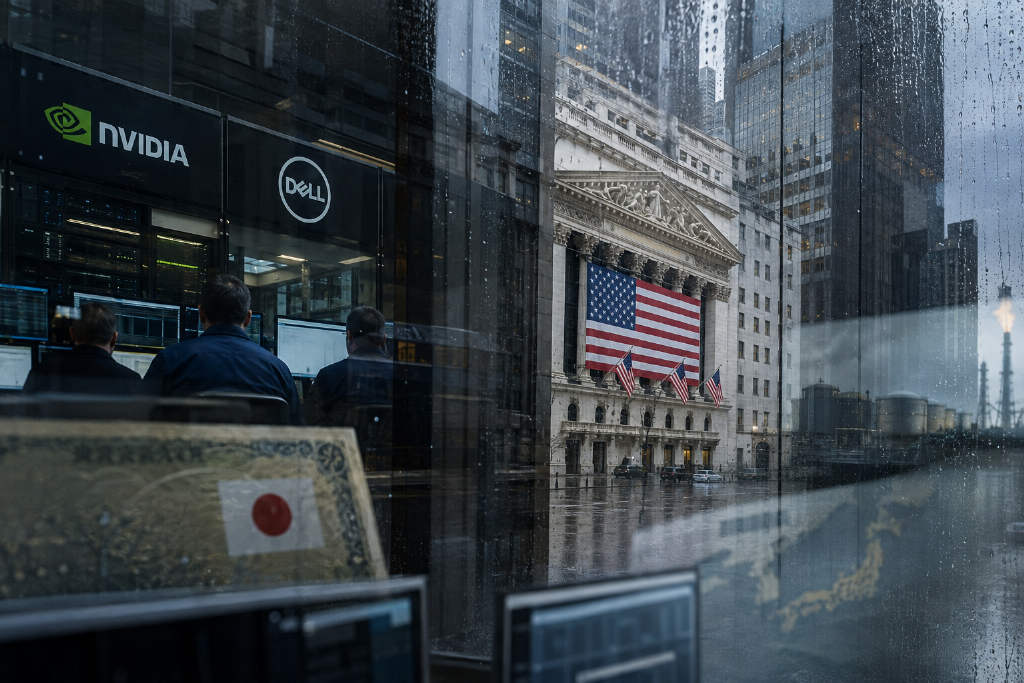
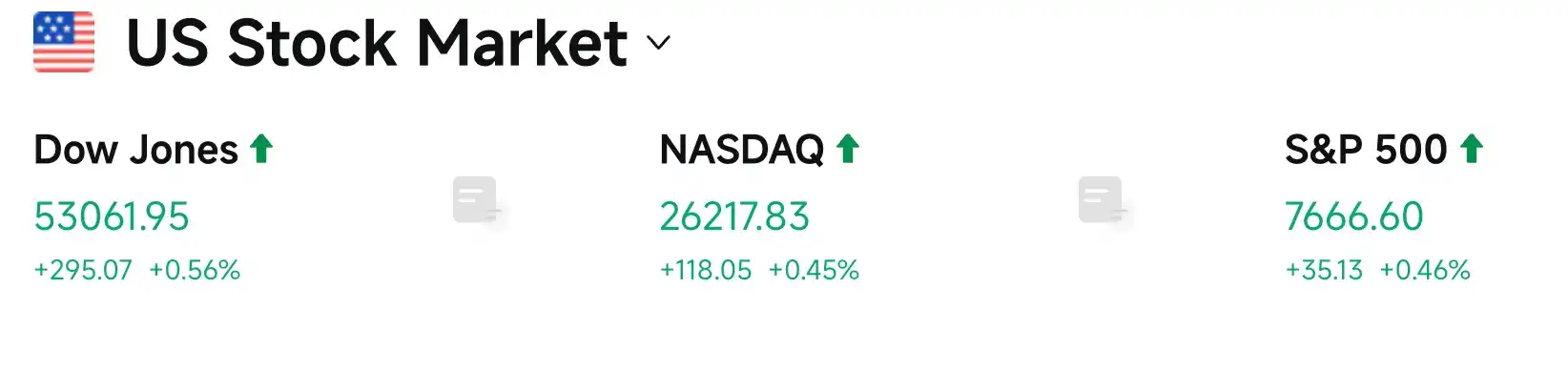
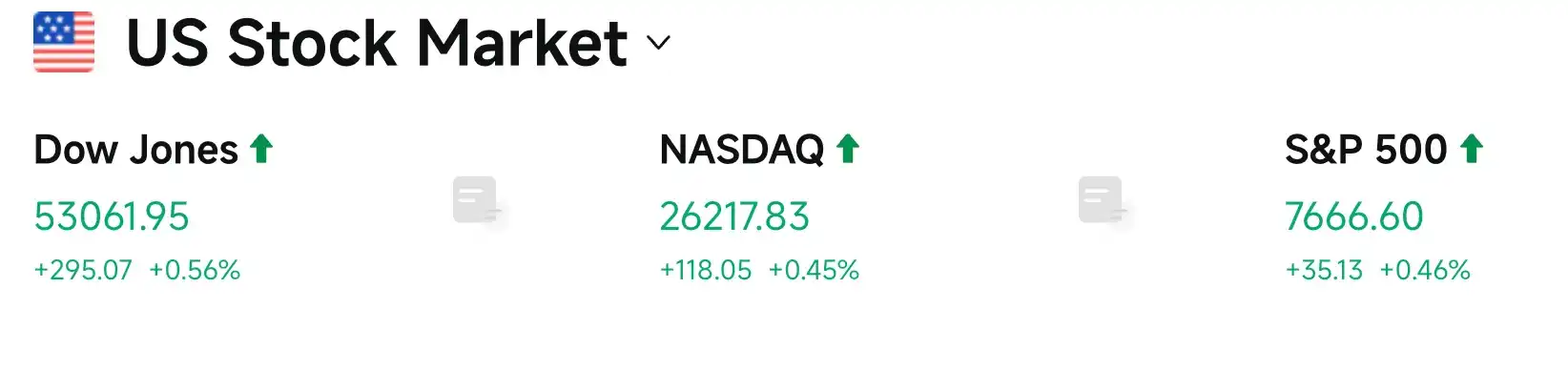
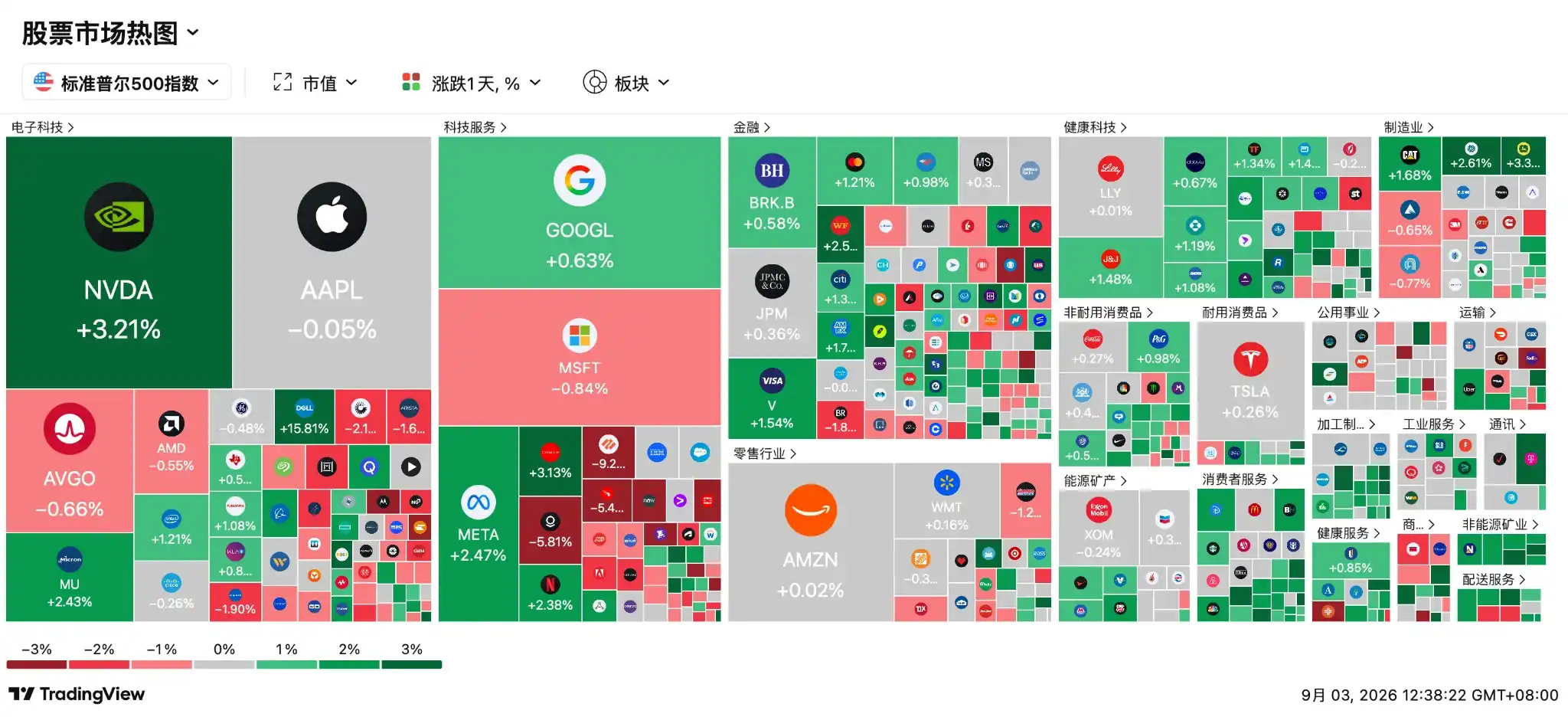
U.S. equities climbed overnight, ending a three-session slide. The Dow Jones Industrial Average rose 0.56%, the Nasdaq Composite gained 0.45%, and the S&P 500 added 0.46%.

Two developments drove the rebound. First, August ADP private payrolls came in at about 38,000, the weakest reading since January this year, easing expectations that the Federal Reserve would need to tighten policy further. Second, the geopolitical premium in oil briefly faded. Donald Trump said on Wednesday that a new round of strikes on Iran 「won’t last too long」 and repeated that the U.S. had control of the Strait of Hormuz and was ready to act again if needed. He also at one point suggested renaming it the “Trump Strait,” later saying it was an offhand remark.
After rising about 9% over the previous three days, WTI crude stabilized near $90 a barrel, while Brent crude slipped below $95. Shipping markets, however, did not fully relax. Even after the U.S. military escorted 40 merchant ships through the Strait of Hormuz on Tuesday, parts of the industry remained cautious, and daily charter rates for some tankers moved above $500,000.
Data from the U.S. Energy Information Administration showed crude inventories fell by a larger-than-expected 4.5 million barrels to 424.5 million barrels. Refinery utilization rose to 98%, the highest level since 2018, pointing to tight energy fundamentals. To address supply risks, the U.S. signed an energy cooperation agreement with Venezuela. Chevron plans to invest $7 billion over the next five years to raise local output to about 600,000 barrels a day, with related crude potentially entering U.S. reserves as early as November. Chevron’s CEO said those additional supplies would take years to build and could not act as a quick fix if flows through Hormuz were disrupted.
The Federal Reserve’s latest Beige Book said economic activity had expanded at a modest pace since early July, with 10 of 12 districts reporting slight to moderate growth. Consumer spending edged higher, though buyers were becoming more price-sensitive, while higher-end spending remained firm. Manufacturing improved on defense and data-center orders, and employment rose only slightly. Business sentiment was generally positive, but companies remained alert to uncertainty tied to energy prices, policy, and international conflict. The report mentioned AI and data centers multiple times, describing them as key supports for current growth.
Treasury yields retreat from highs, while Japan’s long bond market draws attention
The U.S. 10-year Treasury yield climbed to about 4.818% intraday, a high since late 2023, before easing to roughly 4.78% by the close. The 30-year yield remained elevated near 5.27%. Softer ADP data and a pause in crude’s advance helped cool inflation expectations, but long-end rates globally are still sitting in a sensitive range.
Grace Peters, head of strategy at J.P. Morgan Private Bank, warned that if the 10-year Treasury yield nears or breaks 5%, U.S. equities could face a 5% to 8% “healthy correction,” with September seasonality and the approach of midterm elections making markets more sensitive. CITIC Securities attributed the jump in developed-market sovereign yields to higher inflation expectations, concern over sovereign credit, and repricing of central-bank paths, adding that upside risks remain in the near term.
Japan’s 30-year government bond yield has risen to 4.155%, close to a record high. That has put Thursday’s 30-year Japanese government bond auction in focus. TD Securities senior Asia-Pacific rates strategist Prashant Newnaha said: 「Japanese government bonds used to be the anchor of the global fixed-income market, but that logic has now reversed — if the selloff in JGBs extends further, it could trigger a repricing across global fixed income markets.」 Market expectations point to weak demand at the auction. If the sale disappoints, it could add pressure back onto Treasuries and lift borrowing costs globally.
In foreign exchange, the dollar index slipped about 0.1% to around 99.5. Data showed global investors’ hedge ratio on dollar exposure had dropped to 41%, the lowest level since at least 2015. Bloomberg estimated that if hedge ratios across six major markets rebound by 5 percentage points, that could translate into roughly $230 billion in dollar trading volume, leaving potential selling pressure in the background.
The yen surged about 1.2% during the session, with USD/JPY touching 158.22. Markets stayed alert to the possibility of joint U.S.-Japan intervention after Japan spent a record $96.4 billion last month to support the currency.
A softer dollar helped precious metals stage a V-shaped reversal. Spot gold recovered and broke above $4,400 an ounce, while silver rose nearly 2% to about $66 an ounce. Mining shares also advanced, with Endeavour Silver up nearly 9%, First Majestic Silver up nearly 7%, and Newmont and Barrick Gold both gaining more than 2%.
The Dutch central bank has also shifted more than 78 tons of gold from New York and other locations to London because of geopolitical turmoil, highlighting a wider reserve reallocation trend among central banks. Deutsche Bank said selling pressure in gold is close to exhaustion. If gold does not fall below $4,315 an ounce, it said, systematic liquidation would be hard to trigger. If prices move higher, CTA funds may be forced to rebuild long positions, with discretionary money potentially following.

AI hardware leads again as software and cybersecurity names slump
Technology shares moved in different directions. Hardware and infrastructure names were backed by concrete order trends and company guidance, while software and cybersecurity stocks were hit broadly.
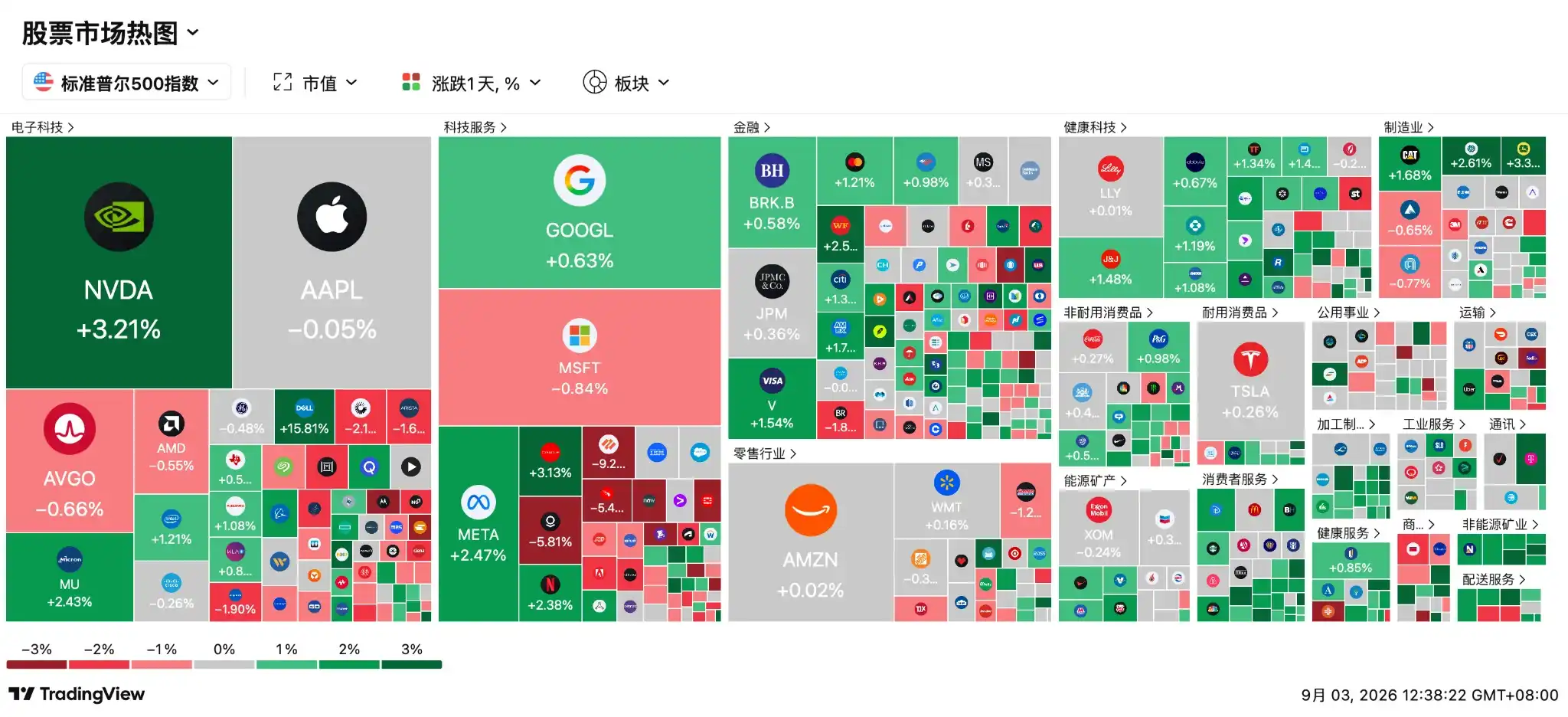
Nvidia rose 3.21%. After investor relations meetings with the company, J.P. Morgan reaffirmed an overweight rating and a $320 price target. Nvidia said its framework for 70% year-over-year growth in fiscal 2028 was not a ceiling for demand. Hyperscale cloud, sovereign AI, and enterprise demand remain strong, and without supply constraints the business could have been more than twice as large. Jensen Huang, speaking around a G20-related event, called on countries to accelerate AI infrastructure buildout and said Nvidia would invest nearly $1 trillion in U.S. infrastructure this year.
Dell surged 15.81% after AI server orders hit a record and the company sharply raised its full-year revenue outlook to about $192 billion, well above market expectations. Analysts pointed to two drivers: a replacement cycle for aging enterprise servers and new inference demand tied to agentic AI.
Broadcom slipped 0.66% in regular trading and fell another 1.5% after hours. Third-quarter revenue rose 86% year over year to about $29.6 billion, while AI semiconductor revenue more than tripled to $16.7 billion. Its fourth-quarter revenue outlook, at about $34.8 billion, was slightly below the $35.05 billion expected by the market. Even so, management raised its AI revenue forecast for the current fiscal year to $58 billion and said AI revenue could reach $230 billion in fiscal 2028, reinforcing its position in the market as one of the main beneficiaries of custom AI chips and networking demand outside Nvidia.
Competition in AI models also intensified. Google released Gemini 3.8 Flash and a cybersecurity model with stronger programming, agent, and cyber capabilities. That raised concern that large-model companies could move directly into the core markets served by Palantir and security vendors. Palantir fell 5.81% even though it won the prime contract for the U.S. Army’s TITAN ground station system.
Meta launched Muse Spark 1.3 and called it the company’s strongest AI model so far. Meta’s chief AI officer said performance had improved sharply, with the biggest step-up in programming and agent capabilities. The company said the model was “competitive” with Anthropic’s Claude Fable 5.1 and “better than” OpenAI’s GPT-5.6 Sol on coding tasks. Meta shares rose 2.47%.
The latest phase of AI competition is also shifting from benchmark scores to deployment cost. Meta said tool calls on the new model were down about 20% and token usage had dropped about 25%, suggesting the cost of getting AI systems to complete tasks is falling. That matters for the pace of future application adoption.
Notable movers and company updates
- Dell rose 15.81% after record AI server orders and a sharply higher full-year outlook, strengthening the long-term data-center growth case.
- Micron Technology gained 2.43%. The company’s high-endurance NAND module built into GPU packaging was cited as breaking memory limits.
- Hewlett Packard Enterprise beat expectations for fiscal Q3, but management said supply-chain bottlenecks could not keep up with surging demand. The stock fell more than 5% in late trading.
- The Philadelphia Semiconductor Index rose about 0.45%.
- Microsoft slipped 0.84%. For the first time in more than a decade, it is overhauling its reporting structure, reducing operating segments to “Agents and Infrastructure” and “Devices and Consumers.” Cloud revenue, including Azure and Microsoft 365 cloud, will be disclosed separately, giving investors a more direct read on the balance between AI cloud investment and monetization.
- Software stocks sold off. Datadog fell more than 6%, CrowdStrike dropped about 5.42%, MongoDB slid more than 13%, Palo Alto Networks lost 9.28%, and C3.ai kept its full-year revenue forecast unchanged while issuing second-quarter guidance below expectations, sending the stock down 1% in late trading.
- Tesla added 0.26% ahead of its Cybercab event in Austin. Autonomous driving, Robotaxi, and humanoid robots remain central to valuation upside. Elon Musk said the global number of humanoid robots could exceed 1 billion by 2036 and said AI could lift the size of the global economy by 20% to 30%, equal to an additional $20 trillion to $30 trillion a year.
- Credo Technology fell 20.04%. First-quarter revenue was $479 million, up about 115% year over year, and EPS came in at $1.20, both above expectations. Gross margin, however, fell 3.7 percentage points from the prior quarter to 64.5%, and Bank of America cut its target price to $275 from $340.
- Eos Energy rose nearly 19% after reaching a solar-plus-zinc-storage partnership in West Virginia with Google and MN8. Google is using its aqueous zinc battery technology for the first time.
- Snowflake fell 4.37% in regular trading but jumped more than 23% after hours after lifting its full-year product revenue outlook to about $6.07 billion, above expectations, as adoption of AI-assisted coding tools accelerated.
What markets are watching next
On Thursday, Sept. 3, investors will focus on two major events.
- At 20:30, Federal Reserve Governor Christopher Waller is scheduled to give an interview. This is one of the last closely watched appearances before the FOMC blackout period. If Waller echoes Kevin Warsh’s hawkish tone, pricing for a September rate hike could increase further. If he stresses labor-market risks, those hike expectations may ease.
- Tesla will hold its Cybercab launch event in Austin. The company is expected to unveil a steering-wheel-free and pedal-free Cybercab. Markets are watching for details on whether it will formally join a Robotaxi fleet, progress on commercialization approvals, the mass-production timeline, and unit economics. A stronger-than-expected event could move Tesla and related autonomous driving, sensor, in-vehicle computing, and Robotaxi names.
The 2026 World Power Battery Conference also begins on Sept. 3 and runs through Sept. 4. Tesla, CATL, and BYD are among the participants, and the event is set to release a power battery industry development index. Any notable progress in solid-state batteries, fast charging, battery safety, or energy-storage technology could affect electric vehicle, battery materials, equipment, and storage shares.
On Friday, Sept. 4, earnings are due from DocuSign, Lululemon, Zscaler, Ciena, UiPath, Planet Labs, and Ambarella. Investors will use those reports to gauge cloud-security demand, optical networking conditions, enterprise software spending, consumer resilience, and trends in edge AI and automotive vision chips.
Also at 20:30 on Friday, the U.S. will release August nonfarm payrolls, the unemployment rate, and average hourly earnings. This is the most important macro data point of the week for global markets. Consensus expectations are for nonfarm payrolls growth of about 55,000 to 58,000 and an unemployment rate of 4.1%. A stronger labor and wage reading could reinforce September rate-hike trades, lifting the dollar and short-dated Treasury yields while weighing on the Nasdaq, gold, and long-duration growth stocks. A clearly weaker report could instead support Treasuries, gold, and technology shares.