
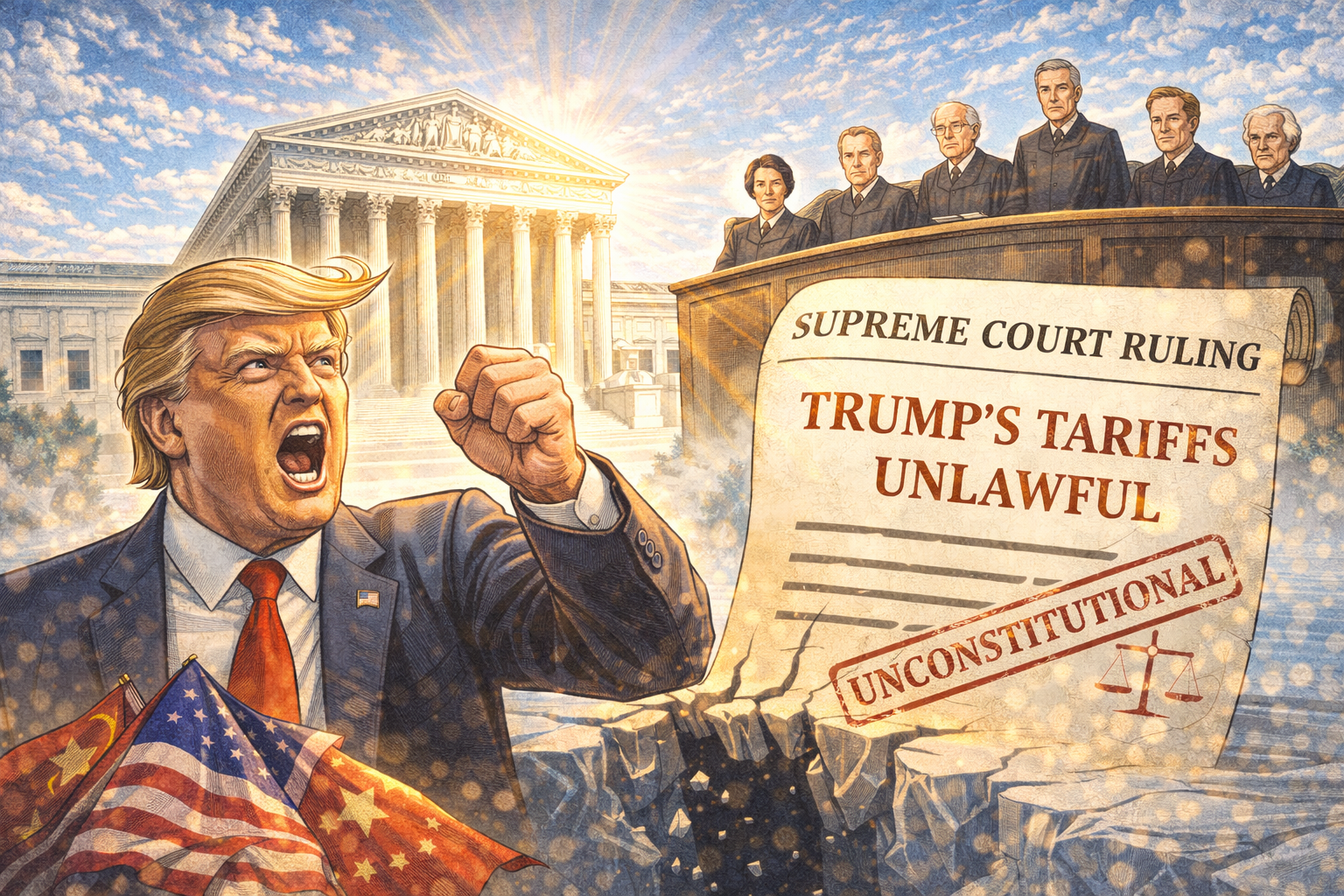
The US Supreme Court ruled 6-3 on Wednesday that President Trump’s tariffs imposed under the International Emergency Economic Powers Act (IEEPA) are unlawful. Chief Justice Roberts wrote that “IEEPA does not authorize the President to impose tariffs,” noting that in the law’s five-decade history, “no president has ever invoked it to levy a tariff, let alone one of this scope and scale.” The court distinguished between the power to “regulate” and the power to “tax,” calling them legally distinct concepts.
Two Tariff Categories Upended: From Fentanyl to Liberation Day
The ruling affects two main groups. The first is the “fentanyl tariffs” that took effect February 4, 2025: 25% on Canada and Mexico, 20% on China. The second is the “Liberation Day” reciprocal tariffs announced April 2, 2025: a 10% baseline on nearly all countries, with higher rates for some (China 34%, Taiwan 32%, Vietnam 46%, EU 20%). According to the Penn-Wharton budget model, total revenue collected under IEEPA tariffs stands at $175–$179 billion, affecting more than 301,000 importers and 34 million import entries. The ruling does not affect tariffs under Section 232 (steel, aluminum, autos) or Section 301 (China tariffs).
The $175 Billion Refund Conundrum: Logistical Nightmare and Political Gap
If tariffs were illegal from the start, collected duties should in principle be refunded. A coalition of over 800 small businesses immediately demanded refunds, and many law firms had advised importers to file protective claims with the Court of International Trade since January. But execution is daunting: 34 million entries, 300,000 importers, and goods in various customs statuses. Dissenting Justice Kavanaugh warned of “chaos,” noting the court said “nothing” about how refunds would work. Compounding the issue, the Trump administration had counted IEEPA tariff revenue as a funding source for the tax cut bill passed in summer 2025. The $175 billion fiscal hole is as much a political problem as a numerical one.
Trump’s “Game Two” Backup Plan: A Downgrade, Not an Equivalent
Before the ruling, Trump said, “If we don’t win, we’ll find a solution.” National Economic Council director Kevin Hassett said the administration had a “Game Two” plan ready and was confident it could “almost immediately reimpose the president’s policy under alternative authority.” Available tools include Section 232 (national security, requires investigations), Section 301 (unfair trade, formal probe), Section 122 (balance of payments, cap 15%, 150 days max), and Section 338 (retaliation). Trump even suggested repackaging tariffs as “licensing fees” under IEEPA. But no alternative can replicate IEEPA’s breadth: it allowed tariffs on nearly all countries, all goods, at any rate, indefinitely. The Atlantic Council and Tax Policy Center agree: Trump still has tariff tools, but cannot rebuild the IEEPA wall. “Game Two” is more like downgrading from nuclear to conventional weapons.
Why Markets Barely Reacted: Stagflation Data and Numbness
Logically, scrapping massive tariffs should be a major risk-on catalyst: tariffs → higher inflation → less room to cut rates → drag on assets. The reverse chain should apply. Yet actual moves were muted: Dow +0.42%, S&P 500 +0.52%, Nasdaq +0.68%. Bitcoin briefly broke $68,000 then fell back to $67,000, gains evaporating within 30 minutes. Three factors explain the tepid response. First, Q4 GDP came in at just 1.4% (vs. 2.5% expected) and core PCE inflation at 3.0% (vs. 2.9%), stagflation data hitting sentiment harder than the court ruling. Second, “Game Two” means tariffs won’t really disappear. Third, markets have been battered over the past four months — down 47% from October highs, persistent ETF outflows, hawkish Fed. A “maybe helpful but uncertain” positive catalyst isn’t enough to reverse the mood.