
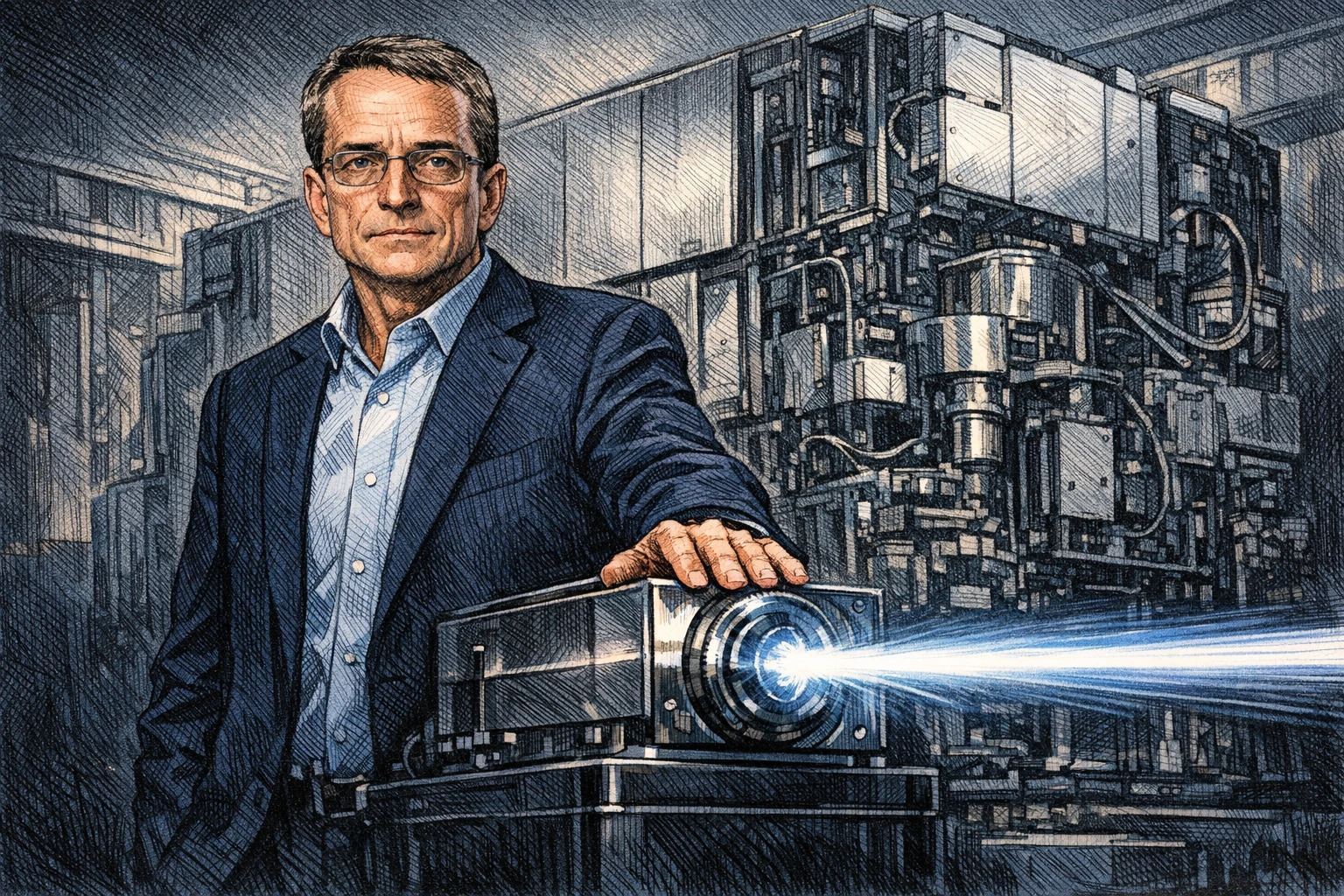
Pat Gelsinger, the former Intel CEO, has become executive chair of xLight, a California startup targeting one of the most protected positions in the chip industry: ASML’s hold over EUV lithography. The move carries extra weight because the US government has already taken a direct equity stake in xLight through the CHIPS and Science Act.
Washington and private capital are backing the company at the same time
In December 2025, the US Commerce Department signed a letter of intent to invest up to $150 million in xLight in exchange for a direct ownership stake. That deal was described as the first equity transaction by the Trump administration’s new CHIPS R&D office. At the same time, xLight has been in talks with Boardman Bay Capital Management and Bain Capital on a new $350 million funding round, with ASML, TSMC, Intel and Micron invited to participate.
Gelsinger’s role fits his long history in semiconductor policy and manufacturing. He formally joined xLight as executive chair in March 2025, and Playground Global, the venture firm he is associated with, led xLight’s $40 million Series B round in July 2025. Including federal support, xLight has raised about $200 million so far, along with up to $4.2 billion in non-binding project financing commitments for future factory construction.
xLight is pursuing a different EUV light source architecture
EUV lithography is essential for manufacturing leading-edge chips, and ASML is the only company currently producing complete EUV tools. ASML’s existing systems rely on a laser-produced plasma source, where powerful lasers repeatedly strike tiny molten tin droplets to generate EUV light. The approach works at scale, but it is highly complex, and the latest machines cost about $300 million to $400 million each.
xLight is developing a free-electron laser system instead. The concept uses a compact particle accelerator to push electrons close to the speed of light, then passes them through alternating magnetic structures so they emit intense EUV radiation. The company says this approach can reach wavelengths as short as 2nm, compared with 13.5nm in current ASML tools. Shorter wavelengths can enable finer circuit patterning, which xLight says could cut both capital and operating costs for advanced AI chip production.
The company wants to supply ASML, not replace it
xLight is not framing itself as a full-system rival to ASML. Its plan is to sell the light source as a component that could fit inside ASML machines. ASML CEO Christophe Fouquet has publicly confirmed that ASML is working with xLight on technical validation. That places xLight more in the role of a high-value supplier than a direct maker of complete lithography platforms.
The startup is building its first prototype facility at Albany NanoTech in New York, with a target of bringing its first working light source online in 2028. The schedule is clear. Commercial proof is still some distance away.
Material compatibility remains an open technical problem
The promise of a 2nm wavelength is striking, but mass-production viability has not been demonstrated in public. On semiconductor forum SemiWiki, industry veteran Fred Chen pointed to a central issue: higher EUV power may not be compatible with pellicles and photoresists.
Pellicles protect masks from contamination and are tied directly to yield. Photoresists are the light-sensitive materials coated on wafers to transfer circuit patterns. If power levels rise too far, pellicles may fail and resist chemistry may become unstable. No public solution to those constraints has been presented in the material available. For now, xLight’s case rests on whether high-power 2nm EUV can work with the required material stack, and that remains a claim rather than a production-proven result.