
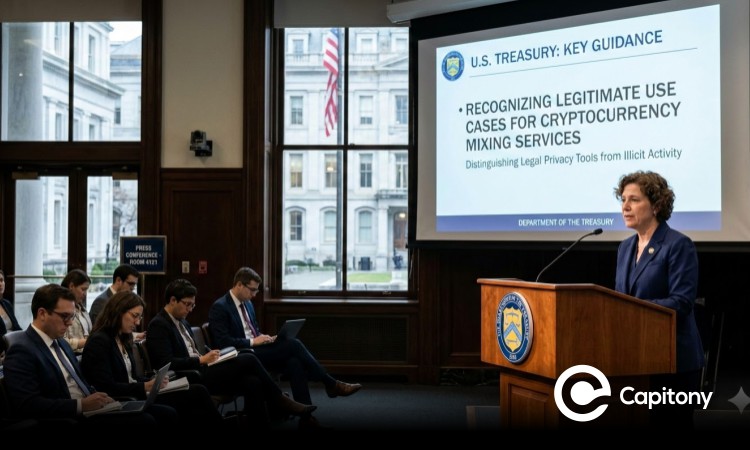
The United States Treasury has officially acknowledged that crypto mixers serve legitimate privacy purposes in a report submitted to Congress titled "Innovative Technologies to Counter Illicit Finance Involving Digital Assets." The report notes that individuals may use mixers to obscure transaction details as they increase use of digital assets for payments. Mixers blend multiple blockchain transfers, making it difficult to trace origins or destinations.
"As consumers increase their use of digital assets for payments, individuals may want to use mixers to maintain more privacy in their consumer spending habits," the report stated. Users can thus protect sensitive information regarding wealth, business payments, or charitable donations.
Custodial vs. Decentralized Mixers: Different Levels of Oversight
However, the Treasury cautioned that some mixers are more dangerous, particularly decentralized, non-custodial ones. These services lack intermediaries and provide no direct means for law enforcement monitoring. Cybercrime groups affiliated with North Korea have allegedly used such platforms for money laundering.
In contrast, custodial mixers handle assets and customer information, giving law enforcement visibility and the ability to comply with legal requests. These services strike a balance between privacy and oversight, making them a relatively “compliant” option.
Privacy Battle Intensifies: CLARITY Bill and CBDC Monitoring Potential
Beyond mixers, digital asset privacy is becoming more contentious. The Digital Asset Market Clarity Act of 2025 (CLARITY bill) proposes extending KYC rules beyond exchanges. Paradigm’s Alexander Grieve warned that ambiguous wording could put open-source code developers at risk.
Meanwhile, the potential of future central bank digital currencies (CBDCs) could enable greater surveillance. Ray Dalio recently described CBDCs as “a very effective controlling mechanism,” suggesting governments could monitor all financial activity. Privacy advocates argue that while mixers' legitimate use is recognized, legislation and CBDC trends are narrowing the privacy space for crypto users.