
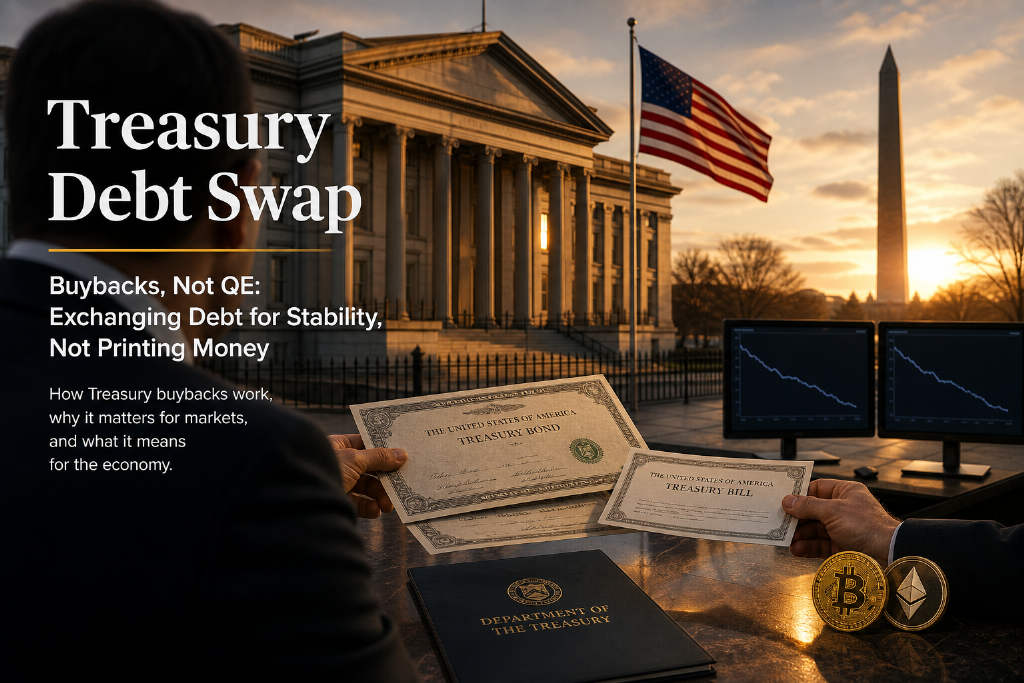
The US Treasury said it will double its long-dated bond buyback operations, lifting the cap for a single operation to at least $4 billion. The announcement sent Treasury yields lower after the 30-year yield had hit a 19-year high the day before, with the 30-year falling from 5.26% to 5.18% and the 10-year yield slipping to 4.647%.
Risk assets moved higher as well. Bitcoin jumped from a low of $64,112 to $70,000, marking its highest level in nearly two months, and was cited in the report at $69,070. Ether rose more than 10% and climbed back above $2,200.
The market response quickly sparked a familiar question: does Treasury buying of long-dated government debt amount to a backdoor version of quantitative easing?
Treasury expands the size and frequency of long-bond buybacks
This round of buybacks targets nominal coupon-bearing Treasuries in the 10- to 20-year and 20- to 30-year sectors. According to the official announcement, the cap for each operation will rise from $2 billion to at least $4 billion. The change takes effect on Sept. 9 and runs through Nov. 4, covering the rest of the current quarterly refinancing period.
The Treasury is also increasing the frequency of the operations, from two per quarter to four, for a total of seven operations. The total notional amount will rise from $14 billion to $28 billion. The department said the goal is to provide greater liquidity support for longer-dated nominal Treasuries.
The decision did not come out of nowhere. On Aug. 18, the 30-year Treasury yield briefly climbed to 5.34% intraday, its highest level since 2007. When combined with the Treasury’s previously scheduled buyback program running from Aug. 6 to Nov. 5, which covers all maturities and has a $69 billion cap, the total ceiling for the quarter rises to about $83 billion.
The key distinction from QE is where the money comes from
The argument for calling the move “QE-like” is straightforward. Buying back long-dated debt removes duration from the market and can put downward pressure on long-end yields. If the buybacks are funded by issuing more short-term Treasury bills, some of the cash parked in the Federal Reserve’s overnight reverse repo facility, or RRP, may flow back into the banking system, loosening liquidity conditions.
Paul Howard, senior director at Wincent, said Bitcoin’s move reflected added liquidity support for long-duration Treasuries. He added, 「This should not be confused with the traditional QE programs we saw five years ago, though the liquidity impact is still real.」
Still, the article argues that a Treasury buyback and Federal Reserve QE are not the same thing once the mechanics are unpacked. The Federal Reserve can create money and reserves. QE uses newly created funds to buy bonds, directly expanding the central bank’s balance sheet and increasing bank reserves. The Treasury cannot do that. It has no authority to create reserves and must borrow every dollar it spends through new debt issuance.
That makes the operation a debt swap rather than money creation. Before and after the buybacks, the Federal Reserve’s balance sheet does not expand, total bank reserves do not increase, and the government’s overall financing need does not change. What changes is the maturity profile of the debt, with longer-dated obligations replaced by shorter-dated ones.
Deutsche Bank said the approach looks more like the Federal Reserve’s 2011-2012 Operation Twist, which involved buying longer-dated securities and selling or issuing shorter-dated ones in order to flatten the yield curve, not expand the balance sheet.
Wolf Street says the effect is too small to reshape a $10 trillion market
Wolf Street founder Wolf Richter took a much harsher view, calling the whole setup a 「sleight of hand.」 He argued that a $4 billion cap for a single operation amounts to just 0.14% of the roughly $10 trillion stock of Treasuries in the 10- to 30-year sector, making it hard to treat as a structural fix. In his view, the program is at most a psychological signal.
He cited one completed trade as an example. The Treasury bought back a 30-year bond issued in February 2021 with a 1.875% coupon and a 2051 maturity at 52.375 cents on the dollar, a 47.625% discount. The government spent $91.7 million to retire $175 million in face value of the older bond.
That bond had been costing about $3.28 million a year in interest, based on $175 million multiplied by 1.875%. If the buyback is financed by newly issued short-term debt at an interest rate of about 4%, the annual interest bill on $91.7 million of new debt comes to roughly $3.67 million. In that example, principal declines modestly, but yearly interest expense rises rather than falls.
Richter also noted that earlier joint US-Japan intervention in the foreign-exchange market only pushed yields lower for a few days before the effect faded.
Liquidity may improve in the short run, but this is not money printing
For risk assets, the signal can be split into two layers. In the near term, liquidity conditions do look easier. The Treasury is buying back long-dated bonds, funding the move through short-term issuance, and yields have pulled back. Gold and cryptocurrencies rising at the same time was the clearest immediate market response described in the report.
Over a longer horizon, though, the operation still does not qualify as traditional QE. The Federal Reserve is not expanding its balance sheet, total bank reserves are not rising, and the Treasury is only rearranging the shape of its debt. No new purchasing power is being created out of thin air.
Put differently, the program may change liquidity expectations and the maturity mix of government debt, but it is not the same as a central bank injecting base money directly into the system. That is why the comparison with QE has gained traction, even though the funding source and the balance-sheet outcome remain materially different.