
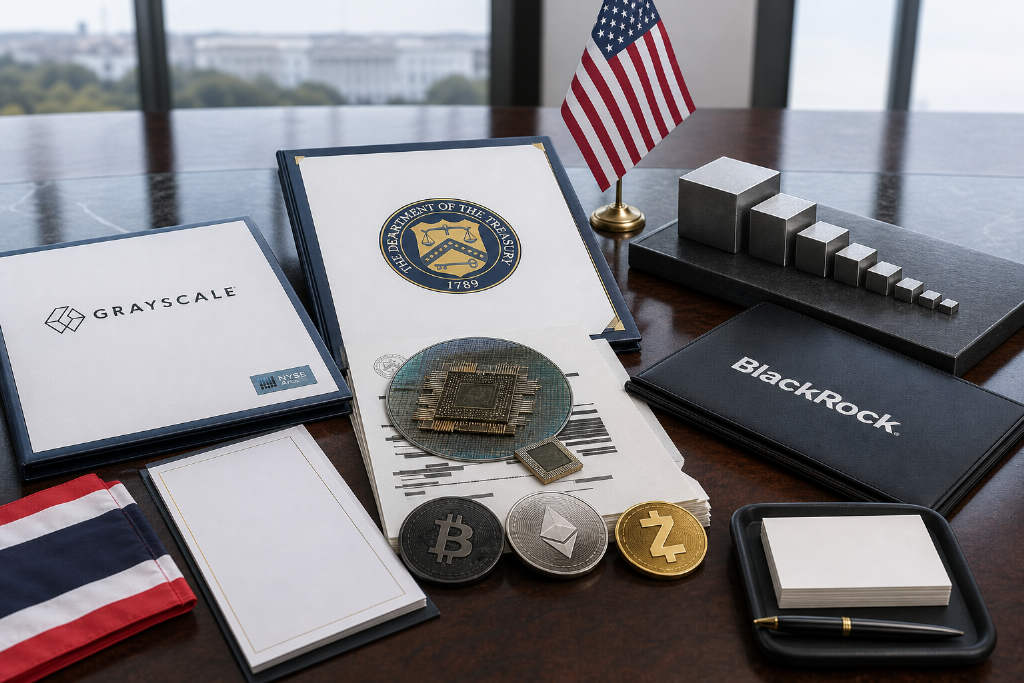
Several crypto, ETF, onchain, and adjacent technology stories emerged between Aug. 25 and Aug. 26, led by a new US Treasury quantum-readiness initiative, a Thai consultation on crypto ETF rules, Grayscale’s launch of a Zcash ETF, and a lower in-kind creation threshold for BlackRock’s spot Bitcoin ETF.
US Treasury sets up Quantum Readiness Working Group
The US Treasury said it is launching a Quantum Readiness Working Group. The body is structured as a public-private partnership and is intended to help the US financial sector move toward quantum-resistant technology in an orderly manner with operational resilience, while aligning with the Group of Seven Cyber Expert Group roadmap for post-quantum cryptography migration.
The group will work across three tracks: industry coordination and post-quantum cryptography migration, third-party and vendor readiness, and digital asset and emerging technology risks. Participants will include government agencies, financial institutions, financial market infrastructures, technology vendors, and other private-sector entities.
Treasury said the effort will focus on identifying critical dependencies, improving cryptographic agility and interoperability, strengthening the protection of critical financial infrastructure, and addressing implementation challenges tied to third-party reliance and digital assets.
Thailand seeks comments on crypto ETF framework
Thailand’s Securities and Exchange Commission is seeking public feedback on a draft regulatory framework for crypto ETFs, along with proposed higher qualification standards for overseas digital-asset custodians hired by funds. The comment period runs through Sept. 20.
Under the draft, crypto ETFs must be established and managed by asset management firms and operate as passive investment vehicles tracking crypto asset prices. For any single crypto asset, the annual average net exposure may not be less than 80% of net asset value. At the initial stage, only Bitcoin and Ether would qualify.
The products would be allowed to trade only on the Stock Exchange of Thailand, and the assets would mainly be held by domestic digital-asset custodians regulated by the Thai SEC. The regulator said it may later allow qualified overseas digital-asset custodians when necessary and appropriate.
The draft also would let mutual funds and private funds invest in locally listed Thai crypto ETFs, while leaving current investment-limit rules in place.
Grayscale lists Zcash ETF on NYSE Arca
Grayscale launched the Zcash ETF, ticker ZCSH, on Tuesday and listed it on NYSE Arca. The product was converted from the Grayscale Zcash Trust and is described as the first ETF to give investors direct exposure to Zcash. It charges a 2.5% fee.
A Grayscale spokesperson said revenue generated by that fee will flow back into the Zcash ecosystem to support the network and broader development efforts.
As of Monday, assets under management in the Grayscale Zcash Trust were more than $313.5 million. Market data cited from The Block showed ZEC had gained about 45% over the past several days.
BlackRock cuts in-kind Bitcoin ETF creation threshold
BlackRock lowered the minimum trade size for investors creating ETF shares through in-kind Bitcoin subscriptions from $25 million to $1 million in July. Robbie Mitchnick, BlackRock’s head of digital assets, said the firm’s spot Bitcoin ETF, IBIT, has now completed more than $5 billion of those conversions, up from more than $3 billion disclosed in October last year.
The mechanism lets investors transfer Bitcoin into a fund that holds the same asset and receive ETF shares through authorized participants or market makers. Bitwise has also reduced the minimum size for handling this type of trade, from an initial $100 million to $3 million.
Bloomberg said market infrastructure supporting the migration of crypto assets into ETFs has continued to expand since US regulators allowed in-kind creations last summer.
LayerZero outlines institutional venue ATLAS
LayerZero said it will launch a blockchain-based exchange called ATLAS in the fall of 2026. The platform is aimed at financial institutions and will not have a consumer-facing app.
ATLAS will be built on Zero, the blockchain LayerZero introduced in February this year. The first version is set to support spot crypto assets and perpetual contracts, with plans to expand later into prediction contracts, futures, and options.
Citadel Securities, the Depository Trust & Clearing Corporation, and Intercontinental Exchange, parent of the New York Stock Exchange, are all partners of Zero. LayerZero said top global market makers will provide liquidity on ATLAS from day one.
Bitwise plans tokenized stock portfolios for non-US investors
Bitwise Asset Management, which manages about $9 billion in client assets, is preparing to launch Automated Token Portfolios, or ATP. The product will allow eligible investors outside the US to hold baskets of tokenized equities in self-custody wallets.
ATP will use Coinbase’s tokenized US stocks and technology from Glider, with automatic rebalancing based on weightings set by Bitwise. The first portfolios will focus on the Magnificent Seven, as well as AI and robotics themes.
Unlike traditional funds, the assets will not be pooled into an investment vehicle and will remain in investors’ own wallets. The product will charge a 0.15% methodology access fee and is expected to go live in the coming weeks.
Funding and company moves
AI security startup Alice said it raised $140 million in a round led by Apax Digital, a fund of Apax Partners, with participation from SentinelOne and Samsung Electronics. The round values the company at close to $1 billion. Alice focuses on protecting AI models and helping enterprises reduce the risk of misuse, attacks, and abnormal system behavior. The company said it already works with major AI firms including Anthropic and Google.
Digital-asset investment firm Hivemind Digital Group announced a $17 million strategic financing led by UK asset manager M&G Investments, with CPIC Investment Management (Hong Kong), ZA Bank, FalconX, Sonic Boom Ventures, and others also participating. The company said the capital will be used to advance tokenization infrastructure and explore the use of blockchain in traditional financial asset management, issuance, and trading.
Crypto venture firm RockawayX, which manages about $2 billion in assets, is raising $150 million for a new Liquid Opportunities fund that will invest in what it described as undervalued tokens and crypto-related stocks. RockawayX previously acquired crypto hedge fund Relayer Capital, and founder Austin Barack, a former CoinFund partner, will remain in place to lead the strategy.
Robotics startup Generalist completed a new financing at a $3 billion valuation, according to people cited in the report. The new money was said to total nearly $200 million and was led by 8VC. It extends a $400 million Series B led by Radical Ventures in June, bringing that round to $600 million in total.
Generalist was founded in 2024 by former Google DeepMind researchers Pete Florence and Andy Zeng, along with former Boston Dynamics engineer Andrew Barry. Early backers include 8VC, Radical Ventures, Nvidia, Union Square Ventures, Bezos Expeditions, and AI researcher Fei-Fei Li. The company builds foundation models for robots, and its Gen 1.5 model can teach robots new tasks from video demonstrations lasting 3 to 12 seconds. The same report said Physical Intelligence is valued at about $11 billion, Skild AI at $14 billion, and Genesis AI is also in talks to raise at a $3 billion valuation.
Stability AI, the developer behind Stable Diffusion, raised $76 million in a Series B, taking cumulative funding to $232 million. Investors in the round include Universal Music Group, Sony Music Group, Warner Music Group, Electronic Arts, AMD Ventures, and Pacific Alliance Ventures. The company said the new capital will support expansion of its creative product suite and professional-services business. The report also said Stability largely prevailed in a UK copyright case, while a similar Getty Images lawsuit in the US remains ongoing.
Exchange and onchain product updates
Robinhood Crypto said Morpho (MORPHO) is now available for trading on Bitstamp by Robinhood.
Arcus launched its pToken protocol on Robinhood Chain. The protocol tokenizes shares in perpetual futures accounts with fixed markets and leverage levels into transferable ERC-20 tokens that can also be used in lending and other onchain protocols. The first markets support leveraged exposure to BTC, SOL, HYPE, and certain tokenized stocks. Arcus also rolled out multi-asset collateral, allowing SPY, QQQ, and MAG7 tokens to be used as collateral for perpetual trading.
Binance said it will list the bStocks tokenized security pair for Trump Media & Technology Group, DJTB/USDT, at 20:00 Beijing time on Aug. 26, 2026, and enable spot algo trading bots for the pair.
Within one hour of the bStocks spot listing, users will be able to swap bStocks into BTC, USDT, or other tokens supported by Binance Convert with zero fees. The pair will also carry zero maker fees from listing until 07:59 Beijing time on Sept. 1, 2026. Users can convert directly held shares into bStocks at a 1:1 ratio with no conversion fee. DJTB withdrawals will open at 21:00 Beijing time on Aug. 26, 2026.
Kraken says customers were hit by dusting attack
Kraken said some customer accounts became temporarily inaccessible after receiving tiny amounts of cryptocurrency from a wallet associated with sanctioned rival HTX. Kraken described the transfers as a dusting attack and said the purpose may have been to trigger compliance reviews by spreading sanctioned funds.
Data from Etherscan and Arkham Intelligence showed that between Aug. 17 and Aug. 24, the wallet sent nearly 12,000 small transfers to Kraken-linked addresses. Most were worth only a few cents or a few dollars.
Kraken said access has been restored for affected customers. The exchange added that it continues to hold the sanctioned funds as required and is working with relevant authorities to limit the impact. HTX denied initiating the transfers and said it is investigating, with possible explanations including source-identification errors or malicious activity by a third party.
Grove builds strategic CFG position
Grove Finance said it has built a strategic position in the Centrifuge ecosystem, initially holding 37.8 million CFG, equal to about 5.4% of total supply. Grove said more than $1.27 billion in assets has already been deployed through Centrifuge infrastructure across the two sides’ existing collaboration.
According to Grove, the relationship goes back to the early MakerDAO period. The new CFG position shifts the partnership from protocol integration toward strategic coordination, combining Centrifuge’s tokenization and distribution infrastructure with Grove’s capital-allocation capabilities to support long-term development of tokenized assets.
Hormuz Strait statements and ceasefire claims
A joint statement from Iran and Oman said Omani Foreign Minister Busaidi held constructive talks with Iranian Foreign Minister Araghchi during a working visit to Iran. The discussions focused on restoring safe navigation through the Strait of Hormuz while preserving the sovereignty and sovereign rights of the two countries.
The statement said recent war and its disastrous consequences had changed conditions in the strait, and the two sides discussed a phased framework that could provide a practical basis for moving the situation forward. The proposal includes a temporary joint maritime corridor in the Strait of Hormuz and a joint mine-clearing project. The countries will continue technical discussions aimed at reaching agreement on a permanent maritime corridor, future management of the strait, mechanisms for exchanging traffic-management information, and related maritime and security service arrangements. The statement also stressed the need for joint dialogue with Gulf coastal states, compliance with applicable international law, and respect for the sovereign rights of littoral countries.
Separately, sources from Pakistan’s military and Iran’s security services said the US and Iran had reached consensus on ceasefire terms, including free navigation through the Strait of Hormuz. The sources said an announcement could come in the coming days and that talks and a round of technical meetings would begin under what they described as the Islamabad memorandum. Earlier reporting had said Iran did not plan to reopen the strait immediately and would finalize a new permanent shipping route with Oman within 60 days.
Barry Silbert comments on ZEC and 24/7 US equities
According to a post shared by WTF Academy founder 0xAA, Grayscale founder Barry Silbert said at a YZi Labs event in Bhutan that US stock trading will move to 24/7 within five years, and that competitive pressure from Hyperliquid’s entry into the US could speed up that shift. He said tokenized US equities would become less attractive in the US under that scenario, though they would still matter in other regions.
On meme coins, Silbert said they are essentially gambling. He added, jokingly, that if someone insisted on making that kind of risky trade, the best choice would be to buy ZEC. He said Zcash is based on Bitcoin but has stronger privacy features, and argued its market capitalization could eventually reach one-tenth of Bitcoin’s, or about $8,000.
AI, IPO, and model-related items
Anthropic is expected to tell investors in its IPO filing that its potential revenue opportunity exceeds $30 trillion, topping SpaceX’s earlier estimate of $28.5 trillion. The figure is presented through total addressable market analysis tied to the full scope of work AI models may eventually be able to perform.
The report said SpaceX previously called its TAM the largest actionable market in human history, with $26.5 trillion of that tied to AI opportunities. Anthropic’s second-quarter revenue has exceeded $11.6 billion, more than double the prior level. The IPO could raise as much as $100 billion at a target valuation of roughly $2 trillion, above SpaceX’s $1.77 trillion valuation at listing. The plans remain under discussion, with a possible listing as early as September or October.
An X account identified as @synthwavedd posted that OpenAI has completed pretraining for its next model, internally codenamed Bel, described as the direct successor to Doug and carrying more than 10T parameters. The post said OpenAI hopes Bel will become the foundation model after GPT-6 and potentially push toward an artificial general intelligence threshold.
The original item also included a definition of AGI as a hypothetical system able to learn, understand, and perform any intellectual task a human can, with cross-domain generalization, reasoning, and self-learning in unfamiliar environments, unlike narrow AI systems built for specific tasks.
ETF flows, trading volumes, and market data
Bloomberg ETF analyst Eric Balchunas said SPDR Gold Shares (GLD) and BlackRock’s IBIT have returned to the top 10 by trading volume, displacing semiconductor ETFs that had dominated much of the summer. He called that another sign that a debasement trade is starting to replace AI mania, with investors rotating from AI growth into hard assets used for capital preservation. He added that semiconductor ETFs remain active, but below summer peaks.
Data released by CryptoRank.io showed that net inflows into Bitcoin ETFs for August had reached $2.72 billion so far, the highest monthly figure of 2026. Last week alone brought in $1.92 billion, close to April’s prior year-to-date peak of $1.97 billion for the full month.
Arkham data showed BlackRock clients were net buyers of $1.33 billion in Bitcoin last week, the largest weekly purchase since Bitcoin’s all-time high on Oct. 6, 2025. The data also showed buying on seven straight days. Since the July 1 low, BlackRock has accumulated a net $2.17 billion in Bitcoin, with more than half of that coming last week.
PANews reported on Aug. 26, citing data from Tokens on Solana, that weekly spot trading volume in Solana meme coins has surpassed $5.2 billion, the highest level of 2026.
PANews also reported on Aug. 26, citing data shared by X user Adam, that crypto trading app Fomo recorded more than 100,000 daily active traders for the first time. The only earlier onchain trading terminal to exceed 100,000 daily active wallets was Moonshot, which hit a record 180,341 during the Trump token launch period in January 2025.
Whale positions and onchain fund movements
After BTC pushed above $80,000 and then pulled back, an entity tied to whale trader Garrett Jin added 600 BTC to a long position at $79,000 in early trading hours, a position worth $47.4 million. The BTC long has been held for three months and at one point showed a peak unrealized loss of $23 million in early July.
The entity now holds a BTC long of 1,868 BTC worth $147 million, with an average entry price of $77,090 and an unrealized gain of $2.78 million. It also holds a ZEC short opened at an average of $444 on 32,700 ZEC, valued at $25.28 million, with an unrealized loss of $10.74 million.
Polychain moved 14.65 million EIGEN, valued in the item at $3.09 million, into Coinbase Prime six hours ago from tokens it had unstaked three months earlier. Of the 131.8 million EIGEN redeemed at the end of May, 46.86 million were restaked one month ago, 14.65 million were transferred to Coinbase Prime today, and 70.29 million remain in the address.
A new address, 0xAef…Dc00B, accumulated 20,000 ETH worth $48.89 million within 50 minutes, in a move the report said may be linked to Bitmine. Bitmine now holds 5.847611 million ETH worth about $14.4 billion, with a cost basis around $3,359 and an unrealized loss of $5.27 billion.
Other notable items
Arthur Hayes said on X that an infographic covering the FLOP tokenomics of Flop Labs, his AI and crypto project, will be released this week. He added that he will host an AMA next week on X Spaces and YouTube to answer tokenomics questions and gather feedback.
Prediction market Kalshi disclosed in a filing with the US Securities and Exchange Commission that it has raised about $1.12 billion through equity financing, out of a total offering size of $1.5 billion.
YZi Labs released the list of 24 early-stage companies selected for the fourth season of EASY Residency. Each company will receive a $500,000 investment. The selected projects are Aile, Alloco, D0, De¹, Facto, FinTax, Kravata, Liquorice, Meddcom AI, Nara, Neutral Trade, Nexroute, Nxos, Primus, Roostoo, SmartX, Spectrum, Surgepay, ViFi Labs, xAPI, XHunt, XStable, and Zerodrift.
Caixin reported that UAE-based investment institution Aqua 1 Foundation has spent $100 million buying WLFI, the token issued by the Trump family crypto project World Liberty Financial, overtaking Justin Sun’s cumulative $75 million and becoming the largest buyer. The report said Aqua 1’s ultimate controller is Zhou Guren, born in Shanghai in 1984. Caixin added that Zhou remains listed as a dishonest judgment debtor in China’s enforcement disclosure system, with six cases involving debts totaling tens of millions of yuan. A recent indictment provided by the UK Crown Prosecution Service also shows Zhou is involved in a money-laundering case in the UK, while a Shanghai timber company for which he served as legal representative had also been implicated in a smuggling case in China.
AI Watch items highlighted by PANews
PANews AI Watch said a 13-year-old girl in Shanghai made 18,000 yuan in three days using AI tools, drawing wide discussion on Weibo around both the ability and controversy of minors monetizing AI.
Skild AI released its S1 robotics foundation model and said it can learn tasks lasting more than 10 minutes from a single video prompt without fine-tuning. Sequoia Capital investor Alfred Lin called it a game changer.
Billionaire investor Stanley Druckenmiller told the media that the Wall Street Journal opinion piece he wrote criticizing Bessent was produced with AI, saying, "I use AI to write everything now." Wall Street Journal opinion editor Paul Gigot replied that "AI is a fact of modern life" and said disclosure was not necessary.