U.S. Treasury bill financing is expanding in a way that is making the Treasury look increasingly like a money issuer and pulling it deeper into Federal Reserve territory, according to Bloomberg macro strategist Simon White. White said on Sept. 2 that the shift is structurally inflationary, weakens the Fed’s policy independence, and raises risks for market stability as well as real returns on stocks and bonds. He pointed to Treasury bills making up 22.7% of outstanding U.S. debt, or 24.1% excluding the Fed’s holdings, above the Treasury’s informal 20% cap. White argued that as fiscal deficits widen, policy rates will no longer be only a monetary-policy tool; they will also become a key anchor for fiscal stability. In his view, that creates a growing conflict for the Fed, since higher rates would lift the government’s funding costs and effectively tighten fiscal policy at the same time. White also said Treasury bills are increasingly acting like “shadow money” in the repo system, where their near-zero haircuts and repeated rehypothecation allow them to behave more like liquidity for final settlement than a standard short-term funding instrument. He said that dynamic expands the supply of quasi-money and may contribute to broader price pressures over time.
U.S. Treasury bill financing is expanding in a way that is making the Treasury look increasingly like a money issuer and pushing it deeper into Federal Reserve territory, according to Bloomberg macro strategist Simon White.
On Sept. 2, White said the trend is structurally inflationary, weakens the Fed’s policy independence, and raises risks for market stability as well as real returns on stocks and bonds.
Treasury bills now account for 22.7% of outstanding U.S. debt, above the Treasury’s informal 20% cap. Excluding the portion held by the Federal Reserve, that share rises to 24.1%.
White said the ratio should keep climbing as fiscal deficits widen. At that point, policy rates would no longer be only a core monetary-policy variable. They would also become a key anchor for fiscal stability.
That shift, he argued, would leave the Fed facing heavier political and fiscal pushback. If the central bank raises rates to fight inflation, it immediately lifts the government’s funding bill. In effect, tighter monetary policy would also tighten fiscal policy.
White said finding a rate that can hit the inflation target, preserve financial stability, and avoid forcing government borrowing costs out of control may be impossible.
Treasury bills have long been a standard short-term funding tool for the U.S. government, but White said the Treasury is now leaning on them more heavily as a substitute for longer-dated bonds to absorb the financing needs created by a larger deficit.
That strategy has a clear funding logic from the Treasury’s point of view. Short-dated borrowing is often cheaper than long-dated debt. Treasury bills also appeal to a broad pool of investors that prefer low-duration assets. And compared with long bonds, they tend to drain less cash from bank deposits, which can help keep market liquidity and household and business spending in place.
White added that the Treasury has also taken steps that point in the direction of financial repression, including a larger buyback program, even if that is not being labeled as such.
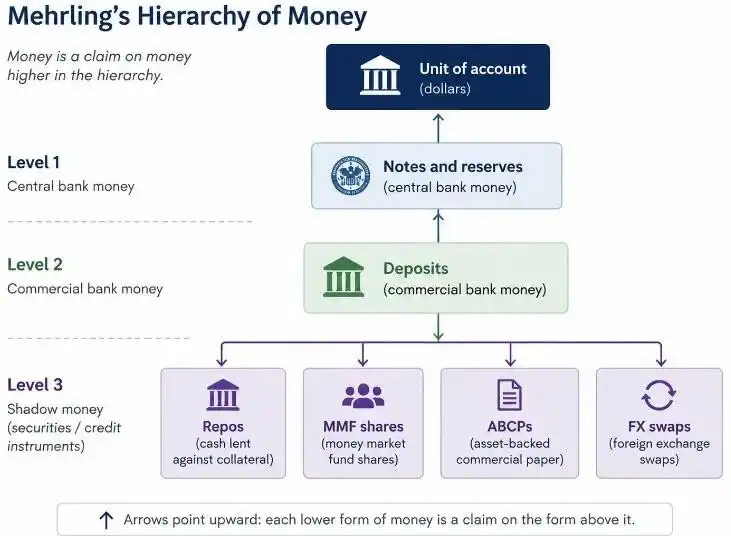
But in White’s view, Treasury bills are no longer just a routine funding instrument. Under Perry Mehrling’s hierarchy of money, reserves sit at the top of the financial system, followed by bank deposits, repo claims, and shares in money market funds. Treasury bills are increasingly behaving like another layer in that stack.
Because they mature quickly and have very little valuation uncertainty, Treasury bills usually trade at zero haircut in repo markets. They can also be reused repeatedly through rehypothecation without losing value. That makes them look far more like money itself — a liquidity instrument that can be used for final settlement.
White said rehypothecation is central to the process. In repo markets, dealers can source collateral from their own Treasury holdings or borrow through reverse repo and then pledge that collateral again to other counterparties.
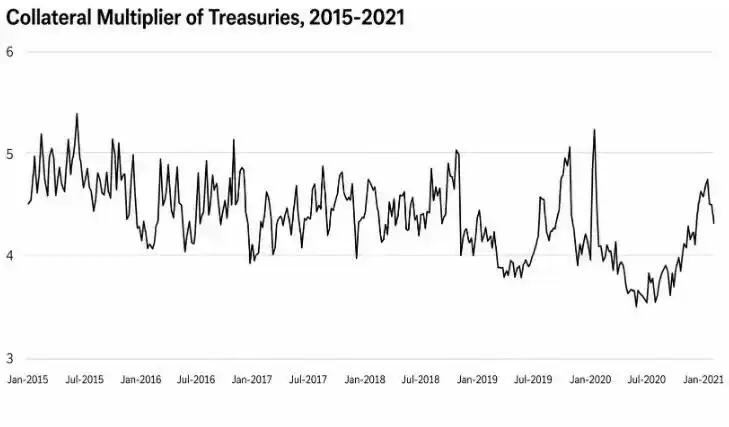
Bloomberg cited a 2021 academic study estimating that, between 2015 and 2021, U.S. Treasury collateral was rehypothecated an average of three to five times. In some other periods, estimates from different sources were even higher. In practice, that means dealers are repeatedly multiplying the amount of effective collateral available to the market.
For longer-dated Treasuries, each round of rehypothecation chips away at value through haircuts. Treasury bills, by contrast, carry zero haircut and can be pledged again and again without any loss of value. That feature lets them replicate themselves through the financial system and creates a quasi-money expansion effect.
White said history has often shown a lead-lag relationship between a rising share of Treasury bills in outstanding debt and the build-up of structural inflation.
His explanation is straightforward: more liquidity lifts asset prices, strengthens wealth effects, and lowers the cost of capital. Those forces then pass through to the real economy and push up the general price level.
He also argued that a larger Treasury bill program places a hard constraint on the Fed’s policy room. When more public debt is tied directly to short-term rates, every hike immediately increases government interest expense, effectively tightening fiscal policy. That creates political pressure and makes it harder for the Fed to act decisively when inflation rises.
White said the Fed may no longer be able to set policy in an optimal way to achieve its inflation goal as Treasury bills take up a larger share of the debt stack.
The growth in Treasury bill supply may also make short-end funding markets more fragile. If new issuance pushes Treasury bill yields higher, money market funds could shift cash out of repo and into bills, cutting the liquidity available in repo markets.
White noted that this risk is more important now because the combined size of Fed reserves and reverse repo balances is low relative to GDP. In that setting, any migration of cash could tighten short-term funding conditions quickly.
The Treasury itself would also become more vulnerable. More Treasury bill issuance means more frequent and larger auctions, and any rise in inflation expectations would show up quickly in borrowing costs. Even if the Treasury wants to reduce long-bond issuance, a sharp rise in term premium could still leave long-term funding costs higher, not lower.
White’s bottom line was bleak: as Treasury bills take a larger share of outstanding debt, the policy rate would have to serve both monetary policy and fiscal stability. In a world where inflation targets, financial stability, and fiscal sustainability all need to be satisfied at once, finding a single equilibrium rate may be an impossible task.
This article was originally published by Bit.Fan. For more cryptocurrency news and market insights, visit www.bit.fan. Disclaimer:
The market information, project data, and third-party content displayed on this platform are for industry information sharing only and do not constitute any form of investment advice or return commitment.
Cryptocurrency trading carries high risks. Users should fully assess their risk tolerance and make independent decisions. All profits, losses, and legal responsibilities are borne by the users themselves.