

USDC has overtaken Tether’s USDT in stablecoin trading against the euro, according to a new Kaiko report, as European Union rules increasingly favor stablecoins that comply with the bloc’s framework.
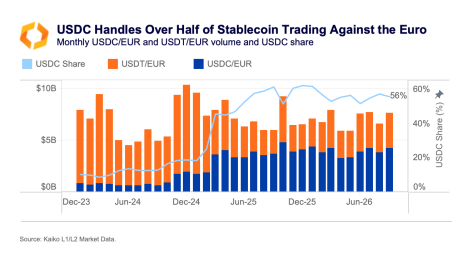
USDC’s share of euro stablecoin trading rose to 56%
Kaiko data shows USDC now accounts for 56% of stablecoin trading against the euro, up from 10% in January 2024. The report said the move picked up after major exchanges restricted USDT trading for customers in the European Economic Area under the Markets in Crypto-Assets Regulation, or MiCA.
USDC has also moved ahead of USDT in euro-denominated trading liquidity. Kaiko said USDC order books are now roughly 40% deeper than those of its rival.
Tether still leads the global stablecoin market by size. Its circulating supply remains about 2.5 times larger than USDC’s.
Kaiko calls euro-stablecoin pairs a key route for European users
Kaiko described stablecoin-to-euro pairs as a main on-ramp and off-ramp for European customers, since they let users swap euros into US dollar-pegged stablecoins when entering crypto markets and convert back when exiting.
A chart included in the report showed the USDC-euro pair overtaking the USDC-USDT pair.
EBA placed USDC under the significant e-money token category
The findings arrived about two weeks after the European Banking Authority designated USDC as the EU’s first “significant e-money token” under MiCA. That status puts the stablecoin under direct EBA supervision and adds regulatory requirements for its issuer.
US rules could also affect the Circle-Tether balance
Kaiko said the United States is moving in a similar direction on stablecoin regulation under the GENIUS Act, opening the door to a comparable shift in trading activity on American exchanges.
On Oct. 21, the Office of the Comptroller of the Currency issued its first final rule under the law. The rule sets reserve and redemption requirements for stablecoin issuers under its supervision and takes effect on Jan. 18, 2027.
Starting in July 2028, US platforms will also face restrictions on offering stablecoins from issuers that do not meet the law’s approval requirements.
Kaiko said those regulatory changes could favor Circle, which has pursued authorization in both Europe and the US. Tether has taken a different route and launched a separate US-focused stablecoin, USAT.



