
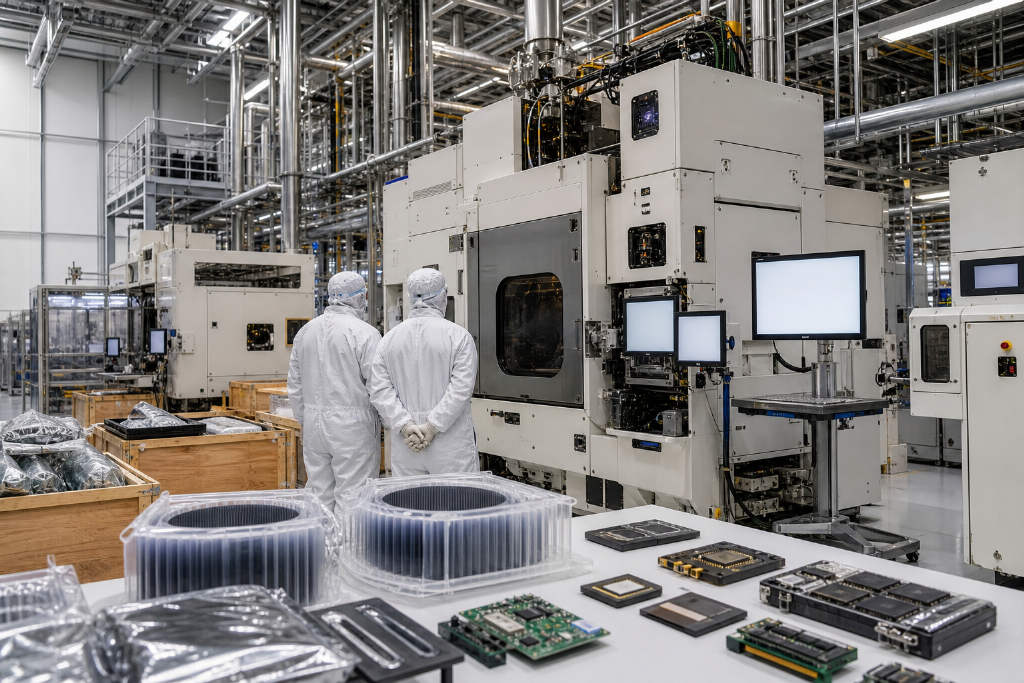
Used semiconductor equipment is taking on a larger role in mature-node manufacturing as advanced-process development becomes more expensive and less efficient on a commercial basis, according to an article published by MarsBit and attributed to the WeChat account ICViews, written by Zi Hao.
The article says R&D costs, tape-out fees and equipment spending for advanced nodes have continued to rise, while the performance gains from technology iteration have narrowed. By contrast, a large group of chips with steady end-market demand—including automotive power devices, industrial control chips, analog signal chips, IoT MCUs and sensor chips—are still mainly produced on 90nm to 28nm process nodes, supporting end markets such as consumer electronics, new energy, industrial control and automotive electronics.
Against that backdrop, used semiconductor tools are no longer described as a marginal backup option. The article frames them as a key asset for wafer fabs trying to expand mature-node output, control costs, smooth out cycle swings and hedge supply-chain risks. It cites data showing that the global used semiconductor equipment market exceeded 26 billion yuan in 2024 and could approach 66.5 billion yuan by 2031, with a six-year compound annual growth rate of 14.4%.
From overflow capacity to a direct production need
For years, the sector viewed used tools in a fixed way. They were often treated as equipment discarded by leading manufacturers after process upgrades and purchased by smaller fabs as a cost-cutting compromise for lower-end capacity. The older model of the semiconductor industry was relatively clear: advanced nodes moved upward, older tools flowed downward, large manufacturers chased the next process generation, and smaller players absorbed existing capacity.
The article argues that this logic has been disrupted over the past three to four years.
On the supply side, the traditional pool of used equipment has been shrinking. Semiconductor tools are long-life industrial assets. The piece says major etch, film and ion implantation equipment typically has a design service life of 15 to 20 years, much longer than the three- to five-year iteration cycle of chip process technology. In practical terms, many tools phased out by top manufacturers still retain workable hardware life and process capability, making them suitable for continued volume production. In the past, when companies such as TSMC, Samsung and Intel upgraded advanced processes, they would shut down older 8-inch and 12-inch lines in batches, sending large volumes of equipment into the global secondary market.
That source logic has changed. The article links the shift to strong demand from electric vehicles, solar-plus-storage and industrial automation. Products made on mature processes—including power semiconductors, high-voltage analog chips, power-management chips and sensors—remain in short supply, pushing major memory makers and foundries to prioritize existing internal capacity. Samsung and SK Hynix, which the article identifies as major suppliers of used tools in the past, are said to have largely stopped bulk external sales of retired equipment. Instead, they are keeping older tools for internal specialty-process conversions, niche-capacity expansion and maintenance replacement on legacy lines. As a result, the volume of quality equipment reaching the open market has fallen and tradable overseas supply has grown scarcer year by year.
Demand conditions have reinforced that trend. The article says the global semiconductor equipment supply chain is tight, with delivery lead times for key tools such as etchers, PVD systems, CVD systems and ion implanters generally stretched to 12 to 18 months. Some specialized process equipment may require more than two years. For wafer manufacturers, a lead-time gap of that length can mean missing an entire market cycle and disrupting capacity plans, customer deliveries and order allocation.
Downstream demand for mature-node chips remains elevated. The article points to rising demand for high-voltage power chips and automotive analog chips as vehicle electronics continue to upgrade, along with steady demand growth for industrial control chips and memory tied to industrial intelligence upgrades. IoT, smart-home systems and edge devices are also consuming large volumes of lower-end compute and control chips. Mainstream 8-inch and 12-inch mature-node lines around the world are described as operating at full capacity for extended periods, with several product categories remaining undersupplied even as manufacturers look to expand.
For many small and mid-sized fabs, specialty-process companies and startup IDMs in China, the challenge is not only the high price of new equipment and the pressure of fixed-asset investment. Long delivery schedules can be just as damaging. Expansion timelines, production ramp-up and customer shipments can all be delayed by equipment lead times. Refurbished used tools that have gone through precision calibration and operating-condition verification offer a different tradeoff. The article sums up the appeal as speed, lower cost and stable performance: delivery can be shortened to a matter of months, procurement costs are significantly lower than those of new machines, and the process capability has already been tested in years of mass production.
In that setting, the old hierarchy of “advanced iteration, outdated overflow” is weakening. Used tools are no longer portrayed simply as symbols of low-end capacity. The article presents them as core support for mature-node expansion, specialty-process growth and project execution at smaller fabs.
A structural clash between standardized production and a non-standard market
After decades of global circulation, used semiconductor equipment now sits inside a broad cross-border industrial chain. The article describes a process that runs from line retirement at overseas manufacturers, dismantling, packaging and customs clearance to refurbishment work in China’s mainland, Taiwan and Southeast Asia, followed by installation, volume production and aftermarket spare-parts support at end-user fabs. Europe, the U.S., Japan and South Korea control upstream supply, while businesses in mainland China, Taiwan and Southeast Asia play a central role in refurbishment, processing and market distribution.
Even so, the article says the industry carries a sharp structural contradiction. Semiconductor manufacturing is one of the most standardized and precision-sensitive industries in global manufacturing, with very little room for error. The circulation market for used tools, by contrast, has long operated with weak supervision and limited standardization.
At the top end of the market, formal service providers have built refurbishment systems that the article says are close to original-manufacturer standards. These companies operate professional clean refurbishment workshops, use precision inspection instruments and rely on experienced technical teams. Their process may include full disassembly, deep chamber cleaning, replacement of aged consumables, electrical and mechanical precision calibration, high- and low-temperature cycle testing, and simulation verification under mass-production conditions. Under that model, refurbished tools can deliver process consistency, operating stability and production yield close to new equipment. The article says comprehensive performance can exceed 95% of a new tool, while procurement and refurbishment costs amount to only 50% to 60% of a new machine.
At the other end of the market, the article describes many small traders and workshops as operating far more roughly. Some lack cleanroom conditions, professional testing equipment and skilled technical staff. In those cases, so-called refurbishment may amount to surface dust removal and basic cleaning, without replacing aging core consumables and worn parts exposed to long-term high-temperature and high-vacuum conditions. Key process parameters may go uncalibrated, and complete system performance tests may not be performed.
The article also says some market participants conceal hidden issues such as chamber wear, circuit aging and vacuum leakage, alter equipment runtime records or overstate process precision in an effort to win price-sensitive business and widen margins.
A more basic problem, it adds, is the lack of unified industry standards, grading systems, inspection rules and warranty frameworks, along with the absence of a credible third-party inspection body. For ordinary fab procurement teams, the real condition of a machine is difficult to judge from appearance or parameter labels alone. Hidden problems such as chamber loss, circuit aging and precision drift are hard to identify, leaving buyers to rely heavily on experience and merchant reputation. That pushes up trial-and-error costs and leaves risks hard to control.
The result is a classic bad-money-drives-out-good problem. Formal refurbishment is more expensive because it involves more complete procedures, which puts those providers at a disadvantage in price competition. Lower-priced and lower-quality refurbished tools can then move quickly into the lower end of the market. The article says this has left the sector with a disorderly pricing system and inconsistent equipment quality, even though chipmaking itself demands precision measured at the micron and nanometer level.
Tighter controls turn used tools into a supply-chain security issue
Supply-demand mismatch and a fragmented market structure are long-running internal issues for the used-equipment trade. The article says tighter global controls in recent years have changed the external environment as well, reshaping the operating logic of the business. Equipment that once moved mainly as a market-driven trade category has become part of a wider contest around semiconductor supply chains.
For a long period, export controls in semiconductors were concentrated on new high-end equipment, advanced process technology, high-end chip IP and cutting-edge materials. Retired tools, refurbished systems, generic spare parts and routine calibration and maintenance services were generally able to move under looser conditions. That flexibility served as a buffer for dynamic capacity balancing, regional complementarity and self-adjustment across the global supply chain.
The article says this picture has changed over the past two years. Multiple countries have updated control lists and expanded compliance scrutiny across the full chain of used-equipment activity, including exports of retired tools, cross-border circulation, refurbishment, trade in core spare parts, original-factory calibration and maintenance, and firmware upgrades. Transactions and services that once moved more freely now face layered approval requirements, longer cycles and more uncertainty, weakening the long-standing model of global free circulation for used semiconductor equipment.
One direct result, according to the article, is that many aging tools already in operation now face what it calls a “three-no maintenance dilemma”: no original spare-parts supply, no original precision calibration and no official firmware updates. A large share of mature-node production tools have been in service for many years and depend heavily on original consumables, parts, program firmware and process calibration. With tighter controls, overseas original technical support and spare-parts supply have largely been cut off.
To avoid shutdowns and keep capacity online, fabs and refurbishment companies have widely adopted an emergency approach based on parts reuse. That means dismantling idle machines of the same model and extracting usable components to replace aging parts in tools still in operation. The article says this can keep output going in the short term, but it comes with clear drawbacks. Non-original parts may offer limited compatibility and fit, and without original calibration and firmware optimization, process precision is more likely to drift. Batch consistency can decline, and long-term operation may weigh on production yield across mature-node lines.
As rules are redrawn, the industry’s competitive logic is changing as well. The article says buyers used to focus mainly on price, delivery speed and basic performance. Now they are placing more weight on a supplier’s inventory of available equipment, local refurbishment know-how, in-house replacement capability for core spare parts, and the strength of localized maintenance and support systems. In this reading, the ability to reactivate installed assets, master domestic refurbishment processes and develop substitute parts is becoming the main competitive moat for companies in the used-equipment business.
The article concludes that as the semiconductor industry moves from a single-minded technology race toward a stage that must balance technology iteration, supply-demand stability and supply-chain security, the old label attached to used tools is fading. It says this low-profile segment is likely to keep releasing industrial value.
The piece was published by MarsBit and sourced to the WeChat account “半导体产业纵横” (ID: ICViews), written by Zi Hao.