

A report jointly released by Uweb and the TGG Stablecoin and RWA Innovation Center under the Faculty of Business at Hong Kong Polytechnic University says the global AIDC, or AI data center, sector has moved into what it describes as a super-cycle of construction. Its central argument is that AIDC is not just another technology theme. It is a physical expansion already being locked in by orders and power availability, and that changes how investors should judge whether listed companies can actually benefit.
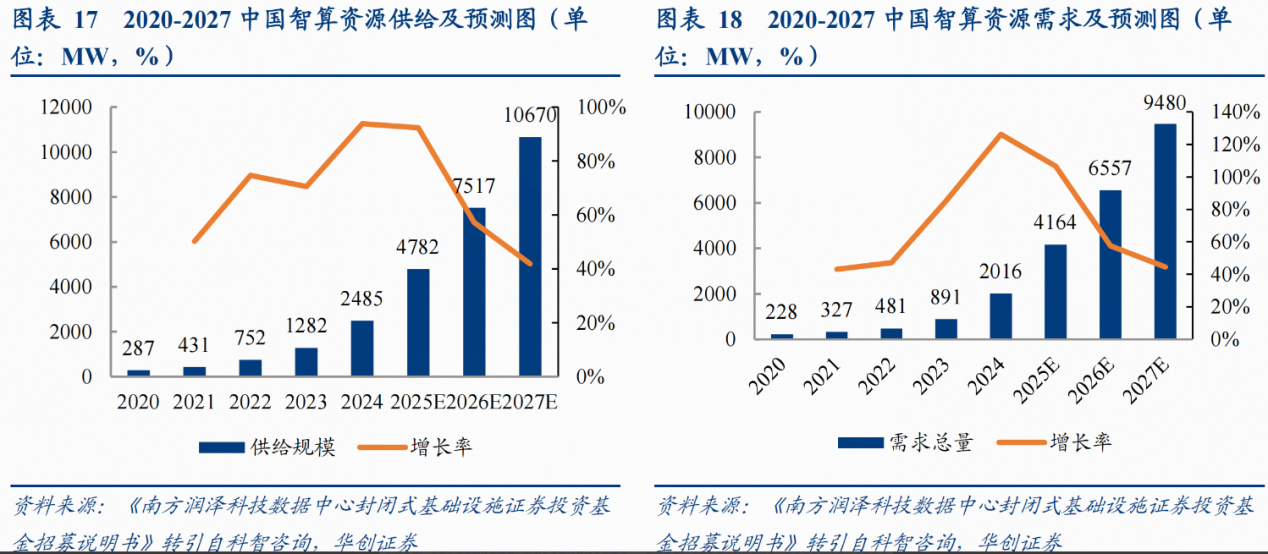
AI has become the main source of new data center demand
Citing JLL’s 2026 Global Data Center Outlook, the report says worldwide data center capacity is projected to rise from 103GW in 2025 to 200GW by 2030. Over the same period, AI workloads are expected to account for about 25% of data center capacity in 2025 and roughly 50% in 2030.
The report also draws on McKinsey estimates showing total global data center demand climbing from 82GW in 2025 to 219GW in 2030. Within that total, AI demand is projected to increase from 44GW to 156GW, while non-AI demand rises from 38GW to 64GW. That implies AI capacity growing 3.5 times in five years and making up about 70% of total demand by 2030.
Based on those figures, the study argues that nearly all incremental data center demand over the next five years will come from AI. In its view, the industry’s growth model has already shifted away from internet traffic and toward AI training and inference. For listed companies, the dividing line is whether they can secure AI-ready capacity and orders, because that determines whether they participate in new demand or just compete over existing capacity.
The report also points to a McKinsey note from April 2025 that estimated global data center capital expenditure at $6.7 trillion by 2030 to meet computing demand. Of that, $5.2 trillion would go to data centers able to handle AI processing loads, and $1.5 trillion would be directed to facilities serving traditional IT applications. In practice, the report treats that near-$7 trillion spending figure as a basis for repricing the entire supply chain.
In China, the study says the AIDC market stood at about RMB 49.4 billion in 2024. It cites Kezhi Consulting forecasts showing the market reaching RMB 196.3 billion in 2027, a compound annual growth rate of about 58%. Compute leasing is expected to expand from RMB 41.5 billion to RMB 152.8 billion, taking a larger share of the market, while intelligent computing infrastructure rises from RMB 7.9 billion to RMB 43.5 billion. The report says service-based delivery is spreading quickly as AI demand accelerates, pushing the sector from a build-heavy model toward one that combines compute services with infrastructure.
On policy, the report notes remarks made in June 2026 by Li Chao, deputy director-general of the Policy Research Office and spokesperson for the National Development and Reform Commission. According to the report, Li said the 15th Five-Year Plan period would place more emphasis on matching supply and demand, coordinating planning for compute networks, new power grids and next-generation communications networks. The NDRC also said the full list of 2026 equipment renewal projects totaling RMB 200 billion would be issued before the end of June. The report says the funding is part of the “two new” policy package. Of that total, RMB 185.1 billion had already been distributed in two batches, supporting more than 11,000 projects and driving more than RMB 840 billion in social investment.
Demand is already visible in spending and revenue
The report argues that what sets AIDC apart from many other technology concepts is that demand is not being guessed at. It is already showing up in hyperscaler capital spending and in Nvidia’s revenue.
It cites Dell’Oro Group as saying Amazon, Google, Meta and Microsoft entered 2026 with combined data center capital expenditure commitments of nearly $600 billion. Global data center capex for the full year is expected to approach $1 trillion.
For Nvidia, the report says fiscal 2026 revenue reached $215.94 billion, up 65% from fiscal 2025. Data center revenue for the full year came in at $193.7 billion, up 68% year over year and accounting for more than 90% of total company revenue. Revenue for the first quarter of fiscal 2027 was about $75.2 billion, up roughly 21% quarter on quarter and about 92% from a year earlier.
Those two sets of figures reinforce each other in the report’s reading. One side shows hyperscalers committing almost $600 billion to data center spending. The other shows Nvidia still posting rapid growth in the business that supplies the hardware. In other words, the money is already being spent and the products are already shipping. For downstream AIDC operators, the question is not whether demand exists, but whether they can capture it.
Power and grid connection have become the hard bottlenecks
The report says that as capital becomes easier to obtain than power access, electricity supply and interconnection capacity now represent the real bottlenecks for AIDC expansion. That shifts the competitive advantage from who has the money to who controls land and power.
Citing the International Energy Agency, the report says global data center electricity consumption will more than double to about 945 terawatt-hours by 2030, close to the annual electricity use of Japan. Electricity use at AI-specific data centers is expected to increase more than fourfold, and U.S. data centers are projected to account for nearly half of the country’s electricity demand growth through 2030.
That, the report says, helps explain why companies that already control land and power resources are in a stronger position as the transition unfolds. It also cites SemiAnalysis, which expects revenue in intelligent computing center infrastructure to grow at a compound annual rate above 30% between 2024 and 2032. Operators and large cloud service providers are actively looking for regions with abundant land and electricity as they expand, driving more centralized and large-scale development. General-purpose data centers are growing more slowly than intelligent computing centers, but the report says they are still benefiting from the broader AI buildout.
How the report classifies listed companies across three markets
The report says listed companies in mainland China, Hong Kong and the United States are all talking about AIDC, but the quality of those transitions differs in systematic ways. In the United States, the main pattern is Bitcoin miners moving into AI hosting. Those companies already own power, machine rooms and cooling systems, so AI is often an extension of existing compute infrastructure. In mainland China, many crossover attempts come from sectors such as monosodium glutamate, papermaking, steel, lottery printing, children’s clothing and furniture, all far removed from IT. Hong Kong sits in the middle, with property-led diversification and upgrades by native IDC operators both appearing.
The study places listed companies into four groups based on how far their transitions have actually materialized, and then adds a fifth reference group for native IDC operators and industry benchmarks.
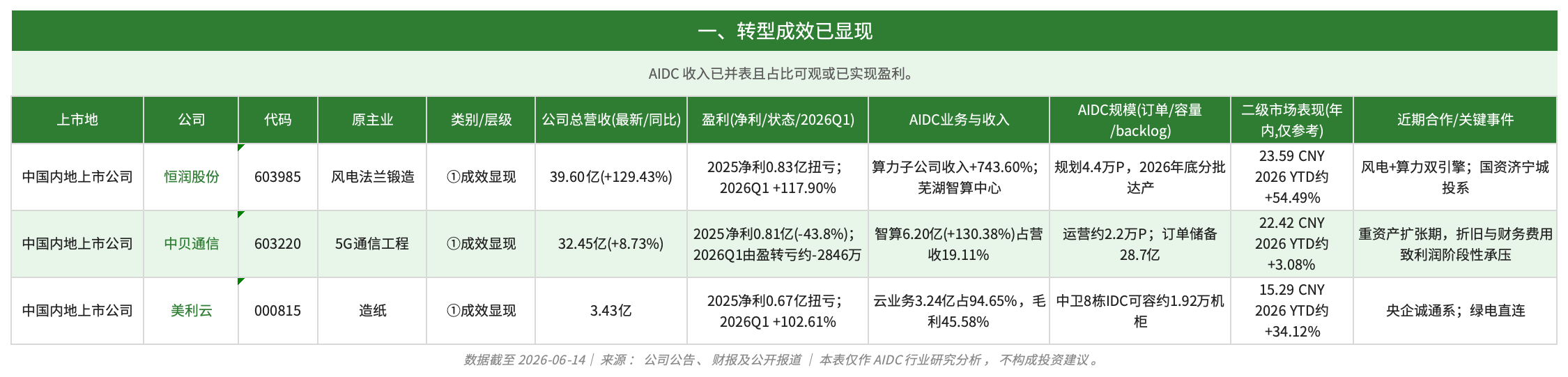
- Group 1: Transition results already visible. AIDC revenue has already been consolidated, takes up a meaningful share of revenue, or the business is already profitable. Examples named in the report are Hengrun Shares, Zhongbei Communication and Meili Cloud.
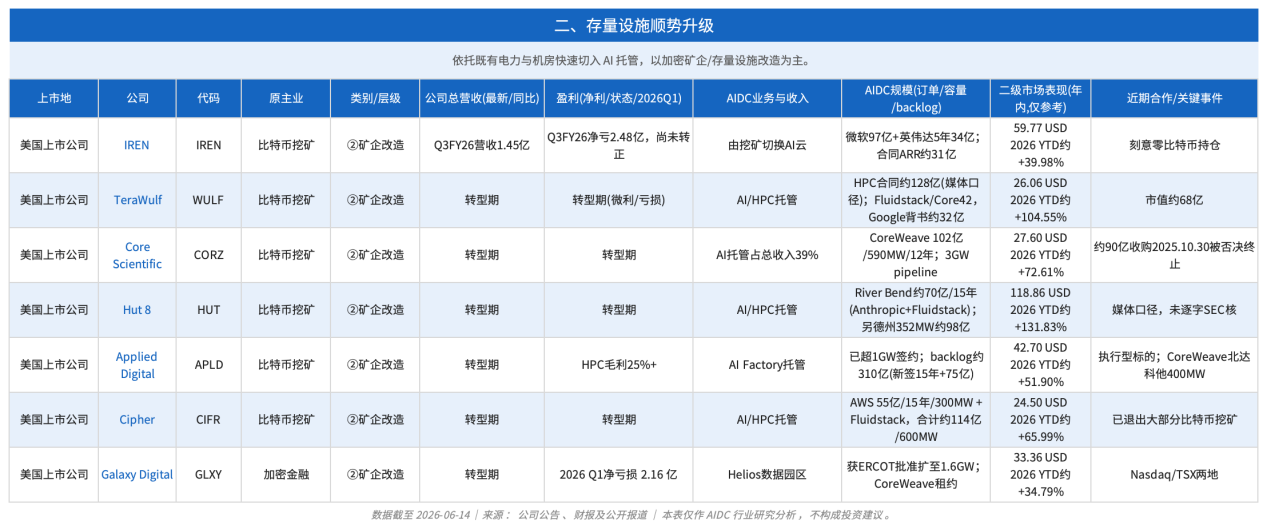
- Group 2: Existing infrastructure upgraded into AI hosting. These companies move quickly by relying on power and machine rooms they already own. Examples include IREN, TeraWulf, Core Scientific, Hut 8, Applied Digital, Cipher and Galaxy.
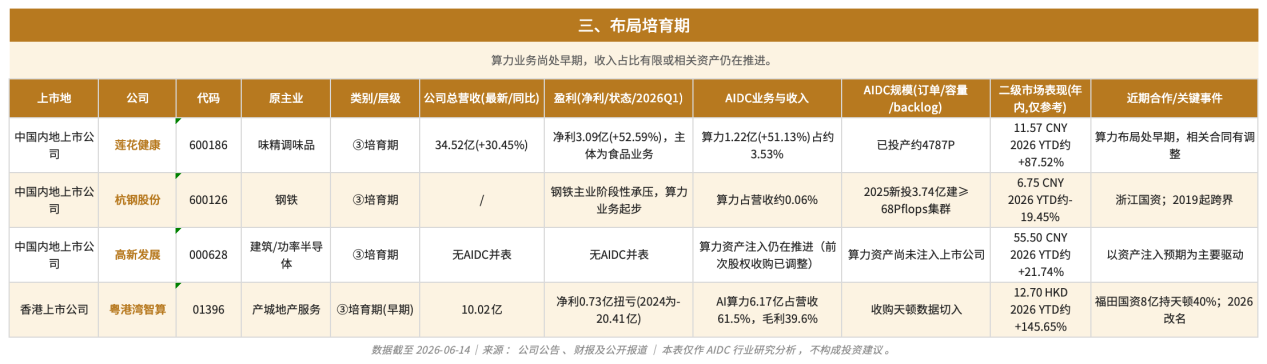
- Group 3: Early-stage buildout. Compute businesses remain small, revenue contribution is limited, or related assets are still being injected or developed. The report lists Lianhua Health, Hanggang Shares, Gaoxin Development and Yuegangwan Zhisuan.
- Group 4: Cautious adjustment. Some companies have re-evaluated, slowed or paused their compute plans. The report treats that as normal trial and error in an early-stage industry.
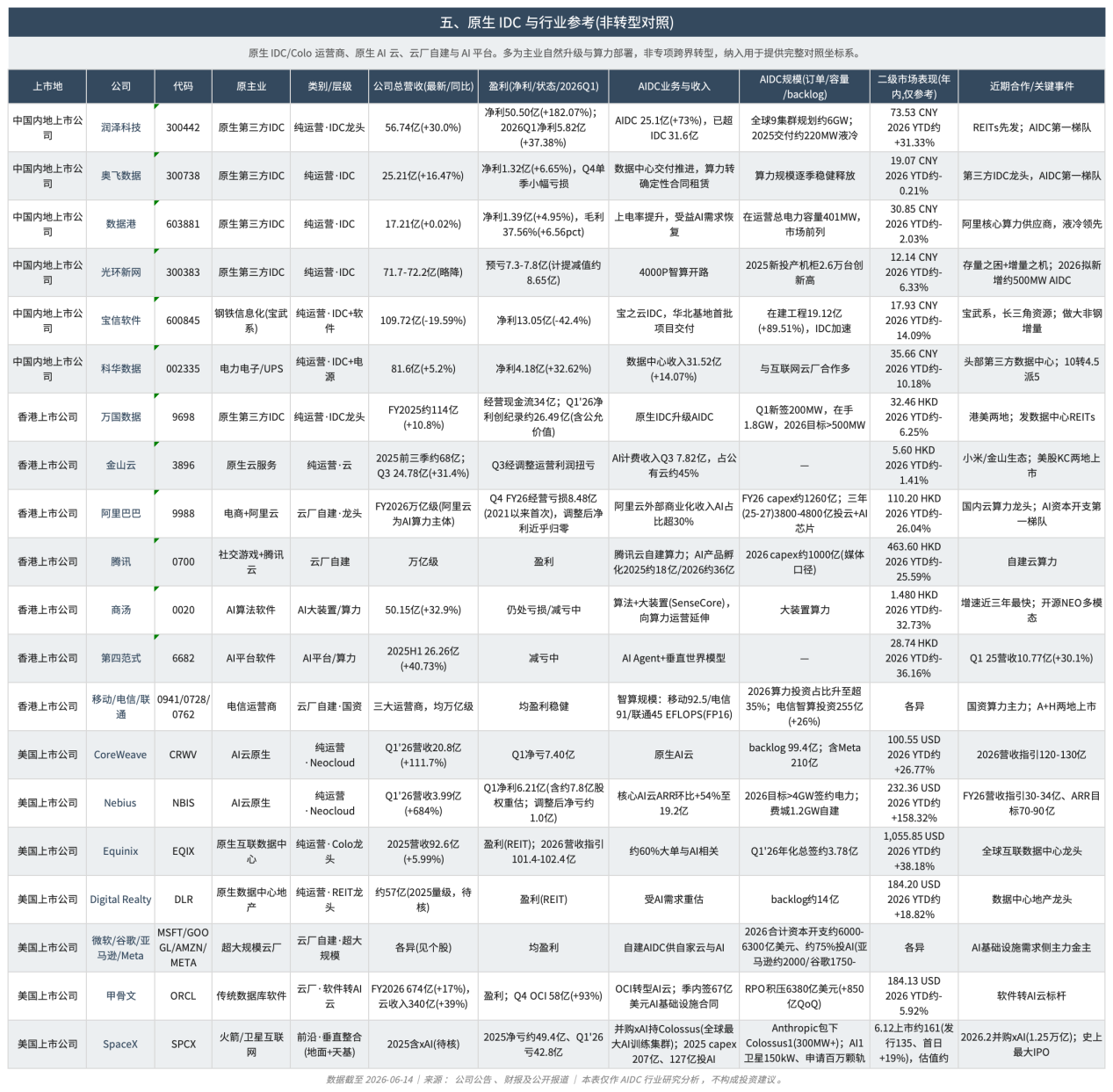
Separate from those four groups, the report includes native compute operators, cloud companies and AI platform firms as a benchmark set. Runze Technology, OFILM Data, Shanghai AtHub, Sinnet, Baoxin Software, Kehua Data and GDS are presented as companies already in the data center business and upgrading from traditional IDC capacity to high-power, liquid-cooled AIDC. CoreWeave and Nebius are also treated as native AI cloud names rather than crossover stories.
Alibaba, Tencent, Microsoft, Google, Amazon, Meta, Oracle and China’s three telecom operators are described as building compute capacity mainly for their own cloud and AI businesses. In the report’s framework, they belong to the demand side and represent the major source of AIDC capex. SenseTime and Fourth Paradigm are placed in a separate category of companies extending from AI algorithms and software platforms into compute operations.
The report says bringing all of these groups into one table is meant to provide a fuller reference frame. It is not arguing that all of them are crossover transformations.
Mainland China: mixed participants and uneven delivery
For mainland China, the report says the participant base is the most diverse. It ranges from specialized operators to cross-sector entrants, and the pace of delivery varies widely. The key tests, in the report’s view, are whether AIDC revenue is consolidated, how much of total revenue it represents and whether profitability is of acceptable quality.
At the more advanced end, the report highlights Hengrun Shares, saying its wind power and compute businesses together helped it return to profit in 2025 with net income of RMB 83.48 million. Revenue at its compute subsidiary Shanghai Runliuchi rose 743.60% year over year. In the first quarter of 2026, net profit reached RMB 65.14 million, up 117.90% from a year earlier.
Meili Cloud is another case the report places in the “results already visible” group. It says the company generated RMB 324 million in cloud business revenue in 2025, accounting for 94.65% of total revenue, with a gross margin of 45.58%. First-quarter net profit rose 102.61% year over year, and operating cash flow turned positive.
Zhongbei Communication represents a different pattern. The report says its compute order backlog reached RMB 2.87 billion in the first quarter of 2026 and intelligent computing revenue grew quickly, but profit in the period came under pressure from depreciation, finance costs and impairment. The report says this is typical for heavy-asset expansion. Revenue often rises before profit does, and the faster the buildout, the greater the near-term hit to earnings.
It also says some crossover companies still derive only a small portion of revenue from compute, or remain in the middle of asset injections and cooperative projects. In those cases, the contribution to overall performance is still limited and reflects market expectations more than realized operating results. Some early participants have already gone through project or partnership adjustments, showing that execution risk remains high.
Hong Kong: native leaders with order visibility and acquisition-led entrants
In Hong Kong, the report says the main AIDC value lies in order conversion by native IDC leaders. GDS signed a record 200MW of new capacity in the first quarter of 2026. By the end of that quarter, total orders on hand stood at 1.8GW, and the company’s target for newly signed AI orders in 2026 was more than 500MW.
On the crossover side, the report points to Yuegangwan Holdings, which changed its name to Yuegangwan Zhisuan in 2026. It entered the compute business through the acquisition of Tiandun Data. The report says AI compute revenue accounted for 61.5% of its revenue in 2025, and that it received an RMB 800 million capital injection from Futian state-owned capital to step up its AI business.
In the report’s view, GDS’s 1.8GW order book represents verifiable and concrete demand, making it a case of steadier execution. Yuegangwan Zhisuan, by contrast, shows how a newcomer can move in quickly through acquisitions and state-backed cooperation. Its compute revenue share is already high, but the business has a short operating history, so durability still needs time to prove out.
United States: Bitcoin miners have the most mature transition path
The report argues that U.S.-listed miners are the most mature transition candidates among the three markets because they typically follow a sequence of signing long-term contracts first, adding capacity second and recognizing revenue later. Under that model, valuation tends to anchor to signed contracts rather than current profit.
Among the examples cited, IREN signed a $9.7 billion GB300 AI cloud contract with Microsoft. AWS signed a 300MW, 15-year hosting agreement with Cipher. Core Scientific expanded its partnership with CoreWeave to roughly 590MW under a 12-year take-or-pay hosting contract valued at about $10.2 billion in aggregate.
Because these multi-year agreements are signed with investment-grade counterparties such as Microsoft, AWS and CoreWeave, the report says they effectively convert miners’ power and data hall resources into predictable future cash flows. That is the core reason it gives for why U.S. miners’ AIDC transitions carry more weight. As one quantitative marker, the report says revenue per megawatt under AI contracts is about three times that of traditional crypto mining.
Before and after AIDC: valuation shifts from legacy business to contracts and power
The report says the most important change before and after an AIDC transition is the movement of the valuation anchor. Before the shift, a company might be valued as a consumer business, a paper producer, a steelmaker or a license-driven printer. After a successful transition, the anchor moves to verifiable long-term compute contracts and available power capacity.
In that framework, GDS is being repriced based on its 1.8GW orders in hand. U.S.-listed miners are being repriced based on backlog and annual recurring revenue rather than short-term earnings per share.
The report stresses that what really separates a company that has crossed over from one that is only talking about crossover is not whether it has made an AIDC announcement. It is whether the company has secured verifiable long-term contracts and power indicators. Some companies announced compute plans but later saw sharp share price swings because revenue contribution stayed low or project timelines fell short of expectations. By contrast, those with power, land and long-term contracts received more durable valuation support.
Profit lagging revenue is described as a common feature of heavy-capex expansion in both China and the United States. The report names Zhongbei Communication, CoreWeave and IREN as examples of companies showing revenue growth while profits remained under pressure or temporarily moved into losses. In the market’s view, that is tolerable only if long-term contracts make future cash flow sufficiently visible. Without those contracts, or without power capacity to back them up, concept premiums can unwind quickly.
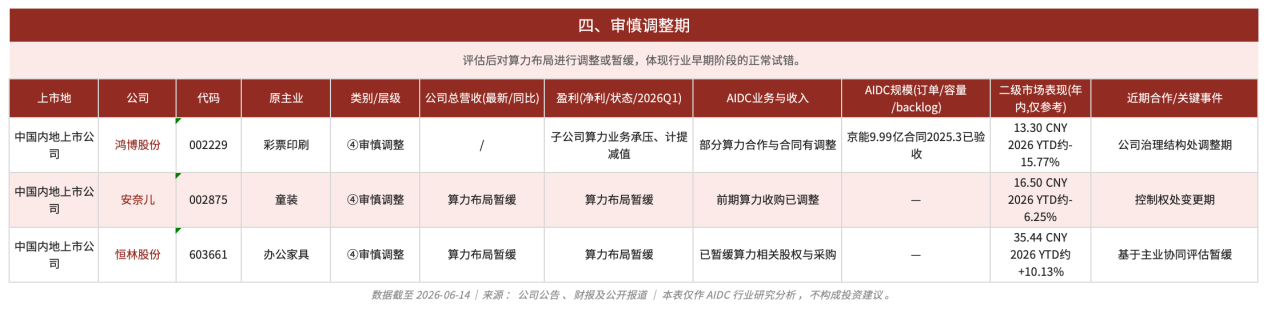
The report adds that capital markets are clearly rewarding AIDC exposure, but the reward is attached to contracts and power rather than slogans. It says GDS, CoreWeave and several miners have all seen material reratings because of backlog. It also notes that mining stocks as a group gained roughly 70 percentage points in 2026, and that Oracle was able to re-rate from database software toward AI cloud on the back of hundreds of billions of dollars in remaining performance obligations, or RPO.
Key risks: depreciation mismatch, customer concentration and leverage
The report says the current upcycle rests on the assumption that demand for AI training and inference will keep growing at a high rate. If large-model commercialization disappoints, or if chip and algorithm advances sharply reduce unit compute demand, the sector could face a period of capacity digestion.
The first major financial risk it identifies is a mismatch between GPU depreciation schedules and actual useful life. Based on public industry discussions, the report says some compute operators depreciate GPUs over about six years, while estimates from engineering and legal circles often place real usable life at three to four years, and some analysts put it at only two to three years. As Nvidia moves from Blackwell to Vera Rubin, the residual value and rental rate of older compute hardware could fall faster than accounting schedules imply. If actual useful life is shorter than the book assumption, real returns may be overstated. The report labels this a variable that deserves close checking when assessing profit quality at heavy-asset operators, with medium confidence.
The second risk is customer concentration and contract stability. Take-or-pay deals help support project finance because they make cash flow more predictable, but they also leave operators dependent on a small number of customers. The report lists OpenAI’s public compute purchasing commitments as including about $22 billion with CoreWeave, about $300 billion with Oracle and about $38 billion with Amazon. It says several neocloud companies and transitioning miners are similarly reliant on a handful of investment-grade counterparties. If one major customer changes its demand pace, revenue visibility for those operators can weaken.
The third risk is leverage and circular financing. AIDC is capital intensive, and debt financing has expanded quickly. The report says CoreWeave completed roughly $8.5 billion in financing in 2026 and secured an investment-grade rating, making it one of the first investment-grade financings backed by HPC infrastructure. At the same time, the report notes market discussion around circular funding. Nvidia holds about a 7% stake in CoreWeave and has committed up to $100 billion to OpenAI, with part of that money ultimately flowing back upstream through GPU procurement. The report says that has echoes of vendor financing in the telecom equipment cycle of the late 1990s.
Financing innovation: REITs, securitization and GPU compute futures
The report describes AIDC as a classic heavy-asset business where internal cash and bank loans alone are unlikely to support exponential growth. That makes financing structure a key variable in how fast operators can expand. Asset securitization through REITs, ABS and CMBS allows companies to move stabilized, operational assets off balance sheet, recycle cash and fund the next round of construction. In the report’s telling, that creates a build-securitize-rebuild loop and gradually shifts the industry toward lighter operating models.
In China, the report highlights a major milestone on June 18, 2025, when the China Securities Regulatory Commission approved the first two public data center REITs: the Southern GDS Data Center REIT and the Southern Runze Technology REIT. The underlying asset of the former is GDS’s data center project in Kunshan, and the latter is Runze Technology’s ICFZ A-18 data center project located at the Beijing-Tianjin-Hebei national hub node. The report says this was the first time domestic public REITs included data center assets, a move with important implications for valuation and expansion capacity among third-party IDC leaders. It also says the early-mover advantage that GDS and Runze gained in REITs has supported their stronger expansion ability relative to peers.
In the United States, debt securitization tied to AIDC assets through ABS and CMBS is growing quickly, and some operators have already issued investment-grade financings backed by HPC infrastructure. According to the report, JPMorgan projects annual data center securitization issuance in the United States at $30 billion to $40 billion in both 2026 and 2027. The study sees the maturity of financing channels as one important reason U.S. and Chinese operators are expanding at different speeds.
Beyond asset-side securitization, the report says compute finance is also moving toward the output side. In May 2026, CME Group and Silicon Data announced plans to launch what the report calls the world’s first GPU compute futures contract, tied to a daily GPU rental price benchmark. The idea is to let operators and buyers hedge compute price swings in the same way companies hedge oil or power prices.
China’s path is described as one led by indices first, spot pilots next and policy guidance throughout. The report notes that the China Securities Commodity Index Company released an intelligent compute supply index at the end of 2025, and that the Ministry of Industry and Information Technology in April 2026 proposed exploring models such as compute banks and compute supermarkets. Based on that, CITIC Securities judged that compute futures could arrive within the year.
The report says REITs and ABS financialize completed assets, while compute futures would financialize compute revenue itself. In its framework, the two developments move in parallel on the asset side and the output side. If output-side pricing and hedging tools mature, they could reduce revenue uncertainty for operators and feed back into stronger valuation and issuance capacity for asset securitization.
Still, the report says compute futures remain constrained by the lack of standardization. Differences in chip models, precision and network architecture mean there is still no unified reference price for compute. Pricing transparency and delivery mechanics are unresolved, so the product is better seen as an emerging tool that may advance this year but still needs key conditions in place first.
The next variable: inference demand and a shift toward networked deployment
In its concluding section, the report again references JLL’s 2026 Global Data Center Outlook, saying AI workloads are expected to rise from about 25% of total data center demand in 2025 to about 50% in 2030. It also points to a structural inflection around 2027, when inference is expected to overtake training as the main driver of AI compute demand. For now, the market is still dominated by large-scale centralized training.
That matters because training and inference impose different infrastructure requirements. Training favors concentrated deployment, very large clusters and extremely high single-site power density. Inference needs to sit closer to users and keep latency low, so it tends to be more distributed. The report says that could support regional deployments and edge compute, including growth in micro data centers and edge colocation.
As a result, competition in AIDC may gradually shift from single-site scale toward network layout and latency coverage. For operators, that would favor companies with nodes across multiple regions and close access to core economic zones and end users. For equipment suppliers, the report says inference will place even greater emphasis on energy efficiency and thermal performance, pushing up adoption of liquid cooling and high-efficiency chips.
The report ends with a standard disclaimer. It says the research is intended only for AIDC industry study and analysis of corporate transition paths. It does not constitute investment advice, a recommendation to buy or sell securities, or a forecast of future earnings, valuation or secondary-market performance for any company. It also says any secondary-market performance data shown in charts is for industry observation only and may be delayed or inconsistent, and that readers should verify information independently before making decisions.