
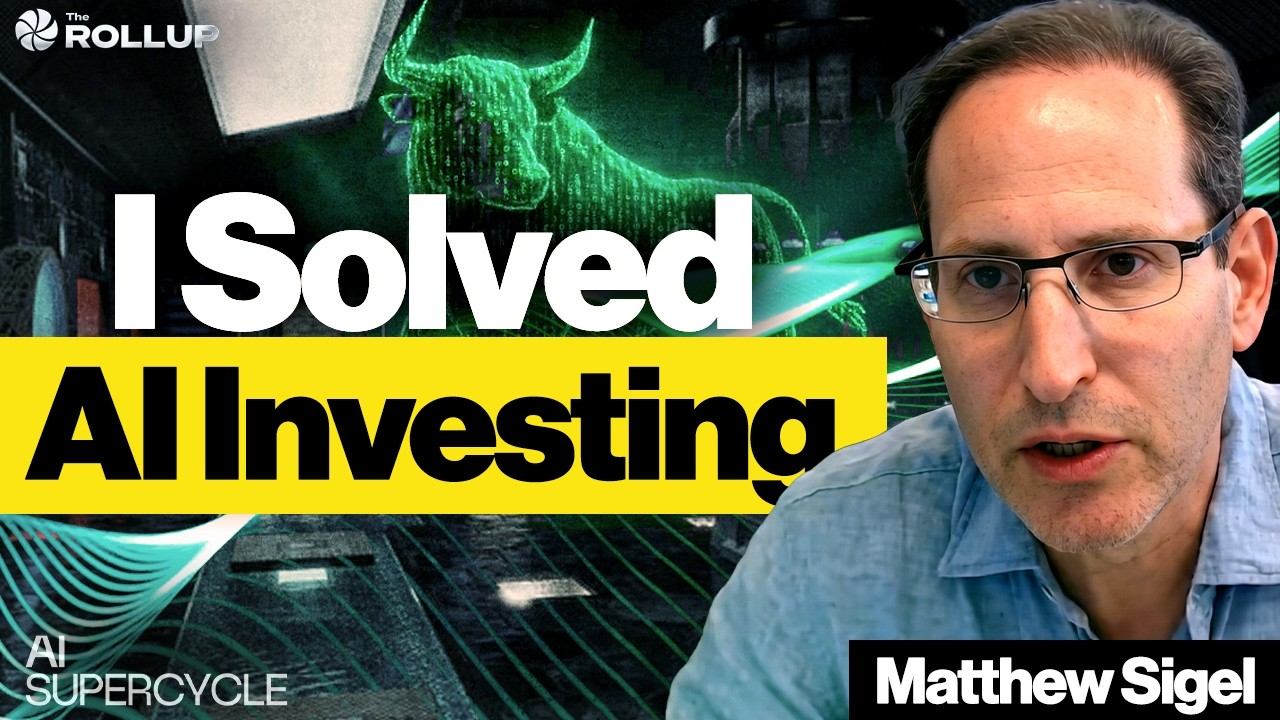
Matthew Sigel, VanEck’s head of digital assets research and portfolio manager of the VanEck Onchain Economy ETF (NODE), said the current AI infrastructure boom should not be treated as the kind of bubble critics fear. Speaking on The Rollup podcast episode titled AI Super Cycle, Sigel said the present cycle differs sharply from the 19th-century U.S. railroad bubble because it is being financed through private-sector long-term contracts rather than government land grants and speculative bond structures.
Sigel also tied the weakness in crypto markets less to broad macro conditions and more to institutional frustration with major layer-1 networks. VanEck, he said, reduced exposure to Solana, Ethereum and other mainstream L1 assets after the election and has shifted more attention toward enterprise-chain opportunities linked to companies such as Circle, Stripe and Robinhood.
Market leadership flipped after June 1
Sigel said the market was highly concentrated during the first five months of the year. The companies spending the most on capital expenditures were also the ones whose shares performed best. That relationship reversed on June 1, he said, and the market began punishing the same high-spending names that had previously led the rally.
Setting aside the recent rebound from the bottom after the Situational Awareness liquidation, he said the broader pattern was clear: high-capex companies were hit hardest. In that environment, Bitcoin and crypto tokens were grouped with software assets, which left them exposed when software as a category came under pressure.
Sigel described Bitcoin as software — specifically open-source software. He said AI tools such as Claude and Codex are already having a real impact on many open-source projects, but unlike Web2 companies, open-source software cannot always push top-down upgrades on users at will. That weaker performance across software, in his view, has weighed on Bitcoin and digital tokens more broadly.
He also pointed to the psychological influence of the four-year halving cycle. Even so, Sigel said he would prefer to see more dispersion in returns and more differentiation across assets, rather than a market driven by one dominant factor. That kind of setup, he said, creates better conditions for finding alpha in individual stocks or tokens instead of relying on a single thematic trade.
As for positioning, he said he still has exposure to the AI infrastructure theme through Bitcoin miners. He remains constructive on a fourth-quarter bottom for Bitcoin and expects a market rebalancing, but said he would rather wait for bullish developments to be confirmed by trading volume than trade aggressively inside a choppy range.
Why NODE leaned into the miner-to-AI transition
Sigel said NODE has been running for 15 months and has outperformed Bitcoin by nearly 100 percentage points over that span. The biggest source of returns, he said, came from identifying early that Bitcoin miners were undervalued as owners of power and land that could be repurposed for AI data centers.
In his assessment, ASIC machines are not the miners’ most valuable assets. Power access and land matter more. He said the market had materially undervalued each megawatt controlled by miners relative to the valuation multiples assigned at the time to the small number of data-center real estate investment trusts.
Sigel described the older mining model as one built on repeated share issuance to buy more ASICs and outrun competitors. Revenue, however, gets cut in half every four years. He called that setup a melting ice cube: capital-intensive, thin-margin and structurally dilutive. Conditions have changed, he said. Not only have hyperscaler economics improved, but financing costs tied to data-center construction leases have also fallen sharply.
That shift has allowed these companies to access debt markets instead of relying solely on equity issuance. Each new lease they sign, he said, tends to come with better economics than the last, and lower interest rates have added another layer of value creation.
He said the market regime change since June has hurt leveraged investors the most. NODE, by contrast, was not using leverage and tried to stay underweight highly leveraged companies. When funds with significant overlap to their holdings — including Situational Awareness — were forced into liquidation by prime brokers, Sigel said they used the dislocation to add exposure. At last Thursday’s open, he said, the fund made its largest single-day trade since launch, moving nearly 10% out of low-volatility, low-beta positions and doubling down on its highest-conviction miner names.
On fundamentals, Sigel said he has not seen deterioration in returns on hyperscaler investment. He pointed to earnings calls from companies including Amazon as evidence that returns have actually come in better than early expectations. Older GPUs that had once been rented out for $2 an hour, he said, are now seeing customers seek renewals at sharply higher prices once contracts roll off.
At the lows, he argued, some of the companies he liked most were being valued only on the basis of their existing leases, with no credit given to terminal data-center value, platform value, or potential new contracts. Even under an assumption that the 10-year Treasury yield rises another 100 basis points, he said the downside work had already been done, leaving a substantial margin of safety.
Miner migration to AI does not create a systemic Bitcoin risk, he says
Sigel said he does not see a systemic risk to the Bitcoin network from miners redirecting resources toward AI. If anything, he argued, lower hash rate would improve economics for miners that remain dedicated to the network.
He specifically mentioned companies including Bit Deer and MARA as firms that still retain valuable optionality. They can continue mining, or they can convert facilities toward AI use. There may come a Bitcoin price at which the market revisits the mining-versus-AI decision, he said, but that is not the same as calling for AI-converted sites to switch back now.
Using CleanSpark as an example, Sigel said his estimate is that Bitcoin would need to rise to $360,000 before it would make economic sense to tear up already-signed AI leases and return to a pure mining model. That flexibility itself, he said, carries significant value.
Why he rejects the railroad-bubble comparison
Sigel said critics often invoke the railroad bubble as a historical warning against AI infrastructure spending, but he believes the analogy breaks down on both scale and financing structure.
On scale, he said the United States spent roughly 3% of GDP on railroads for nearly 20 consecutive years. In AI, by contrast, the period from the emergence of GPT to today spans five years, and only this year has spending reached the 3%-of-GDP level. In his view, current AI equity valuations do not reflect a market pricing in a 20-year buildout. Most analysts, he said, still think the cycle peaks in 2030. That disconnect matters to him.
On financing, Sigel argued the railroad boom was fundamentally government-led. In 1862, Congress passed railroad legislation that granted hundreds of millions of acres of federal land to railroad companies, though title would transfer only after the full network was completed. The U.S. Treasury also issued construction bonds, and those bonds were subordinated to private capital.
He said major railroad companies then sold bonds overseas as if they were safe assets, even though the debt depended on future land sales and the companies did not yet hold actual ownership of the land. That, in his telling, is the structure of a bubble.
AI factories, he said, work differently. Rail infrastructure needed a coast-to-coast network before the full utility of the system could be realized. AI factories can begin training models and handling inference as soon as they are connected to the grid, equipped with fiber and fitted with chips. They do not need to wait for a complete global network to become useful.
Sigel also stressed the backlog distinction. Nobody in 1870 was buying train tickets for service that would begin in 1885, he said, and there was no forward freight market to support those investments. Today, the four largest cloud providers together hold more than $2 trillion in contracted backlog, with Microsoft and Oracle accounting for about half of that total. Many of those contracts include customer prepayments, customer-supplied GPUs, and terms longer than five years.
That means the compute produced by these AI factories is backed by real purchase orders, and financing is being raised against those contracts rather than government subsidy, he said. His conclusion was straightforward: this buildout is more durable because it rests on long-term private-sector agreements and multi-year backlog that can serve as collateral.
VanEck cut major L1 exposure and shifted toward enterprise chains
On crypto allocation, Sigel said VanEck reduced its broader L1 exposure after the election. Many tokens doubled, he said, but real-world adoption did not accelerate with them. Nor did any application emerge that clearly broke into the mainstream or drew in global capital at scale.
What followed instead, in his view, was the rise of enterprise chains. Circle, Stripe and Robinhood are all building or using semi-permissioned chains, he said, allowing public companies to customize user experience and capture part of the economic upside.
Sigel acknowledged that this model may not fit open-source ideals or crypto purist thinking. But for institutions trying to use blockchain networks at scale, he said, predictable fee flows matter more.
When asked specifically about Solana, he first pointed to Ethereum as an example of a network where transaction-fee volatility has been a problem for large institutional participants seeking more stable costs. Solana’s fee volatility has not been as severe, he said, but he also noted that until recently, users in New York could not buy USDC on Solana. On the same morning, he added, Wells Fargo was seen researching its own tokenized-deposit chain.
His conclusion was that banks and other regulated institutions do not want to place core financial assets on open public chains. Even if they participate, they are likely to support three to five different chains at once, which dilutes the winner-take-all profile of any individual L1. That is one reason VanEck remains very underweight these tokens, he said, because market share is leaking away and winner-take-all dynamics are weakening.
CLARITY Act could trigger a relief rally, but he remains cautious
Despite that cautious stance, Sigel said the CLARITY Act remains a meaningful variable for the sector. He added that the odds of passage this year have fallen to their lowest point, but if the bill does pass and establishes a real disclosure regime, some tokens could stage a large relief rally.
Such a framework would let investors see who the true beneficial owners are, how much supply is held by labs and foundations, and whether influential promoters are touting assets without disclosing positions. Sigel said the absence of that disclosure structure is one of the reasons many institutional investors have simply chosen to ignore the sector. He said he would need to see that change before seriously revisiting many L1 assets.
Lower inflation could help L1s, though execution matters
Sigel also commented on proposals from Ethereum, Solana and Near to reduce validator inflation. VanEck conducted research several quarters ago comparing average inflation rates across major L1 networks with user growth and fee revenue, he said, and the conclusion was that inflation is indeed a problem in this segment.
He drew another comparison with software companies. This year, semiconductors have significantly outperformed software, forcing many software firms to rethink the pace of share issuance. In some cases, dilution has already come down noticeably. For Sigel, it makes sense that L1 projects are now exploring lower inflation.
Still, he said the result will depend on the details. There may also be second-order effects for companies that rely heavily on staking income. He mentioned Bitmine as an example, saying the company often promotes its staking yield and that part of the business could be hit hard under a lower-inflation structure.
Overall, he said it is sensible for L1 networks to revisit inflation design six years after their emergence.
Disclosure: Matthew Sigel is VanEck’s head of digital assets research and portfolio manager of NODE. The views discussed in the episode may align with positions held by VanEck-managed funds.