
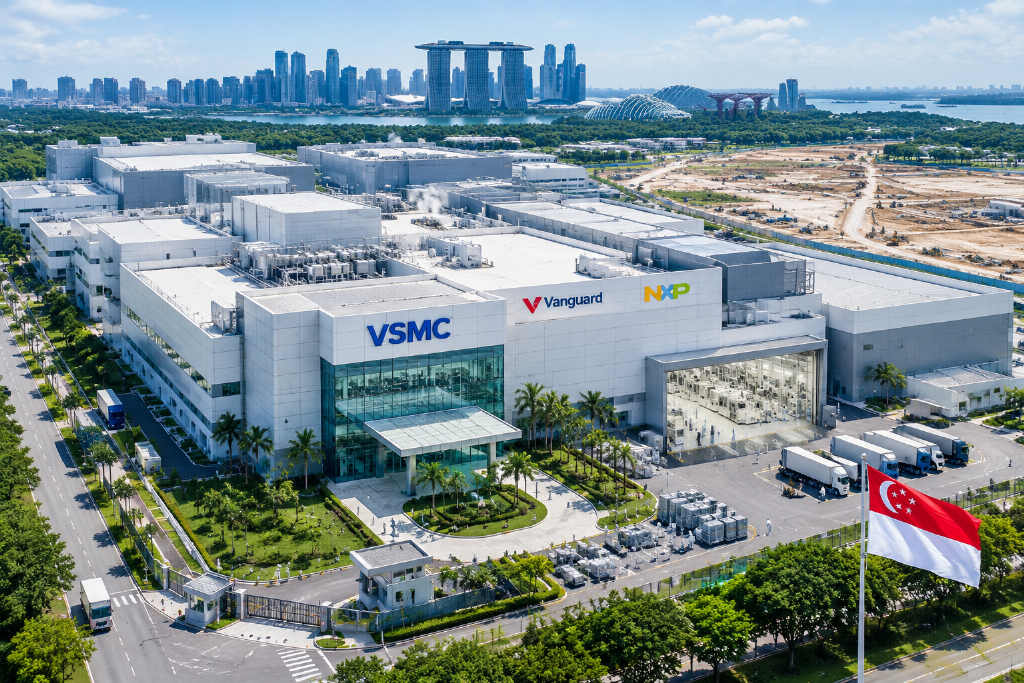
Vanguard International Semiconductor (VIS), a TSMC-backed chipmaker, and Dutch semiconductor company NXP Semiconductors opened the first 12-inch fab of their VSMC joint venture in Tampines, Singapore, on Sept. 28. The plant’s initial capacity has already been booked by customers, and Bloomberg reported that VIS Chairman Fang Leuh is considering a second fab.
The first fab opened, and management is already looking at a second
In an interview with Bloomberg, Fang said, 「We should have built two here from the start.」 He also said the company is considering a second fab that could use a more advanced process than the first one, because capacity at the first plant was spoken for early.
Bloomberg reporter Gao Yuan wrote that demand from AI services and data centers has tightened semiconductor supply globally, even as TSMC keeps expanding output. That demand wave has also pushed Taiwanese manufacturers to build more capacity overseas. Fang told Bloomberg, 「The supply shortage will continue for some time.」
First plant will run 130 nm to 40 nm processes
According to VSMC’s opening-day press release, the fab will support process technologies ranging from 130 nm to 40 nm. It will produce mixed-signal, power management, analog chips and silicon interposers. Sample wafer yields have exceeded 99%. The company expects mass production to begin in the first quarter of 2027. At full utilization in 2029, monthly capacity is projected at about 44,000 12-inch wafers, and the site is expected to create around 1,600 jobs.
The report noted that 40 nm to 130 nm are mature and specialty nodes used for products such as power management and analog chips, rather than AI compute chips themselves. Even so, those components remain necessary for server power delivery and voltage regulation, as well as for automotive and industrial applications.
Cost, technology and timing for a second fab remain undecided
Bloomberg said the first fab is estimated to cost $7.8 billion. Fang declined to estimate the cost of a second plant. He said, 「It is too early to talk about budget now, because we have not decided which technologies to use. Different technologies will have a major impact on the total investment size.」
After the ceremony, Fang told Taiwanese media that all first-phase capacity at the first fab had already been reserved by customers, and that some additional silicon interposer demand had also been agreed. Any new demand will have to wait for the next stage of capacity. More than 10 customers are already in talks over additional output, and the company is gathering customer, financial and technical requirements as it evaluates whether to bring forward the second fab. He did not provide a timetable, saying only, 「We will move after careful planning, and once we move, we will move fast.」
A second fab was already part of the original plan. When VIS announced the joint venture two years ago, the filing said a second phase would be considered after successful ramp-up of phase one, provided both shareholders committed capital. What has changed now is that customer demand may pull that schedule forward.
At the event, TSMC Vice President of Facility Management Chuang Tzu-shou said the land next to the first fab is sufficient for another 12-inch plant. Asked whether the second fab could move to 28 nm, Fang said the company is still 「looking, listening and thinking,」 with both in-house development and technology licensing under consideration. He said licensing would be faster and more economical.
Monthly capacity was revised down by 11,000 wafers
Under the joint venture announcement made two years ago, VSMC had originally planned to reach monthly output of 55,000 wafers in 2029, with total investment of about $7.8 billion. VIS holds 60% of the venture and NXP holds 40%.
The new opening-day release now lists capacity at about 44,000 wafers, a reduction of 11,000 wafers from the earlier plan. Fang said the change came after the company decided to add silicon interposer production. That process requires more manufacturing steps and more equipment, while cleanroom space is limited, so wafer volume had to be revised lower. He said the change was not driven by weaker demand.
The report added that silicon interposers serve as the base layer in advanced packaging technologies such as CoWoS, linking GPUs and memory. In effect, VSMC allocated part of its cleanroom space to components used in advanced packaging, trading wafer count for a different product mix.
Fang called AI demand irreversible, while NXP stressed geographic resilience
On the question of what happens if the AI boom slows and new fabs face weaker demand, Fang said AI is 「unstoppable and irreversible,」 adding, 「Even if it slows, that does not mean capacity will sit idle.」 He also said views differ on when any slowdown might happen: 「Some say the end of 2027, some say 2028, some say 2030.」 In his view, capital, talent, electricity and semiconductor resources are flowing heavily into AI, which is crowding out other applications.
NXP CEO Rafael Sotomayor said in his opening remarks that the joint venture strengthens NXP’s geographic resilience, supply control and cost competitiveness, and represents the company’s largest investment since its 2015 acquisition of Freescale. He also said AI is moving from the cloud into cars, robots, factories and infrastructure, and that VSMC will serve as a manufacturing base supporting that form of 「physical AI.」