
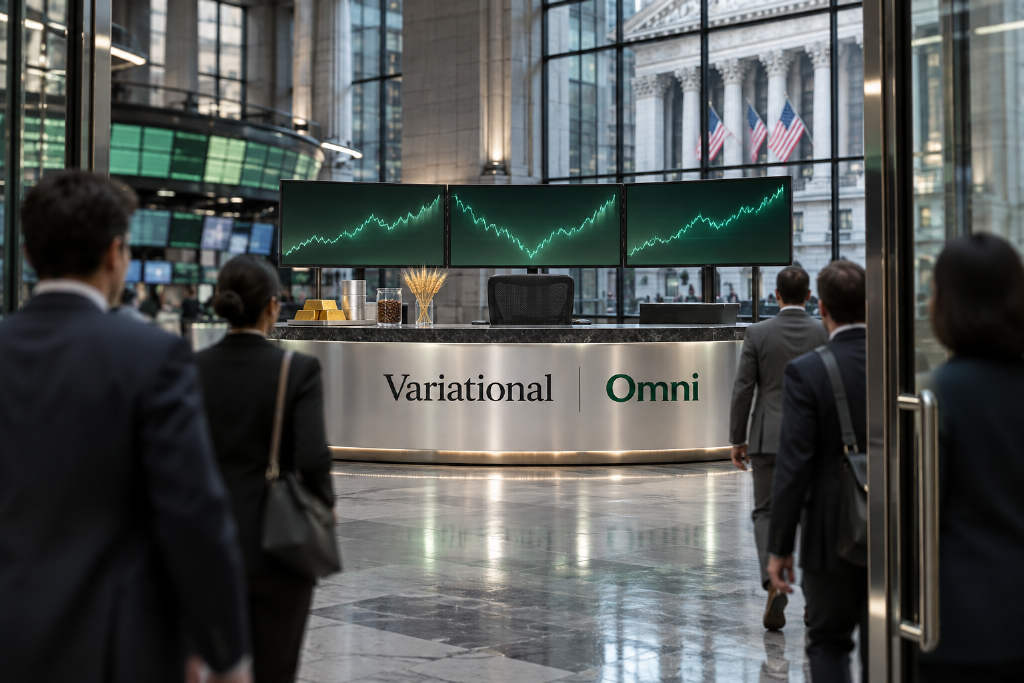
Variational’s Omni trading application has ended its closed beta and no longer requires an invitation code to register. Its 30-day trading volume stood at approximately $66.4 billion as of Thursday morning, roughly double the level recorded about two months earlier, according to DefiLlama.
Traditional finance markets now account for more than 60% of Omni’s total trading volume, Variational said. The public opening also puts the platform’s single-market-maker structure under a larger test, Bankless reported. Supporters see it as a way to build an on-chain brokerage; critics question whether a venue with one counterparty quoting every trade qualifies as a decentralized exchange (DEX).
When Bankless last covered Variational in September, Omni was available only to invited users but was already climbing DefiLlama’s perpetual futures rankings. With that access barrier removed, the question is whether the model can continue to compete on liquidity and price.
Omni executes trades through a request-for-quote (RFQ) system rather than a public order book. Users request a price and a market maker responds. The counterparty is always the Omni Liquidity Provider (OLP), a pool initially funded by the Variational team that quotes every trade and hedges the resulting exposure on other venues.
Volume doubles as traditional markets take a larger share
Omni charges no trading fees. Instead, users pay the bid-ask spread, and the protocol currently takes 20% of the spread revenue earned by OLP.
On September 10, Bankless had recorded more than $34 billion in 30-day volume for Variational. By Thursday morning, DefiLlama put the figure at approximately $66.4 billion, with about $2.2 billion traded over the preceding 24 hours. On the 24-hour figures cited in the report, that placed Variational third among perpetual trading platforms, behind Hyperliquid at roughly $9.84 billion and Lighter at about $2.69 billion.
Most activity is no longer in crypto assets. Omni’s Swaps markets offer market-maker quotes on traditional assets including gold, crude oil and stock indexes. When Bankless previously reviewed the product, it had handled $2.8 billion in its first week. On November 10, Variational said cumulative Swaps volume had passed $80 billion and that traditional finance markets represented more than 60% of Omni’s total volume.
The team has also laid out more of its VAR token plan. In a September 23 tokenomics article, Variational allocated 32% of the total supply to a genesis airdrop for points holders, postponed the token generation event (TGE) to the fourth quarter of 2026 and said it planned to use 100% of treasury revenue to buy back and burn VAR. Bankless said its earlier speculation that the points program might continue beyond the third-quarter deadline had proved correct.
A brokerage model and the cost of trading
Chief Executive Lucas Schuermann told Bankless in September that Omni was 「a brokerage-like model, rather than an exchange」. The team compares it with Robinhood and Interactive Brokers rather than Hyperliquid.
Traditional finance market makers generally want to know their counterparty before quoting, the report explained. An anonymous order book cannot provide that certainty, while a single market maker operating under signed agreements can. OLP sits between professional market makers on one side and ordinary users on the other.
Variational’s public data API showed approximately $595 million in Nasdaq 100 swaps volume during the 24 hours to Thursday morning, compared with about $458 million for Bitcoin. Three of Omni’s five most active markets tracked US stock indexes or individual equities.
Alea Research estimated that Variational’s third-quarter spread costs amounted to 2.35 basis points (bps) of trading volume, compared with an average perpetual trading fee of 2.40 bps on Hyperliquid. Bankless noted that the estimate relied partly on data disclosed by the team, but said it suggested that 「zero fees」 had not concealed worse execution.
Leveraged positions also carry periodic funding costs. Variational said that during the Nasdaq sell-off in early November, annualized perpetual funding rates briefly exceeded 80%, while funding in its Swaps markets remained around 5%. Bankless said a persistent gap of that size would benefit traders holding equity exposure beyond an intraday trading window.
Critics challenge single quotes and examine OLP risk
On October 31, X user 0xLoris argued that Omni 「does not even qualify as a real perpetual DEX」 because one counterparty quotes every asset. Traditional finance RFQ systems typically have several market makers competing for the same quote, he said, rather than just one.
Variational co-founder Edward Yu responded that posting collateral transparently on-chain was the most transparent way to conduct a trading business. He also said Omni had to win users in a free market where many perpetual trading venues were available.
User deposits are not held by the market maker. Each user receives a separate settlement pool: an isolated on-chain contract holding only that person’s collateral. OLP uses its own funds to hedge on other platforms.
When Binance experienced a security incident on October 29, Yu said less than 25% of OLP’s funds were held on the exchange. Any losses would be borne by liquidity providers (LPs), not ordinary users, he said.
The documentation also identifies tail risk. If OLP becomes insolvent, its documentation says any profits users accumulate from that point will be treated as 「bad debt」 and cannot be paid. Outsiders cannot currently audit OLP’s hedging book.
Bankless argued that the sharper criticism concerned pricing rather than solvency. X user Rencrypta described the risk of a single market maker as 「a single quote with no competition」. In an order book, participants can constrain market makers by improving prices; on Omni, the constraint comes from users’ ability to leave, the report said.
Bankless said that constraint works as long as spreads remain competitive and that they had done so to date. The arrangement still involves a trust model unlike the one most decentralized finance (DeFi) users are accustomed to, it added.
Variational Pro, VAR and the trading API
Yu has said single- and multi-market-maker platforms 「each have their uses」 and that Variational wants to serve both segments. Bankless said a multi-market-maker version was most likely to appear on Variational Pro, an institutional platform that has not yet launched.
In its September 23 tokenomics article, Variational said the final weeks before the TGE would bring a public mainnet, more swap markets, a trading application programming interface (API), and details of VAR buybacks and token utility. The public mainnet is now live.
On November 4, Schuermann said the team still planned to complete the TGE within the year. A small group of early testers already had access to the API, which was expected to launch publicly this month.
Polymarket traders put the probability of a VAR launch by year-end at approximately 71% at the time of the report. The 「major strategic partner」 mentioned by the team when it postponed the timeline had still not been named.
Points, buyback revenue and regional restrictions
- Points: The weekly airdrop is fixed at 150,000 points and was recently shared among approximately 32,000 accounts. Bankless noted that removing the invitation requirement would put more accounts in line for the same fixed allocation.
- Buybacks: In the preceding two weeks disclosed by the team, the treasury’s 20% share of spread revenue came to approximately $1.05 million. Bankless said that if all of it were used to buy back and burn VAR, support for the token’s value would ultimately depend on OLP’s spread income.
- Access and competition: Residents of the United States and Canada still cannot use Omni. Bankless said US regulators were working to clarify the domestic regulatory treatment of equity perpetuals. The report argued that such clarity could validate the market while also handing market share to compliant US-based platforms.
Bankless framed the public phase as a test of whether a single market maker can serve users at scale through a market sell-off or venue failure without deterioration in quote quality. The report also said it would watch whether the team delivers the API and publishes VAR details on schedule in the coming weeks.



