
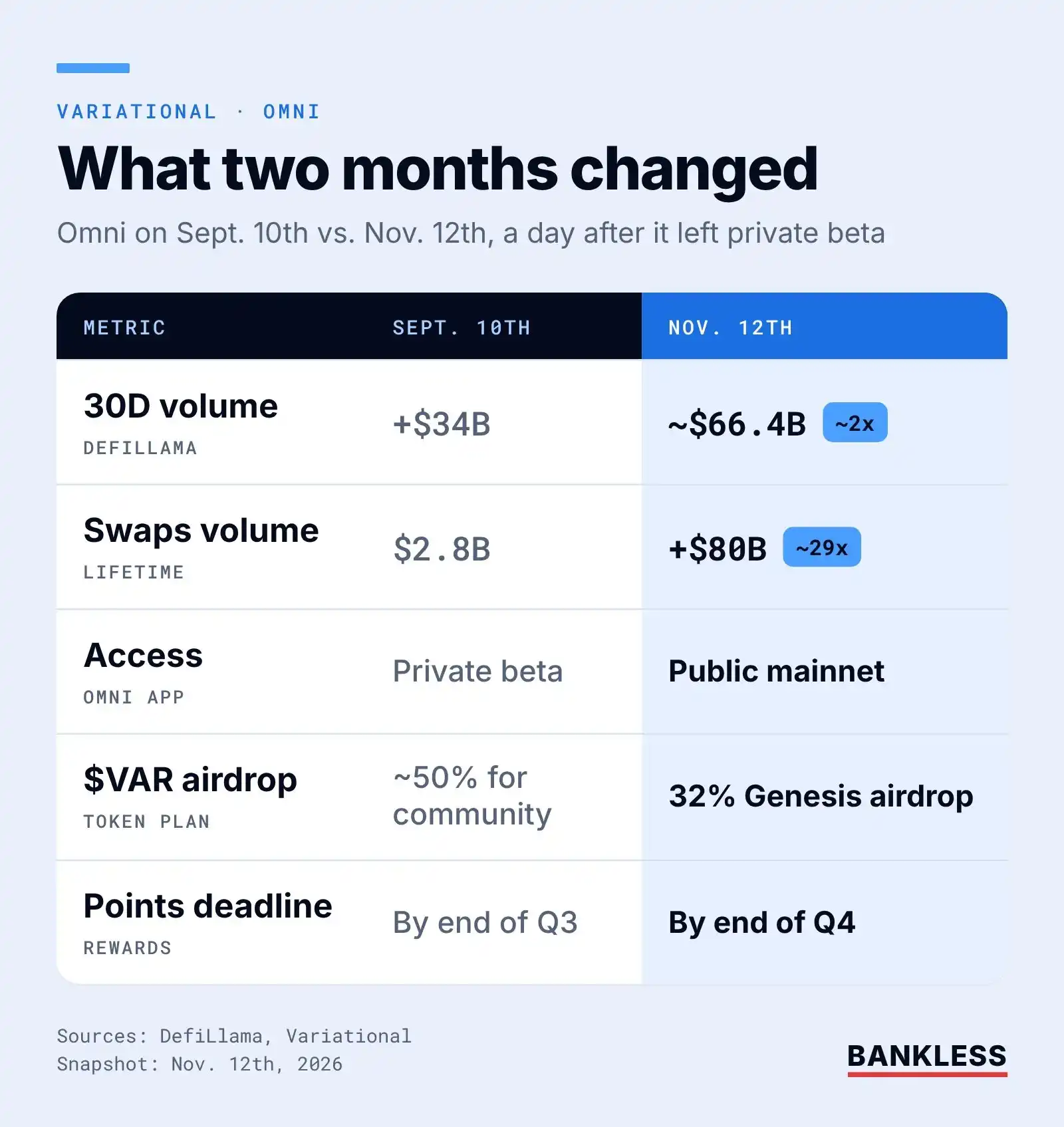
Variational has opened its flagship perpetuals application Omni to the public after ending its private test. New accounts no longer need an invitation. The platform’s 30-day trading volume has doubled over the past two months to about $66.4 billion, while traditional-finance swaps covering gold, oil and stock indexes account for more than 60% of total Omni volume.
Omni does not use a public order book. It runs through a request-for-quote, or RFQ, system in which a single counterparty responds to each request. That counterparty is the Omni Liquidity Provider, or OLP. Variational describes the product as an onchain brokerage rather than a conventional exchange. With access now open, the model is moving from a restricted test into a broader examination of its liquidity and pricing.
Volume doubles as traditional markets take the lead
Omni had previously been limited to invited users. On Sept. 10, Variational’s 30-day volume had passed $34 billion. By Thursday morning, DefiLlama showed the figure at about $66.4 billion, with approximately $2.2 billion traded during the preceding 24 hours. Variational ranked third among perpetuals platforms, behind Hyperliquid at about $9.84 billion and Lighter at about $2.69 billion.
Crypto assets no longer make up most of the activity. Omni’s Swaps market offers maker-provided quotes for traditional-finance products, including gold, oil and stock indexes. The market processed $2.8 billion during its first week when it was previously reviewed. On Nov. 10, Variational said cumulative Swaps volume had exceeded $80 billion, and that traditional-finance markets represented more than 60% of Omni’s total volume.
The OLP quotes trades while users pay the spread
Omni’s RFQ process does not involve an open order book. A user requests a quote, and the OLP responds. Variational funded the pool at launch. It quotes each trade and hedges the resulting exposure on other trading venues.
There is no trading fee. Users instead pay the bid-ask spread, and the protocol currently takes 20% of the spread revenue earned by the OLP.
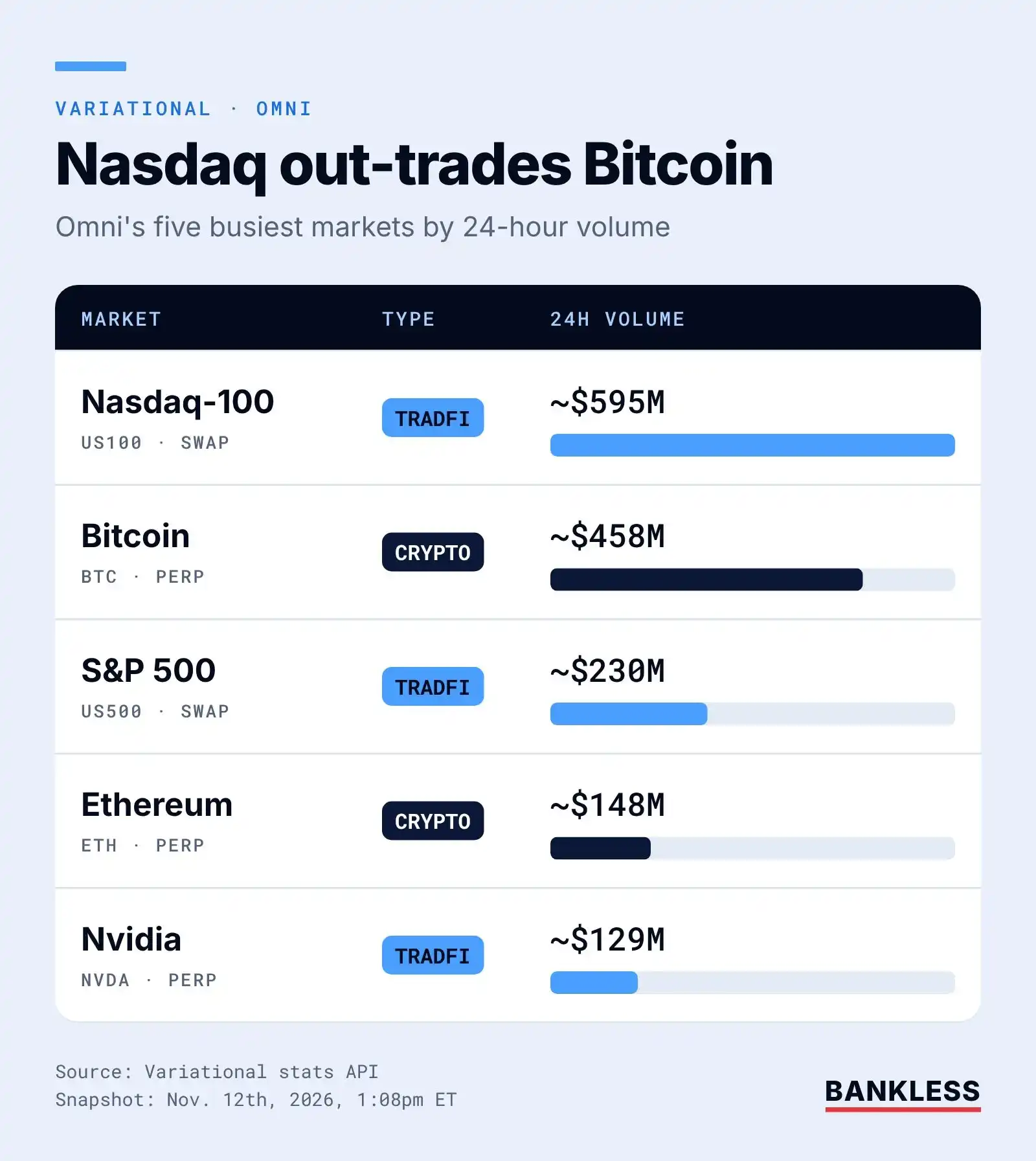
Data from Variational’s public API showed that, during the 24 hours ending Thursday morning, Nasdaq 100 swaps generated about $595 million in volume, compared with about $458 million for Bitcoin. Three of Omni’s five most active markets track U.S. stock indexes or equities.
Execution cost has also been part of the comparison. Alea Research estimated Variational’s third-quarter spread cost at 2.35 basis points of volume, while Hyperliquid’s average perpetuals fee was 2.40 basis points. The estimate partly relied on figures disclosed by Variational, but it suggested that the absence of a trading fee was not paired with materially worse execution conditions.
Funding rates add another cost for leveraged positions. Variational said its perpetuals funding rate briefly rose above an annualized 80% during the Nasdaq sell-off in early November. Funding on its Swaps markets remained around 5% during that period.
A brokerage design draws criticism
Chief Executive Officer Lucas Schuermann told Bankless in September that Omni was a brokerage-style product rather than an exchange. Variational therefore compares the platform with Robinhood and Interactive Brokers, not Hyperliquid.
The design reflects a preference among traditional-finance market makers to know the identity or profile of a counterparty before quoting. An anonymous order book does not provide that certainty, while a contracted single market maker can. The OLP sits between professional liquidity providers and retail users.
On Oct. 31, X user 0xLoris started a discussion arguing that Omni was not even a true perpetuals decentralized exchange because one counterparty quotes every asset. He also said that traditional-finance RFQ systems normally let several market makers compete for the same request rather than assigning it to one provider.
Variational co-founder Edward Yu responded that posting collateral transparently onchain was the most open approach for the trading business. He said Omni had to win users in a free market with many available perpetuals venues.
User deposits are not held by the market maker. Each user receives a dedicated settlement pool, an isolated onchain contract containing that user’s collateral. The OLP uses its own funds to hedge on other venues. Yu said that, when Binance experienced a security incident on Oct. 29, less than 25% of the OLP’s funds were held there. Any loss, he said, would be borne by liquidity providers rather than ordinary users.
The OLP documentation also describes a tail risk. If the OLP becomes insolvent, any profits accumulated by users after that point would be treated as bad debt and could not be paid. External parties currently cannot audit the OLP’s hedge book.
For critics, pricing is a sharper concern than solvency. X user Rencrypta said the risk of a single market maker was that one quote faced no competition. An order book constrains market makers by allowing other participants to improve the price. On Omni, the constraint is the user’s ability to leave.
That pressure can work as long as spreads remain competitive. Yu has also said that single-maker and multi-maker platforms serve different purposes, and that Variational wants to address both segments. The multi-maker version is most likely to arrive through Variational Pro, an institutional platform that has not yet launched.
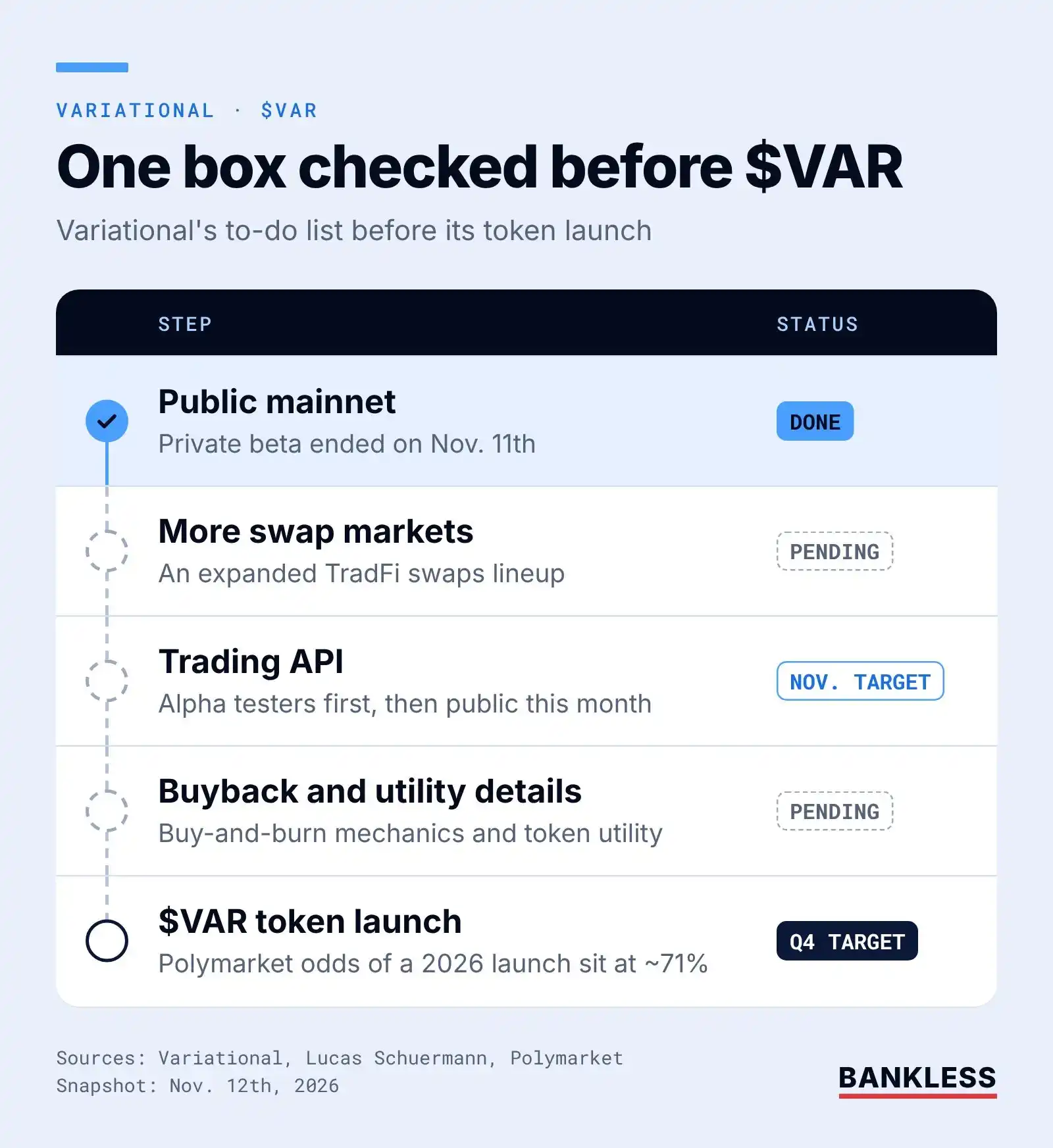
The remaining pieces before the $VAR launch
Variational’s public launch is also part of its token timeline. In a Sept. 23 tokenomics post, the team allocated 32% of the total supply to a genesis airdrop for points holders, moved the token-generation event, or TGE, to the fourth quarter of 2026, and said 100% of treasury revenue would be used to buy back and burn $VAR. A points program that might have ended after a third-quarter deadline was extended.
The tokenomics post said that the final weeks before the TGE would bring a public mainnet, more Swaps markets, a trading API, and detailed information about $VAR buybacks and token utility. The public mainnet is now live.
Schuermann said on Nov. 4 that the team still planned to complete the TGE this year. The API had already been opened to a small group of early testers and was expected to become publicly available this month. Polymarket traders currently assign about a 71% probability to a token launch before the end of the year. The major strategic partner mentioned when the timeline was postponed has not been named.
- Points are harder to earn. The weekly airdrop remains fixed at 150,000 points and has recently been divided among about 32,000 accounts. Removing the invitation requirement brings more accounts into the same allocation.
- The buyback plan has a disclosed revenue base. During the two weeks covered by the team’s disclosure, the treasury’s 20% share amounted to about $1.05 million. If all of that money were used to buy and burn $VAR, the token’s support would depend on OLP spread revenue.
- Domestic competition has not arrived yet. Residents of the United States and Canada still cannot use Omni. U.S. regulators are working through the regulatory classification of domestic equity perpetuals, a process that could affect the sector’s legal status and leave market share to compliant U.S. platforms.
The public phase will test resilience
The private test was intended to show that traditional-finance markets could operate on crypto rails. The public phase asks a different question: can a single market maker continue to serve substantial volume during a market sell-off or an exchange failure without a deterioration in quote quality?
The article was written by William M. Peaster for Bankless and compiled by TechFlow.



