
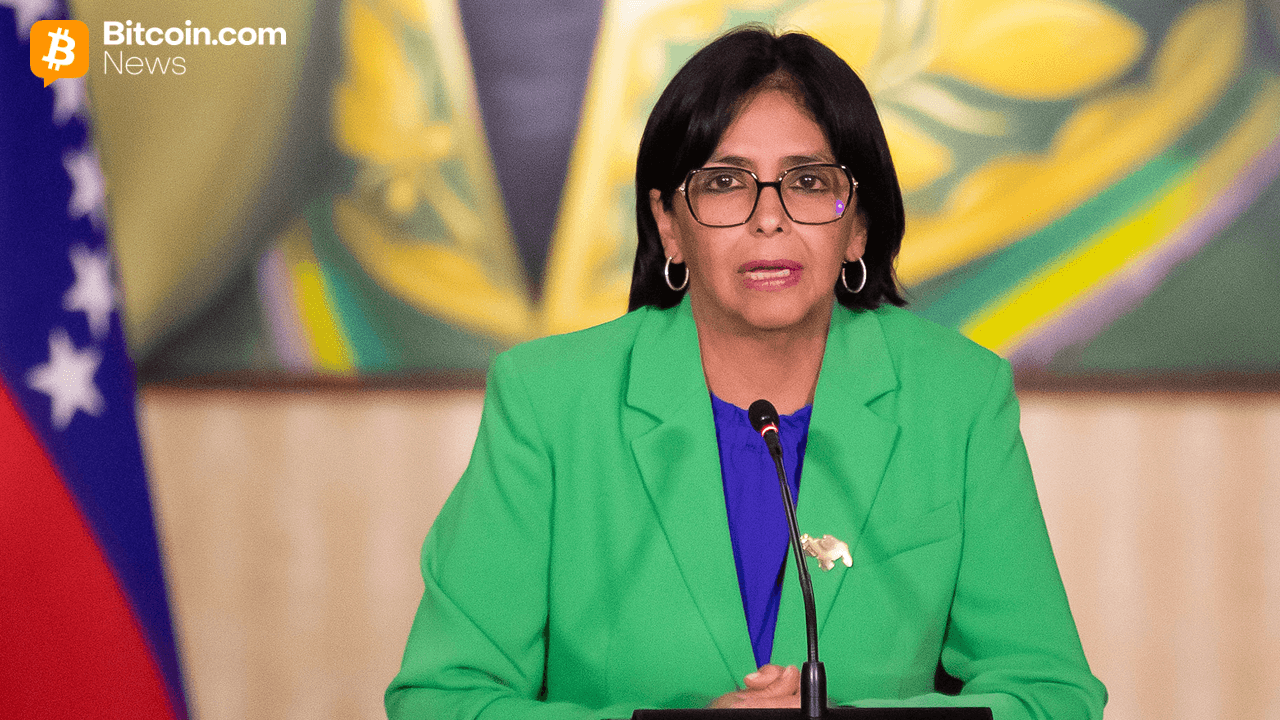
Since the U.S. removed Venezuelan President Nicolás Maduro, prediction markets tracking the Latin American nation's political future have drawn large capital flows. Two specific contracts focused on who will govern the country by the end of 2026 have recorded close to $2 million in trading volume. The implied probabilities on both Polymarket and Kalshi now center on acting President Delcy Rodríguez, though certainty remains elusive.
Polymarket: Rodríguez at 44%, Opposition Trio Below 60% Combined
On Polymarket, Rodríguez holds a 44% implied probability, well ahead of the field. Edmundo González Urrutia follows at 21%, and María Corina Machado at 18%. Captured leader Maduro and a “No Head of State” outcome are each priced near 4%. Several long-shot candidates cluster in the low single digits.
Rodríguez is a longtime Venezuelan politician who served under Hugo Chávez and Maduro as foreign minister and vice president. González Urrutia is a veteran diplomat and academic who emerged as the opposition's unity candidate in the disputed 2024 presidential election. Machado is a prominent opposition figure and former legislator known for her liberal economic views and vocal criticism of chavismo; she won the opposition primary but was barred from the 2024 vote.
Kalshi: Slightly Higher Weight to Secondary Figures
Kalshi's pricing tells a similar story with subtle differences. Rodríguez leads at 45%, followed by González Urrutia at 24% and Machado at 20%. Unlike Polymarket, Kalshi assigns more weight to secondary figures: Diosdado Cabello Rondón at 5% and Maduro at 6%. Names such as Dinorah Figuera, Vladimir Padrino López, and Jorge Rodríguez sit between 3% and 5% on Kalshi while hovering around 1%-2% on Polymarket. U.S. political figures including Donald Trump and Marco Rubio also appear on both platforms with marginal odds, underscoring the breadth of outcomes traders are technically pricing but largely discounting.
Despite minor differences, both markets signal the same core takeaway: conviction is building around Rodríguez, but certainty remains distant. The tight clustering behind the leader suggests traders are still grappling with unresolved questions about Venezuela's political transition, institutional control, and the durability of post-Maduro power structures.
With nearly all probability mass concentrated among three Venezuelan figures, prediction markets continue to function less as a crystal ball and more as a live barometer of uncertainty—one highly sensitive to new political signals as 2026 approaches.