
Cases involving Venice, Aave and other crypto projects are pushing a long-running question back into view: what, exactly, does a token holder own?
Written by Prathik Desai
Translated by Saoirse, Foresight News
In corporate finance, a shareholder holds a residual claim. After a company pays employees, bondholders and lenders, general creditors, taxes and preferred shareholders, whatever remains belongs to common equity holders. That position also comes with specific rights: voting on who runs the company, receiving dividends if they are declared, and sharing in the remaining value if the business is sold or liquidated.
Crypto protocols have spent years presenting token ownership in language that sounds close to that model. Hold the token, take part in governance, and share in the network’s future upside. The article argues that this has always been a one-sided arrangement rather than a binding one. For a long time, the tension stayed muted because there was no sharp conflict of interest. That is changing now.
During a period of regulatory ambiguity, protocols could lean on that narrative without being forced to settle the underlying legal question. The proposed CLARITY Act may narrow that room. Once a project has both equity holders and public token holders, the difference between the two becomes much harder to ignore.
What ownership means in law, not just in marketing
The article says stock has endured as a financial instrument not only because of return potential. Its real strength lies in a rights structure backed by enforceable contracts and law.
If a company generates profits, the board can declare dividends and shareholders are legally entitled to receive them. If directors refuse to distribute value, shareholders can vote to replace them. If a majority wants to sell the business, there is a legal path to pursue that outcome. Corporate structures have evolved over the past century, but the basic economic claim attached to equity has remained intact.
The piece points to several examples from public markets. When Google went public in 2004, it adopted a dual-class structure that gave Larry Page, Sergey Brin and then-CEO Eric Schmidt voting power 10 times that of public shareholders. Even so, ordinary investors had the same economic rights as founders and insiders. Snap Inc. issued non-voting stock in 2017. Berkshire Hathaway has operated a dual-class structure since 1996. Those cases changed control mechanics, but not the core foundation of equity: a legally enforceable claim on residual enterprise value.
Token holders, by contrast, do not have that protection. They are not entitled to dividends. If the company behind a protocol is acquired, they generally have no right to share in the sale proceeds. The article frames this as the gap between truly owning an asset and being told that you do. Legal systems built around ownership assume enforceable rights. Token holders, in many cases, do not have them.
A common way projects support token prices is by using a share of revenue to buy tokens in the secondary market and burn them. The article calls out the weakest part of that design: the arrangement is usually not contractually binding. A protocol can alter, pause or end a buyback-and-burn policy without going through a corporate board process, and token holders who lose out may have no legal basis to challenge the decision.
Why the issue is surfacing now
In crypto’s earlier years, the conflict was less visible. There were no equity investors serving as a direct comparison point. Teams, communities and core contributors often held the same native token, so incentives appeared aligned.
That balance starts to break once a protocol becomes a real business with revenue, products and user scale. Expansion eventually requires large outside financing, and the most mature route for raising that capital still comes from traditional capital markets.
On July 1, Venice AI closed a $65 million Series A led by Dragonfly and Coinbase Ventures at a $1 billion valuation. Investors received 8.98% equity plus token incentives. In the article’s telling, that financing structure did more than raise money. It changed the ownership map and exposed a structural flaw the crypto industry had avoided confronting for years.
Before the round, Venice had only one class of economic participant. After it, there were two. Equity investors now hold formal contracts, board seats, information rights and anti-dilution protection, along with a legal claim tied to 8.98% of the company’s assets and upside. Holders of the native VVV token, meanwhile, are left relying on a burn program the company can change or stop.
The financing also gave Venice equity a market valuation. If the company grows from here, equity holders can participate through legal agreements. Token holders do not automatically share in that appreciation. Whether they benefit depends on whether Venice management continues to direct resources into buybacks and burns. In other words, management controls how future revenue is allocated across those two groups.
Venice is not alone
The article places Aave and Hyperliquid in the same broader discussion. Aave directs 100% of protocol revenue to AAVE buybacks. Hyperliquid has built one of the largest buyback systems in crypto, committing more than $1.2 billion in protocol revenue to HYPE repurchases and allocating 97% of fees, for an annualized buyback rate of roughly 5% to 6% of market capitalization.
Neither project has yet followed Venice into the same type of equity financing, but the underlying problem is presented as the same. Buyback policy remains discretionary. There is no rule, the article says, that stops a Hyperliquid team from redirecting support funds elsewhere in the future.
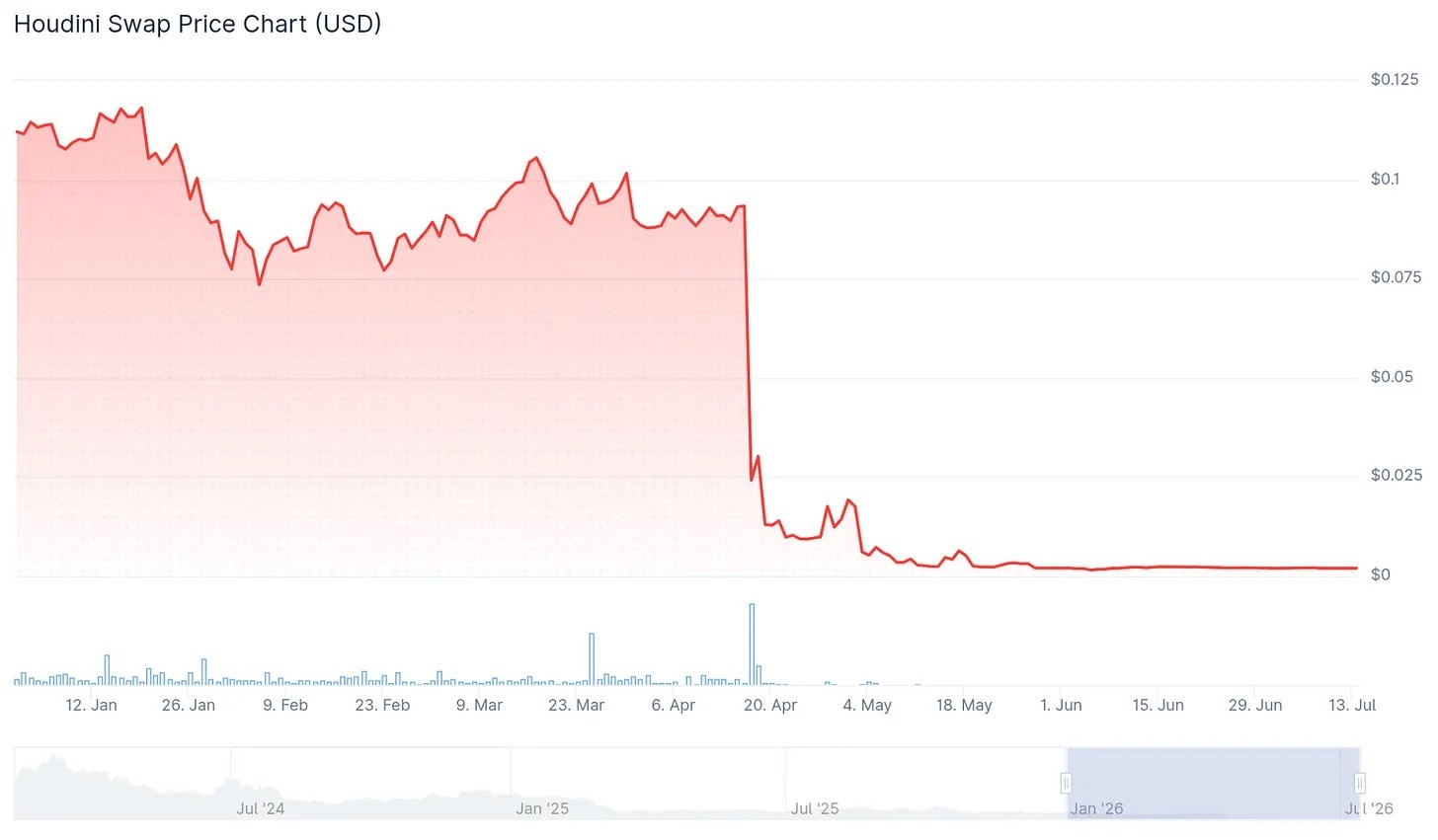
A recent acquisition is used to show how this can end. In May 2026, Sol Strategies acquired Houdini Swap for $18 million. The payment went entirely to founders and equity holders. Holders of Houdini Swap’s native LOCK token received nothing, and the token price fell to zero.
The point, according to the article, is that mechanisms advertised as protection for token holders remain under protocol control. The upside token holders expect depends on whether management sticks with the policy. In an acquisition, a buyer has no legal obligation to compensate token holders.
The CLARITY Act and the legal boundary
The article argues that the proposed CLARITY Act could make this divide even starker. The bill passed the U.S. House of Representatives in July 2025 and, as of July 2026, remains stalled in the Senate.
Its framework would divide crypto assets into two categories:
- digital commodities, regulated by the Commodity Futures Trading Commission;
- investment contract assets, treated as securities under the Securities and Exchange Commission.
Most protocols want their tokens classified as digital commodities because that would preserve public trading liquidity. If a token is treated as a security, liquidity would likely shrink and compliance costs would rise sharply.
The article says the real conflict lies in the conditions attached to that distinction. Under the bill, a digital commodity token may include governance rights and staking rewards, and its value may rise with protocol usage. But the issuer cannot give token holders a legal claim on company revenue, profits, assets or liabilities. Put plainly, a token may capture value generated by network use, but not the enterprise appreciation of the company operating that network.
That is where buybacks and burns enter a difficult gray area. A protocol can still design token economics tied to activity and demand, but not one openly based on corporate operating income in the way equity works. The SEC has not yet provided a definitive position on buyback-and-burn structures, and regulators are under no obligation to interpret them in ways that favor token holders.
In the article’s view, projects have benefited from legal uncertainty by suggesting that tokens are close to informal equity without saying so outright. If the CLARITY Act becomes law, that balancing act gets much harder. A project would no longer be able to present a token as a commodity while also implying that holders own part of the company behind it.
Aavenomics 3.0 tests the limit of on-chain commitments
Some protocols are already trying to redesign their token systems near that legal line. On June 27, Aave launched Aavenomics 3.0, replacing a committee-managed buyback model with an automated on-chain mechanism. All revenue from the protocol and from GHO, Aave’s overcollateralized decentralized stablecoin, is directed to buying AAVE on the secondary market.
Aave founder Stani Kulechov described the mechanism as automated and unchangeable. The article presents that as perhaps the furthest a DeFi project can go in making a constraint-based promise to its community.
But it also says the limitation is obvious. Aavenomics 3.0 is still code, not a legal contract. Aave governance can vote to shut the mechanism down. If that happened, token holders would not be able to sue on the basis of a breached equity-like claim. At most, the system remains a policy that most holders choose to trust.
That matters because projects trying to avoid securities registration while still creating token value-capture mechanisms may all run into the same barrier if the CLARITY Act takes effect.
Aave could soon face the Venice problem
The article notes that Aave may not be far from confronting the same dual-ownership structure that Venice now has. Reports emerged in late June that Payward, Kraken’s parent company, was in talks to acquire a 15% stake in Aave Group at a $385 million valuation. Stani Kulechov challenged the reported price, but did not deny that discussions were taking place.
If that deal is completed, Aave would become another major protocol layering formal equity on top of a circulating token. The difference in rights between equity investors and token holders would then move from theory into the capital structure itself.
Utility tokens do not close the gap
A common defense in the industry is that tokens have real utility and should not be compared too directly with equity. The article uses Venice’s DIEM token as an example. DIEM can be redeemed for $1 of AI compute per day, making it an application token. Exchange fee tokens are often presented in a similar way.
The article argues that utility comes with a built-in limit. Value tied to use cases is hard to compound over long periods. It compares the logic to casino chips: useful inside the venue, redeemable for cash at the end, but not a durable store of value once separated from the setting that gives them purpose. In the same view, DIEM’s claim on a fixed amount of compute may support demand in the short run, but does not naturally create long-term compounding appreciation.
For that reason, the article says that once a token is sold on the promise that protocol profits will lift its value, it starts to look less like a utility token and more like synthetic equity, which would make it harder to avoid the CLARITY Act’s securities analysis.
Two paths, not three
The article ends by reducing the industry’s choices to two. One option is to accept that a token is a digital commodity and stop suggesting that it shares in company operating income. The other is to give token holders genuine economic rights and register the token as a security, taking on the compliance burden that follows.
For the past decade, the idea that a token itself was an asset could hold because few participants pushed hard on the legal details. Once outside equity investors arrive with formal term sheets and enforceable agreements, that older story becomes harder to maintain.
On that reading, Aave’s automated buyback structure may be the best reassurance token holders can get under current conditions. Even then, its protection lasts only until governance decides to change the rules. The distance between that outcome and the sector’s largest protocols, the article suggests, may be nothing more than the next investment term sheet.