

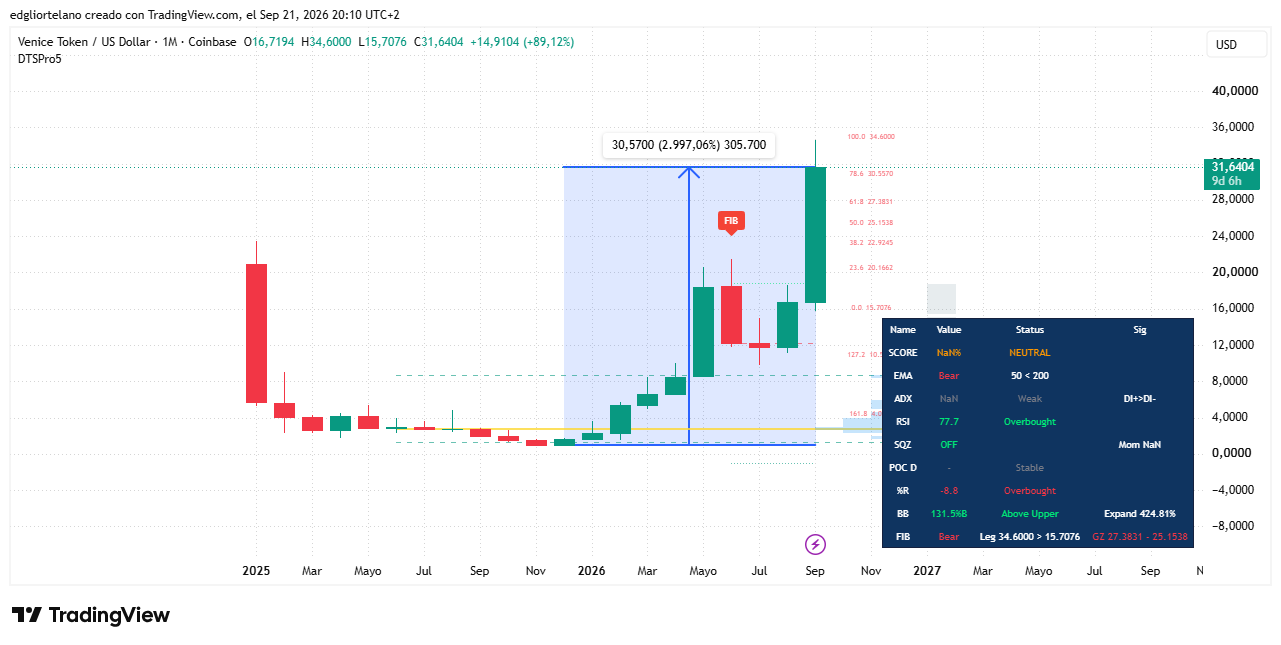
Venice AI’s native token VVV climbed to a fresh all-time high of $34.51 on Sunday, extending a run that has made it one of the standout movers in the AI crypto segment. The token was up about 17% over the past 24 hours, according to the report, and has gained roughly 3,000% since bottoming at $0.92 last December. Its market capitalization is now near $1.6 billion, placing it third among AI-focused cryptocurrencies behind Near and Tao.
VVV is the native token of Venice AI, a chatbot and image-generation platform built by Erik Voorhees, the early Bitcoin entrepreneur and founder of ShapeShift. The token is not positioned as a payments coin. In the Venice system, it functions more like an access key tied to use of the platform.
How staking VVV is used in place of a standard subscription
Instead of charging users per prompt in the way ChatGPT does, Venice allows users to stake VVV by locking it in a smart contract. In return, they receive a daily share of the platform’s inference capacity, meaning the computing work an AI model performs to turn a prompt into an answer.
Users can still pay in fiat for a private inference plan, but Venice has also built a second token into the system: DIEM. When users lock staked VVV, Venice mints DIEM, which gives the holder $1 worth of API credit every day on a perpetual basis. The report describes the structure as an unusual piece of financial engineering, part subscription and part perpetuity, designed to connect token value to actual platform usage rather than pure speculation.
Venice also directs part of its revenue to buying VVV on the open market and burning those tokens permanently, reducing supply over time.
Privacy is the core pitch
The report presents VVV as a utility token with a live use case. Most mainstream chatbots keep at least a temporary copy of what users type, whether to improve models or screen for abuse. Venice says it does neither. The platform says it keeps no logs, requires no account, and does not use the content filters that block some requests on other services.
That setup can be seen as either a privacy advantage or a warning sign, depending on the audience, but the report says it is the central reason Venice and VVV exist as a business. Venice’s pitch is straightforward: users should not have to worry that ideas entered into a chat could leak out later.
A September dispute helped sharpen the privacy debate
Earlier in September, a public dispute broke out between an NYU mathematician and OpenAI over who deserved credit for a fluid-dynamics proof. Neither side accused the other of misusing private chats, but the argument raised a question that spread quickly on X and Hacker News: if a company can read user prompts, could those ideas eventually be folded into a competitor’s research?
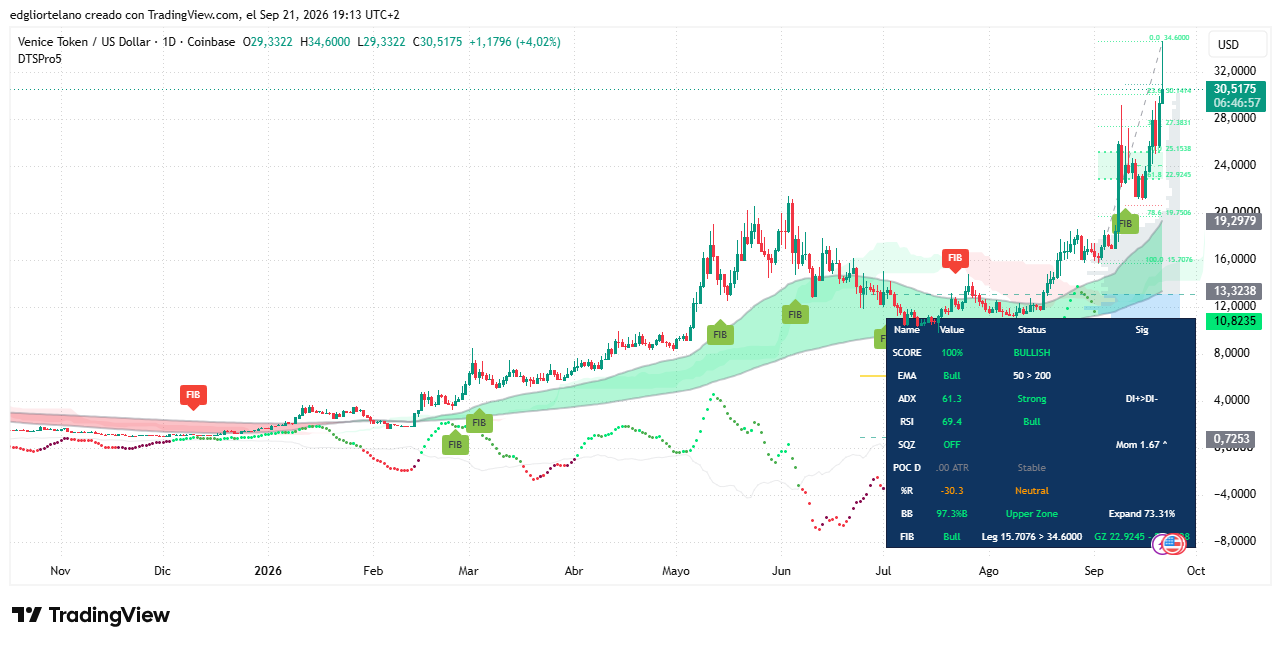
Venice’s answer is that its platform design makes that impossible. According to the report, speculation around that privacy angle alone helped send VVV up 34% in a single day, and the token has continued to surge since then.
Revenue growth, funding, and lower issuance
Beyond the market narrative, Venice has also posted business milestones. In August, the company said it had crossed a $100 million annualized revenue run rate, up from $70 million a month earlier. In July, it raised $65 million in a Series A led by crypto fund Dragonfly at a $1 billion valuation. The round marked Venice’s first outside capital since launching in 2024.
Token issuance has been reduced several times. Annual emissions started at 14 million VVV at launch and had fallen to 2.5 million as of September 1, according to the report. Another cut is scheduled for October, bringing annual issuance down to 2 million VVV.
What Venice offers, and where the risk sits
The report does not present Venice as the strongest AI provider on model quality. The company does not train its own frontier model. Instead, it routes prompts to open-source systems such as Llama and DeepSeek, which trail the top models from OpenAI and Google on most public benchmarks.
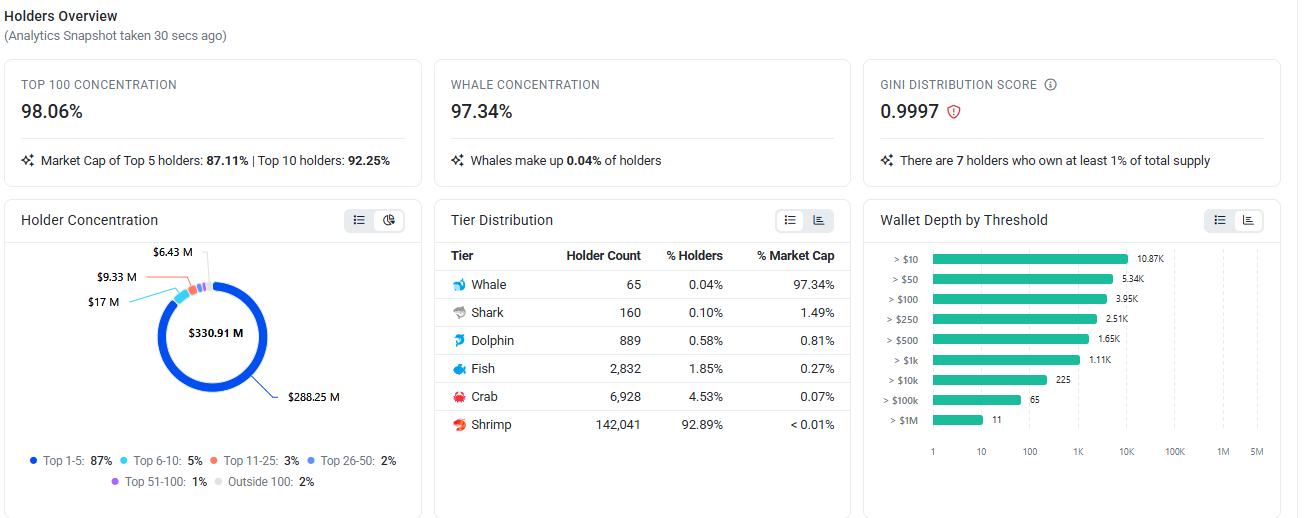
What Venice is selling, the report says, is discretion. That does not remove the token’s own risks. Market data cited in the story shows the 100 largest VVV wallets control roughly 98% of supply, leaving price action highly exposed to a small group of holders rather than broad retail demand.
The next supply milestone is set for October 1, when annual emissions are scheduled to fall again from 2.5 million to 2 million VVV. Traders are watching that reduction closely as the supply squeeze continues.