

Vicarious Surgical, a U.S. surgical robotics company that once positioned itself against the da Vinci system, is shutting down after investors voted to stop operations and move ahead with bankruptcy liquidation.
The company had backing from high-profile investors including Bill Gates and Jerry Yang, and it went public in 2021. But years of delays in development and commercialization left it unable to sustain the business, even after raising more than RMB 2 billion, or about $300 million.
Founded by MIT students, backed by major investors
Vicarious Surgical was founded in 2014. The idea was inspired by the 1966 science fiction film Fantastic Voyage, which imagined doctors being miniaturized and sent inside a patient’s body to perform surgery. MIT students Adam Sachs and Sammy Khalifa teamed up with surgeon Barry Greene, who had years of laparoscopic experience, to turn that concept into a company.
The founding team came from engineering-heavy backgrounds. Sachs had worked in manufacturing engineering at Apple, while Khalifa had been a product design engineer there. From the start, the company tried to bring consumer electronics-style miniaturization into robotic surgery.
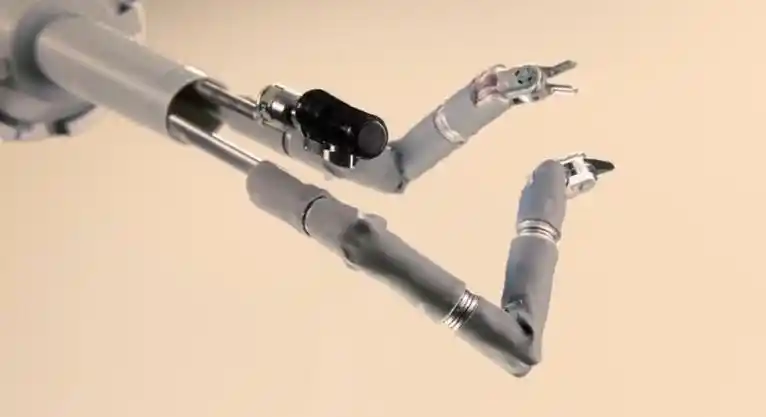
Its system centered on a new robotic arm design. Vicarious said the arm had nine degrees of freedom, intended to match the flexibility of a human arm and reach deeper into the abdominal cavity. The report noted that the da Vinci surgical robot has seven degrees of freedom.
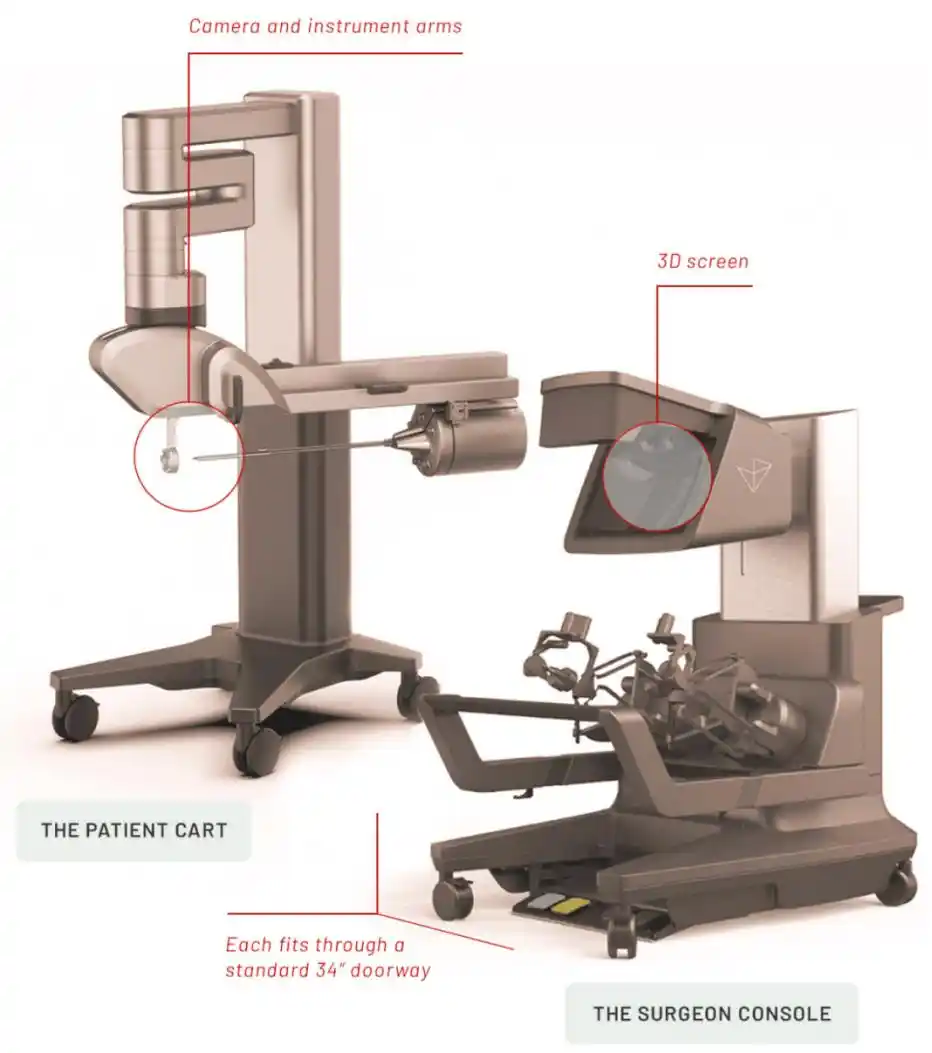
The company also tied its product vision to virtual reality. The design called for a small robot inserted through an incision of less than 1.5 centimeters. Two robotic arms would perform the work, while a shoulder-mounted camera would provide a 360° real-time view. Surgeons wearing a VR headset would control the arms through direct motion mapping.
That pitch attracted a long list of well-known backers. According to the report, investors included Bill Gates, former Google CEO Eric Schmidt, Yahoo co-founder Jerry Yang, and Khosla Ventures, through their funds or investment vehicles.
Its peak came in 2021, when Vicarious completed a SPAC listing and at one point reached a market capitalization of more than $1.2 billion. In 2022, its product was named one of Time’s Best Inventions of the year and became the first surgical robot to receive the U.S. Food and Drug Administration’s Breakthrough Device designation.
In total, the company raised about $300 million, roughly RMB 2 billion. That capital is now effectively being wiped out as the company heads into liquidation.
Public listing was followed by delays, losses, and delisting pressure
The listing did not mark the start of a growth phase. It turned out to be the company’s last major high point.
Back in 2023, Vicarious had already received a delisting warning tied to its market value, with its share price down 90% from its peak. The company had planned to launch its first clinical trial in 2024 and submit a medical device approval application before the end of 2025, but both timelines slipped because of engineering difficulties.
For a startup that had not reached profitability, the market’s patience ran thin. In March this year, the New York Stock Exchange sent Vicarious a delisting notice after its average market capitalization remained below $15 million for 30 consecutive trading days.
The company said it was unable to secure additional financing and also failed to find a buyer. By the end of March, its cash, cash equivalents, and short-term investments had fallen to about $3.7 million.
Losses were still mounting. The report said Vicarious posted a quarterly loss of $7.3 million, and annual losses of $63 million in 2024 and $50.2 million in 2025, equal to about RMB 426 million and RMB 340 million, respectively.
An aggressive technical design ran into manufacturing and clinical reality
The company’s problems were not limited to financing.
According to the report, Vicarious used a decoupled drive design to make its robotic arms behave more like human hands. That approach made the structure far more complex and harder to control in manufacturing yields. The system was described as being comparable in complexity to a Swiss watch, making it extremely difficult to produce stable units at scale that could meet FDA standards.
The company’s pursuit of an ultra-small incision brought another trade-off. It equipped the system with only two robotic arms, which meant some surgical tasks could not be completed smoothly. The VR headset featured heavily in promotional materials, but the report said it was often seen as more of a gimmick than a practical tool, especially since long periods of use could add to physician fatigue.
The report also pointed to the founders’ engineering mindset as part of the issue. The product looked impressive on paper and offered unusual features, but the team underestimated the difficulty of bringing a medical device through long development cycles, regulatory requirements, and clinical validation.
Before the special shareholder meeting, Vicarious said: “Since inception, we have incurred operating losses and negative cash flows from operations, and we expect to continue to incur operating losses and use significant cash resources in the future.”
Under the liquidation proposal, the company’s assets will be transferred to a third party, Vicarious Liquidation LLC, to repay debts. For shareholders who had put in substantial capital, the outlook appears bleak. The company had previously said it was “unable to predict whether any funds will remain for distribution to investors.”
The collapse lands as robotics funding stays hot but commercialization remains hard
The bankruptcy also throws fresh attention on the current robotics investment boom.
The report said robotics financing has accelerated this year. Funding rounds that were once limited to a small number of companies are becoming more common across embodied intelligence startups, and unicorn valuations in the tens of billions of yuan are appearing at a faster pace.
Still, the field has seen a growing list of failures. In November last year, Silicon Valley humanoid robot startup K-Scale Labs collapsed after completing three financing rounds but running out of money before mass production. Earlier, U.S. robotics pioneer iRobot also filed for bankruptcy protection.
The report cited a view heard within the industry: robot demos often look impressive, but buyers still lack a clear reason to purchase. Most robots today are still sold to laboratories, university robotics departments, science museums, and data collection centers. Only a small portion are working on production lines.
The economics remain difficult. A robot built for industrial use can cost hundreds of thousands of yuan, with companies needing four to five years to break even. The home market looks even tougher. According to Stanford’s 2026 AI Index Report, humanoid robots have a 12.4% success rate in completing 1,000 household tasks in real homes, compared with 89.4% in simulated environments.
LanChi Ventures partner Cao Wei said in the report that emerging industries often move through two phases. In the first, companies can generally keep raising money. Once the external market goes through structural change, the industry enters an elimination stage, and long-term strength in productization and commercialization becomes decisive.
Cao said: “Capital markets are inherently cyclical. Embodied intelligence companies still have some distance to go before real productization. To get through future risk periods, they either need ample cash or strong products.”
The original article was published by the WeChat account Touzijie (ID: pedaily2012) and written by Yu Mengying.