

Buterin confirms AI solved his anonymous Ethereum writing challenge
Ethereum co-founder Vitalik Buterin has confirmed that an AI-assisted submission from Co-Invest CEO Franklyn Wang correctly identified an anonymous Ethereum-related document he had written. The result brings an end to a public challenge Buterin launched two weeks ago to test whether current AI systems are already capable of piercing online anonymity in technical writing.
Wang’s winning entry identified an anonymous rewrite of EIP-7503 by focusing on how the document explained mathematical and technical concepts. In a Monday post on X, Wang said the text had been deliberately concealed by being written in Chinese first and then machine-translated into English. In his view, the decisive signal was not vocabulary choice or visible writing tics, but the underlying reasoning style used to structure and explain the ideas.

Buterin later agreed with that assessment. He said the stylistic cues detected by the AI were really intellectual habits and his characteristic way of presenting math and algorithmic concepts. Those deeper patterns, he noted, effectively bypassed his obfuscation strategy, which only targeted surface-level prose rather than the logic embedded in the text.
The challenge began as a test of AI-powered deanonymization
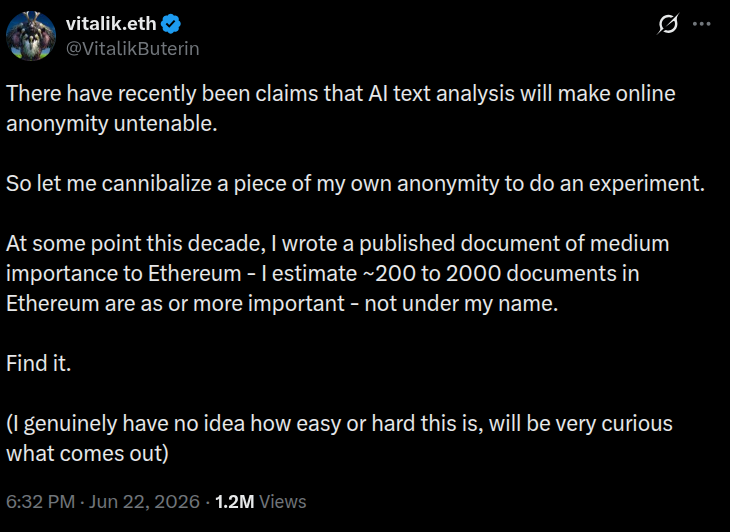
The experiment started on June 22, when Buterin publicly addressed growing claims that AI text analysis could make online anonymity increasingly difficult to maintain. Rather than discussing the issue abstractly, he said he would “cannibalize” part of his own anonymity and turn the concern into an experiment. He revealed that at some point during the last decade he had published a document of “medium importance” to Ethereum under another name, then challenged the public to find it.

The backdrop to that challenge was a February paper from researchers at ETH Zurich and Anthropic. The study argued that large language models have made online deanonymization practical at scale. According to the paper, AI systems can extract identity-related information from unstructured text, search for possible matches, and reason over likely candidates more effectively than traditional deanonymization approaches.
That prospect has obvious implications for crypto. The industry has long depended on pseudonyms, both culturally and operationally. Some of its most influential contributors, including Bitcoin creator Satoshi Nakamoto, used aliases to separate identity from work. If AI can reliably attribute authorship based on reasoning patterns rather than mere phrasing, pseudonymous technical participation in open-source blockchain ecosystems could become much harder to preserve.
How Co-Invest identified the anonymous EIP-7503 rewrite
Wang said Co-Invest analyzed 27 documents and ranked Buterin as the most likely author of the anonymous December 2024 rewrite of EIP-7503. The system reportedly assigned that conclusion about 20% confidence, which may not sound overwhelming in absolute terms, but was around 10 times higher than the next candidate in the ranking. That relative gap was enough to make the submission the strongest match in Buterin’s challenge.
Buterin later explained the concealment method he had used. He wrote the anonymous rewrite in Chinese, translated it into English with Qwen 2.5, and then manually corrected the translated draft to further disguise his normal prose. The goal was clearly to reduce the chance that observers could identify him through familiar English-language stylistic markers.

The outcome suggests that this kind of masking may be less effective than many assumed. Wang argued that the AI did not succeed because it found signature words or recognizable expressions. Instead, it detected the way Buterin builds explanations, frames technical relationships, and reasons through mathematical or algorithmic questions. In other words, the higher-level architecture of thought remained visible even after the wording was filtered through translation and revision.
What the result may mean for pseudonymous crypto contributors
The case has broader significance beyond one successful attribution. In open-source blockchain communities, developers and researchers often assume that changing language, rewriting passages, or publishing under another name can provide a meaningful layer of anonymity. But if AI systems can identify authors through latent reasoning structures, those methods may no longer be enough on their own.
That does not mean deanonymization is now universally easy or always reliable. Lighter CEO Vladimir Novakovski said on Monday that he had worked with Wang on a 2023 project using GPT-4 to try to identify Satoshi Nakamoto by matching writing style in cryptography research. According to Novakovski, that effort failed to produce a high-confidence result. Wang later applied a similar approach to Buterin’s challenge with better success.
The contrast is important. It shows that AI-based attribution still has limits, especially when the candidate pool is larger, the text corpus is thinner, or the target has maintained stronger separation across identities. Still, the Buterin result indicates that in cases where technical documents are available and the candidate set is more tractable, AI’s ability to infer authorship from abstract patterns is advancing quickly.

For Ethereum and the wider crypto developer ecosystem, the episode serves as a practical warning. Anonymous proposal drafts, governance discussions, research notes, and technical explanations may reveal more than authors intend, even when names are removed and wording is transformed. As AI attribution tools improve, the challenge of sustaining pseudonymous contributions in public technical communities may become less about hiding one’s prose and more about whether one can hide one’s way of thinking.