
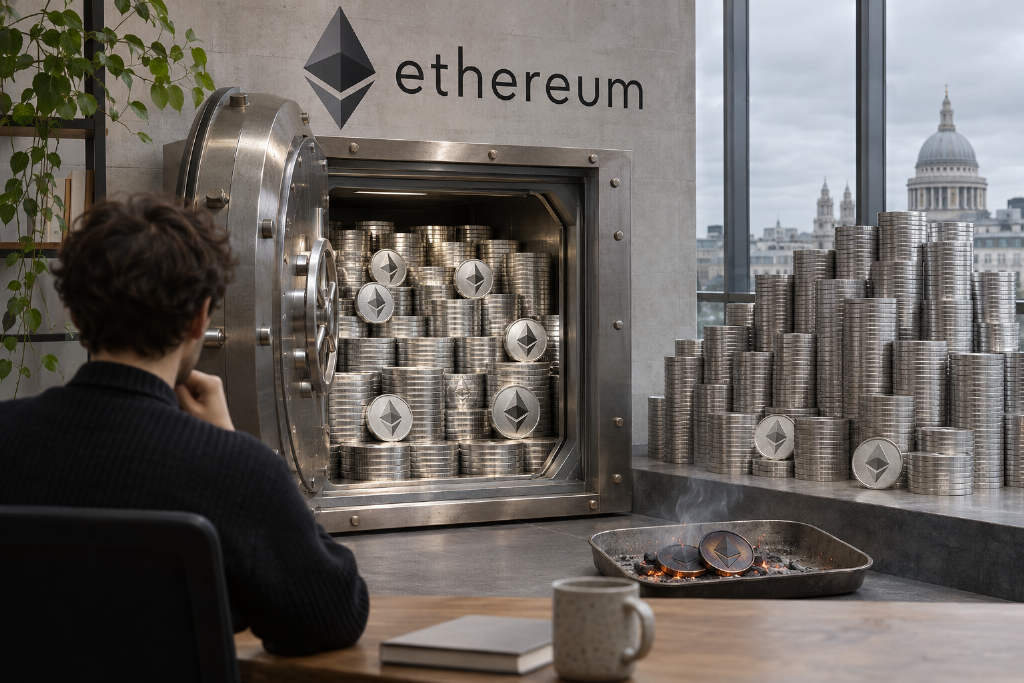
Vitalik Buterin has reopened the debate over what gives ETH its value, arguing that transaction-fee burns should not be treated as a dependable valuation floor. Ethereum’s long-running “Ultrasound Money” narrative tied network activity to higher gas consumption, with fee burning offsetting issuance and potentially pushing ETH into deflation. Buterin’s latest discussion questions whether that framework can serve as a durable valuation model.
On Nov. 8, Buterin published a long post on X examining ETH’s value source. He noted that a significant share of historical fee revenue came from speculative activity within crypto markets. When market activity cools, fee revenue and burn volumes can fall as well, making them difficult to treat as a stable long-term cash flow.
Buterin still supports retaining EIP-1559. He also said Ethereum should not regret a future in which burns remain below 10% of new issuance for an extended period. Deliberately seeking higher fees to preserve a large burn rate could damage Ethereum’s decentralization and long-term development.
The argument raises a broader question for public blockchains: if the formula of stronger applications leading to more burns and a higher token value is no longer dependable, what supports the valuation of networks that continue to issue tokens?
How major chains issue and burn tokens
Most proof-of-stake networks issue tokens as validator rewards and use fee burning to reduce supply. Their issuance and burn rules differ, producing different changes in circulating supply.
Bitcoin: halving keeps reducing inflation
Bitcoin’s supply rules are relatively simple. Its maximum supply is about 21 million coins. The current block reward is 3.125 BTC. At an average block time of 10 minutes, annual new issuance is about 164,300 BTC, implying an annual supply inflation rate of roughly 0.82%. The block reward halves every four years, so the inflation rate continues to decline.
Ethereum: burns offset only about 3.2% of new issuance
After The Merge in 2022, ETH issuance fell sharply. Cumulative supply growth since the Merge is about 1.37%. EIP-1559 burns the entire base fee, but the expansion of layer-2 networks and lower gas fees have reduced the burn rate. Over the past 30 days, ETH burns offset only about 3.2% of new issuance, putting pressure on the earlier deflationary narrative.
Solana: ongoing issuance with a declining inflation rate
Solana started with an annual inflation rate of 8%. That rate declines by 15% each year, with a long-term target of 1.5%. During the 2024 memecoin surge, daily burns briefly exceeded 10,000 SOL. In January 2025, burns at one point offset about 23% of new issuance.
After the implementation of SIMD-0096, all priority fees went to validators, while only 50% of base fees were burned. Daily burns subsequently fell as low as about 700 SOL.
BNB: supply reduction through burns
BNB does not rely on continuous issuance to maintain its economics. Instead, quarterly Auto-Burn events and BEP-95 real-time gas burns reduce supply, with a target total supply of 100 million BNB. The first four quarterly burns of 2026 totaled about 6.2 million BNB. Auto-Burn determines the amount using the token price and block production, while BEP-95 burns part of network fees.
TRX: resource fees do not necessarily track transfer activity
TRON issues TRX through block rewards and burns the Energy and Bandwidth fees paid by users. Users can also obtain resources through staking or leasing. As a result, higher USDT transfer activity does not necessarily produce a matching increase in TRX burns.
AVAX: burns remain below new issuance
AVAX has a maximum supply of 720 million tokens and issues new tokens as validator rewards. Fees on the X, C and P chains of the primary network are burned.
By early November 2026, about 474 million AVAX had been minted. Staking rewards accounted for about 114 million AVAX, while cumulative burns reached roughly 5.18 million AVAX. Burns still had not offset new issuance.
SUI: fixed supply makes unlocks the key issue
SUI has a fixed total supply of 10 billion tokens. Circulating supply mainly increases as tokens unlock. Its Storage Fund locks part of storage fees and uses staking returns to compensate validators. When data is deleted, most of the fee can be returned, while the non-returned portion remains in the fund. This reduces freely circulating supply but is not a permanent burn.
The limits of burn-based valuation
Buterin revisited a burn-based valuation model that was once widely discussed:
Token valuation = annual burn value ÷ discount rate
Under that formula, a blockchain that consistently burns $1 billion worth of tokens each year would have a theoretical valuation of about $25 billion at a 4% discount rate.
Buterin said the resulting “valuation floor” is not reliable. Ethereum burned about 1.48 million ETH in 2022, worth roughly $3.6 billion. By Nov. 8, 2026, cumulative ETH burns stood at only about 19,200 ETH, worth around $43 million.
If the year’s burn value were simply annualized to about $50 million and discounted at the same 4% rate, the theoretical valuation would be about $1.25 billion. ETH’s market capitalization during the same period was about $270 billion. The difference was more than 200 times, exposing the limitations of the model itself.
The source also mentioned that HYPE broke above $66 and set another all-time high, while HypeStrat reported $1 billion in unrealized gains and ranked first among digital-asset treasury companies. Bitmine, by contrast, suffered an $8 billion loss.
Ethereum’s valuation case moves toward store of value
Unstable fee revenue makes burn volume difficult to use as a common valuation standard for all public blockchains. Earlier periods of high burns were driven in large part by speculative activity such as NFTs. Once that activity cooled, the related revenue declined.
Burning is only one way for a blockchain to distribute or capture value. Solana sends priority fees to validators, while TRON’s resource rents may become staking returns. Those forms of economic value do not all appear in token burns. Burn data can measure part of a network’s value capture, but it cannot serve as a universal valuation benchmark on its own.
Buterin placed greater emphasis on Ethereum’s decentralization, censorship resistance, open-source structure, privacy and security. He also pointed to the possibility that systems able to operate reliably over the long term without control by a single entity could become more valuable as artificial intelligence advances.
ETH already has a market capitalization worth hundreds of billions of dollars, which cannot be explained entirely by fee revenue. The token is also used as an on-chain collateral asset, a medium of exchange and the native asset of financial infrastructure. Ethereum’s valuation discussion is therefore shifting away from fee burning and toward its role as a store of value.



