
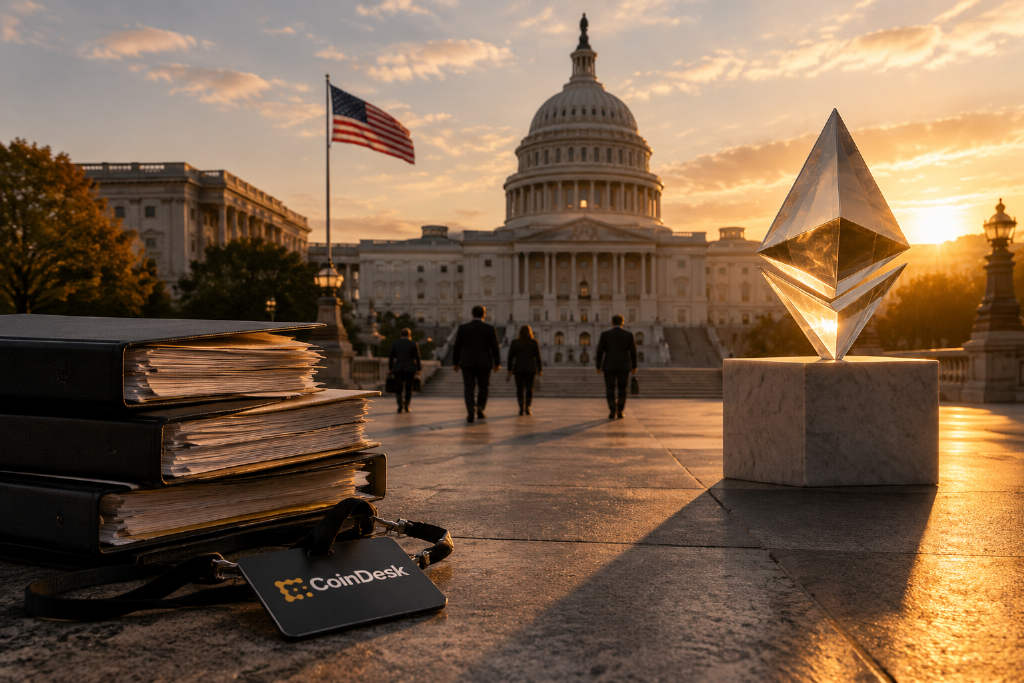
The last 24 hours brought a heavy run of crypto headlines across regulation, protocol design, fundraising, mining infrastructure and market data. Two stories stood out first: the collapse of U.S. CLARITY Act negotiations and Ethereum co-founder Vitalik Buterin’s new 2030 vision for Ethereum.
CLARITY Act effort breaks down in Washington
According to CoinDesk, the U.S. CLARITY Act, which was designed to establish a clearer regulatory framework for cryptocurrencies, failed after months of tense negotiations. The bill had been expected to address how digital assets would be defined at the federal level, but it never reached a final vote.
Multiple sources said the breakdown centered on jurisdictional conflicts and disputes over specific provisions. The Commodity Futures Trading Commission and the Securities and Exchange Commission remained divided over which agency should oversee certain digital assets. Lawmakers also failed to reach agreement on how NFTs, DeFi protocols and stablecoins should be classified under the law. Some institutions had pushed for legislation to reduce uncertainty, but no workable compromise emerged.
Fintech Association and other industry groups had actively lobbied for the bill in hopes of setting clearer standards for the sector. With the effort now stalled, Wall Street institutions and crypto projects remain in a legal gray zone, and the broader compliance push is delayed.
Buterin sets out a 2030 roadmap for Ethereum
CoinDesk also reported that Vitalik Buterin has presented a long-term roadmap for Ethereum, describing it as an effort to simplify the network. In that plan, Ethereum by 2030 would move beyond being a blockchain ledger and become a more general computing layer.
The roadmap calls for a full protocol redesign over the next three to four years. It targets an approximately 1,000x increase in transaction throughput and the use of zero-knowledge proofs to strengthen privacy and defend against quantum-computing threats. By 2030, the network is expected to handle 2TB of conventional dynamic state data plus 100TB of new scalable storage, with state separation and optimization at the base layer.
The broader idea is to turn Ethereum into infrastructure secured by cryptographic verification, with applications extending from finance into social systems. CoinDesk said most developers support the direction, though some view the proposed timeline as slow.
In a separate post on X, Buterin said he wanted to explain what Ethereum’s plans after the Hegota-era forks really mean. He wrote that Ethereum is no longer just a blockchain but a hybrid architecture combining blockchain systems and modern cryptography. He listed FOCIL, EIP-8288, simplified consensus, state management, formal verification, mempool improvements with privacy features and long-term obfuscation techniques among the related efforts.
Snowmoon is finished and released under GPL v3
Buterin also said his original novel Snowmoon has been completed. The work spans 32 chapters and has been released under a GPL v3 license.
The novel is written as speculative science fiction and depicts a world heavily shaped by cryptography and decentralized governance. It focuses on ideological conflict among societies including Veridia and the Arctic Empire and incorporates zero-knowledge proofs, quadratic voting, privacy technology and content-directed tax mechanisms.
Buterin said film, animation and other derivative adaptations are allowed, but the related production pipeline must also be open-sourced, including AI prompts, scripts and other non-general materials. He added that all text was written by him personally, with AI used only for spelling and grammar checks, consistency checks and web formatting, and included the note: “Snowmoon was written with love.”
Monochrome launches MCR IEO and raises more than 5.5 million USDT
Lookonchain said Monochrome Exchange, the Australian digital asset management company founded by former Binance Australia co-founder and former CEO Jeff Yew, has launched the MCR token IEO and has already raised more than 5.5 million USDT.
MCR has a total supply of 210 million tokens. Five percent of that amount, or 10.5 million tokens, has been allocated to the public IEO. Tokens sold in the IEO will be locked for one month after the token generation event and then released linearly over the following three months.
MCR holders are set to receive spot and derivatives fee discounts, priority access in Digital IPOs and token offerings, staking rewards, increased Launchpad allocation weighting, participation in a node program and governance rights through Monochrome DAO.
The company said 20% of quarterly net profit will be used to buy back and burn MCR on the open market, while 25% of Digital IPO fee income will also be included in quarterly buyback-and-burn funding.
Monochrome previously announced a $1.8 million Series A round on Sept. 13, 2021, at a post-money valuation of about $15 million. The round was co-led by Litecoin creator Charlie Lee, Blockstream chief strategy officer Samson Mow, former Binance CFO Wei Zhou, Blueshyft and Synthetix founder Kain Warwick. On Aug. 18, 2022, Monochrome Asset Management received Australia’s first Australian Financial Services Licence, or AFSL, intended for crypto-related exchange-traded fund issuance.
MARA and CleanSpark push ahead with U.S. data center projects
According to TheEnergyMag, bitcoin miner MARA said it has posted a $100 million power deposit for its data center project in Matagorda County, Texas, and revised payment and exit terms in its deal with sustainable fuel developer HIF USA.
The site is southwest of Houston, spans more than 1,200 acres and is planned for as much as 2 gigawatts of power capacity. MARA intends to use it for a campus supporting both high-performance computing and bitcoin mining. Under the amended agreement, some payments that had been tied to regulatory approval will now be made in two installments. If all milestones are achieved, the total acquisition price remains capped at $600 million.
CleanSpark separately said it completed $2.276 billion in debt financing for its Sandersville, Georgia data center project. The notes carry a 7.875% rate. The proceeds will fund construction and repay previously invested equity capital. The Sandersville project comes with a 20-year lease.
Key macro releases and earnings are due next week
Next week’s macro focus is Friday’s U.S. nonfarm payrolls report, which includes payroll growth, the unemployment rate and average hourly earnings. The release is tied closely to the Federal Reserve rate path and is one of the key labor readings ahead of the October policy meeting.
- Wednesday 20:15 Beijing time: U.S. September ADP employment
- Wednesday 20:30 Beijing time: U.S. August core PCE inflation, annual rate
- Thursday 20:30 Beijing time: U.S. initial jobless claims for the week ending Sept. 26
- Friday 20:30 Beijing time: U.S. September nonfarm payrolls and unemployment rate
On the central bank side, Bank of England Governor Andrew Bailey is scheduled to speak at 16:00 Beijing time on Thursday, and European Central Bank President Christine Lagarde at 21:30 the same day. Federal Reserve officials are also due to appear across the week, including Chicago Fed President Austan Goolsbee, St. Louis Fed President Alberto Musalem, New York Fed President John Williams, Fed Governor Lisa Cook, Minneapolis Fed President Neel Kashkari, Richmond Fed President Tom Barkin and Dallas Fed President Lorie Logan.
In U.S. equities, Micron is set to report after the close on Wednesday, while Nike is due to release quarterly results on Thursday.
Quant partners with The Clearing House on tokenized deposits
Interoperability company Quant said it is working with The Clearing House to bring programmable money into the United States and provide an interoperability layer for tokenized deposits inside the regulated banking system, allowing those deposits to move within bank infrastructure.
Quant said the partnership extends similar work it has already done in the U.K., Europe and other regions. The company also referenced its On-Chain Money Initiative and published a press release and blog post describing the arrangement.
THORChain faces renewed criticism after the Bitget incident
THORChain’s decentralization claims came under fresh scrutiny after the Bitget security incident.
SlowMist founder Yu Xian wrote on X that the Bitget theft spread widely, involved a large amount of funds and was quickly linked to North Korean hackers. He said Circle and Tether had already helped freeze related funds, including USDC held by the hackers.
Yu Xian argued that THORChain had moved quickly to intervene when its own platform previously suffered a theft, but in this case answered a major industry security incident by saying it was decentralized and had no authority to interfere. He also criticized the protocol for comparing itself with Bitcoin and Ethereum while continuing to collect fees from large cross-chain transfers involving hacker funds. In his view, decentralization should not be a slogan, and THORChain should not be casually placed in the same category as Bitcoin and Ethereum because their mechanisms and degree of decentralization differ.
GoPlus Security also posted on X that outbound transfers on THORChain require validators to actively sign through threshold signature schemes, unlike Bitcoin and Ethereum. It said about 101.5 BTC from the Bitget theft, worth roughly $8.5 million, had already moved through the protocol, while about 27.63 million XRP, worth about $43 million, was being converted into BTC. GoPlus called for THORChain to block North Korea-linked addresses.
OKX founder Star Xu said on X that THORChain had already shown it is not truly decentralized. He pointed to the May incident in which the protocol’s own treasury was drained and node operators paused the network within minutes, taking it offline for 13 hours. A network that can stop when its own funds are at risk but refuses to stop when others’ funds are at risk, he said, is not “like Bitcoin.”
THORChain responded that its protocol, like Bitcoin, Ethereum and BNB Chain, is a decentralized and permissionless network. MistTrack said nearly $1.2 billion of stolen funds in last year’s $1.46 billion Bybit hack moved through THORChain, and that funds from Bitget’s recent security incident appear to have flowed through the protocol as well.
Bitwise releases NEAR scenarios and files final prospectus
Bitwise has filed a final prospectus for its spot NEAR ETF and released a 39-page investment report on NEAR, with chief investment officer Matt Hougan listed among the contributors.
The report sets out several scenarios. In the base case, NEAR reaches $155 by 2030. In an extreme bullish case, the target rises to $562. In a bearish case, the figure is $1.63.
The report also compares NEAR with Visa in the most optimistic scenario. It says Visa processed $15.7 trillion in payment volume in 2024 and currently has a market capitalization of about $701 billion, using those numbers as one reference point for NEAR’s possible future valuation. The report also includes a product page for Bitwise Europe’s NEAR ETP.
Korean exchanges see severe stablecoin dislocations
Fiat-backed stablecoins have recently traded at large premiums on South Korean virtual asset exchanges. Yen-denominated stablecoin JPYC rose to as much as four times its reference value after listing. Euro stablecoin EURC jumped more than 400% in a single day on Bithumb. Dollar stablecoin PYUSD also traded at a visible premium.
Industry analysis said the moves were driven by thin circulating supply at launch combined with concentrated buying, not by any issue with reserve assets. Market participants said reserves alone cannot prevent secondary-market distortions and called for South Korea to include initial circulation safeguards, market maker and liquidity provider mechanisms, disclosure of price deviation rates and limits on market orders when designing a won-backed stablecoin regime.
Kalshi wins appeal and keeps event contracts running in two states
Cointelegraph reported that prediction market platform Kalshi won a significant ruling from the U.S. Court of Appeals for the Sixth Circuit, allowing it to continue offering event contracts in Ohio and Tennessee. The decision addresses a dispute between Kalshi and state regulators over whether those contracts can remain available.
Executives comment on bitcoin buying, tokenization and AI
Bitcoin Magazine cited comments from the CEO of public company Strive, who hinted that the firm will continue buying bitcoin and said it would “turn the leverage up a little more.”
Bitmine chairman Tom Lee said AI and crypto are gradually converging and that tokenization and AI agents could become the two main drivers of the next market cycle. He said BlackRock expects more assets to be tokenized, that financial settlement infrastructure is increasingly being built on crypto networks, and that fintech companies such as Revolut have already started building related business on Ethereum. He added that AI is helping form the digital economy, while cryptocurrencies provide the digital money and blockchain infrastructure needed to support it.
CoinDesk also reported that U.S. House Financial Services Committee Chairman French Hill said tokenization has shifted from something viewed as futuristic during FIT21 and CLARITY Act discussions into something already happening in real time. “We may actually tokenize an asset like a real security,” Hill said. “In fact, we are doing that now.”
On-chain positioning, buybacks and security tracking
Coinglass data shows whale positions on Hyperliquid currently total $9.695 billion. Long positions account for $4.548 billion, or 46.91%, while short positions account for $5.147 billion, or 53.09%. Unrealized PnL stands at $683 million for longs and -$756 million for shorts. One whale address, 0x5b5d..60, opened a 5x isolated ETH short at $2,304.06 and is now showing an unrealized loss of $42.0707 million.
Onchain Lens said Hyperliquid bought back and burned 10,400 HYPE over the past 24 hours at a volume-weighted average price of $91.97, for a total value of about $956,800. The platform has now burned 48.96 million HYPE in total, worth about $4.48 billion by the cited calculation, equal to 4.90% of maximum supply. Revenue over the past 30 days stands at $58.27 million.
Galaxy’s head of research said the COLDCARD Seed Entropy theft has resulted in the loss of 1,830 BTC, across three attack waves and more than 30 smaller related indicators. A total of 256 victims have reported cases to GLXY Research, with a median loss of 1.1 BTC. Tracing of the attackers is still ongoing.
Price moves and liquidation levels
Gate market data shows BTC/USDT at $85,000, up 1.04% over 24 hours.
Coinglass data shows that if ETH rises above $2,813, cumulative short liquidation intensity across major centralized exchanges would reach $528 million. If ETH falls below $2,561, cumulative long liquidation intensity would reach $501 million.
If BTC rises above $87,904, cumulative short liquidation intensity across major centralized exchanges would reach $636 million. If BTC falls below $80,508, cumulative long liquidation intensity would also reach $636 million.
On-chain analyst Ai Yi said trader mk4 currently holds the largest NEAR position on Hyperliquid by size, accounting for 7.68% of open interest, with floating profit at $17.55 million. The position consists of 5.838 million NEAR in a 10x leveraged long, worth about $31.28 million, with an entry price of $2.35. The current price has risen to $5.36. NEAR is up 187% this month, and mk4 entered in early September. It is also the only long position in the trader’s current book.
PPP market tracking shows the Polymarket contract for “ETH to reach $2,800 during the rest of September” has dropped to 37%, down 38% on the week. The probability of ETH reaching $2,900 during the rest of the month has fallen to 12%, down 8% week on week. Under the settlement rules, the market resolves to Yes if any one-minute Binance ETH/USDT candle in the specified month reaches or exceeds the target price; otherwise it resolves to No. Only Binance ETH/USDT price data counts.
Meme leaderboard and featured reads
According to GMGN data as of 08:45 on Sept. 28, the five most popular ETH ecosystem tokens over the last 24 hours were ZC, SNOWMOON, zc, SEND and 爱. On Solana, the top five were e/acc, PAID, STONK, JACK and CAKE. On Base, they were Basecat, boar, INVSTMNT, BLUECHIP and SOL.
ChainCatcher also highlighted several featured reads for the day, including Michael Saylor’s twelve policy proposals for digital economic prosperity, comments from Mark Zuckerberg on Muse and AI agents, Goldman Sachs on a possible early “Goldilocks” year-end stock rally, and an analysis of Jev at the model level.