


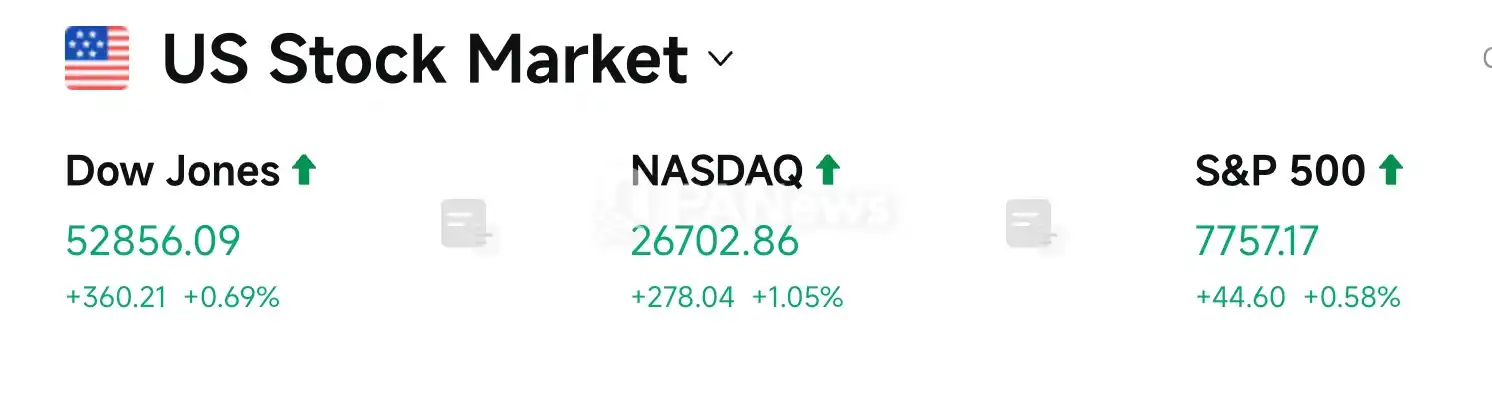
Strong earnings from major technology companies and SpaceX pushed U.S. stocks higher on Wednesday, but the tone shifted after the close as Nasdaq and S&P 500 futures gave back part of their gains, putting funding pressure and rate volatility back in focus.

The Dow Jones Industrial Average rose 0.69% to its highest level in more than a month. The S&P 500 added 0.58% for a third straight gain, while the Nasdaq Composite climbed 1.05%, its second daily advance of more than 1% this week. Former New York Fed President Dudley warned that AI data-center capital spending is crowding out financing capacity, while the wealth effect from tech stocks is supporting consumption. In his view, that combination is creating a rate "roller coaster," and the path for yields could reverse sharply if capex growth peaks or credit tightens.
Oil jumps as supply fears build
Oil prices moved sharply higher after attacks by the Houthis on Dammam airport and Saudi Aramco's Shaybah oil field, alongside the U.S. evacuation of non-essential personnel from Saudi Arabia and Israeli forces moving closer to Iran's border. WTI crude rose above $100 intraday, and Brent briefly traded above $111.
Iranian Foreign Minister Araghchi said Tehran was willing to restore shipping in stages through mediation, but made clear the strait would not be fully reopened before an understanding was reached. Rebecca Babin, senior energy trader at CIBC, said ongoing military activity and the risk that the U.S. and Israel could resume plans to strike Iran after the U.S. midterm elections were giving crude a strong floor.
With oil prices running higher and the Nov. 3 congressional midterm elections approaching, the Trump administration is using multiple policy tools in an effort to contain inflation. The report said Ukraine has stepped up attacks on Russian refineries, while refined-product constraints in the Gulf have pushed the U.S. average diesel price close to a record $6.32 a gallon. Russian Deputy Prime Minister Novak confirmed that the first tanker carrying 300,000 barrels of diesel was set to sail to the U.S. on Thursday.
The U.S. Department of Energy also announced the release of nearly one-third of the Northeast emergency heating oil reserve and $42 million to advance natural gas pipeline projects. Strategic Petroleum Reserve holdings were described as the lowest since 1982, with another 300,000 barrels drawn last week. Crude inventories fell by more than 3 million barrels, while distillate inventories rose by nearly 2 million barrels. A chief energy adviser at Gulf Oil said those steps would not solve the shortage in refining capacity.
Russia talks and pressure in global bond markets
Trump envoy Witkoff and Jared Kushner met Russian President Vladimir Putin in St. Petersburg for nearly three hours. Russia released an American teacher as a goodwill gesture and agreed in principle to resume trilateral technical talks involving Russia, the U.S. and Ukraine in Abu Dhabi after Nov. 10. Putin also proposed helping the U.S. mediate the Iran nuclear issue and supply fertilizer.
At the same time, Kremlin aide Ushakov said Moscow was not satisfied with progress in the Oslo talks involving the U.S., Ukraine and Europe. Differences over territory and NATO remain unresolved, and Ukrainian President Volodymyr Zelensky has also kept a cautious view of Russia's intentions.
In rates, a 20-year U.S. Treasury auction drew a lukewarm response, with the stop-out yield coming in nearly 1 basis point above the pre-sale level. The 10-year Treasury yield held near 5.10%. Pressure was also visible in Europe. ECB Governing Council member Kazaks warned that policy could tighten further if inflation stays elevated. France's 10-year government bond yield moved above 5% for the first time since 2002, and the spread between French and German bonds widened to a 15-year extreme.
On the Federal Reserve balance sheet, Brookings Institution researcher Chris Hughes suggested that Fed Chair Kevin Warsh replace the idea of "ample reserves" with "elastic reserves" and shrink the Fed's balance sheet from $6.8 trillion to $4.5 trillion, including by removing the cap on the standing repo facility.
Gold, copper and mining shares
Gold edged lower with U.S. equity futures in early trading, while silver, copper and other commodities stayed firm. Copper has already risen to $6 a pound. BlackRock's global thematic and sector investing head backed the long-term case for gold, arguing that markets are dealing with mild stagflation, long-term erosion in the dollar's purchasing power and sovereign debt that is slipping out of control.
He said government bond markets are already sending a warning and that countries will ultimately rely on inflation to dilute debt. In that framework, gold remains the best "portfolio insurance" even after moving above $4,000, with a suggested 10% allocation. He also said gold miners offer 3x leverage to the gold price, and that the same logic applies to copper and other commodities. He criticized Barrick, Newmont and two other major miners for launching $12 billion in buybacks near share-price peaks, then stopping repurchases when gold fell back to $4,000 and mining shares were 40% cheaper.
AI earnings rally meets balance-sheet strain
SpaceX and large-cap tech earnings lifted chips, memory, optical communications, space-related names and crypto-linked stocks, with the Philadelphia Semiconductor Index up nearly 2%. Joe Zidle, chief market strategist at Cresset, said SpaceX's results reflected broad strength in AI demand. Mark Hackett, strategist at Nationwide, said money was rotating back in as investors took profits and repositioned.
As questions about an AI bubble grew louder, Treasury Secretary Bessent told a closed-door charity dinner hosted by JPMorgan and RobinHood that the AI boom was not another Pets.com moment and did not pose a systemic problem because "the smartest people in the world have put 99% of their net worth behind it." Former Treasury Secretary Janet Yellen later criticized the event for the information asymmetry risk it created.
Still, the report said the strain under the surface is becoming harder to ignore. Bloomberg strategist Simon White had warned about a $223 billion stock inventory supply bottleneck, and that pressure is now showing up. Goldman Sachs CFO Denis Coleman and UBS CFO Todd Tuckner both acknowledged that financing demand has moved beyond capacity limits. One example cited was Situational Awareness, the fund run by Leopold, which shrank from $45 billion to $10 billion in July and was sold to Citadel Investment at a 10% discount.
Barclays, seeking to capture prime brokerage revenue, is expected by Barclays itself to post third-quarter equities revenue of £865 million, the highest since 2009. The report said the bank used an internal auction mechanism to reallocate capital and get around risk limits, drawing scrutiny from the Bank of England over its Asian AI equity financing book. Traders at Goldman Sachs and Barclays were also said to have pushed clients to add short positions to reduce balance-sheet usage.
Data from Goldman Sachs' Lee Coppersmith showed U.S. long-short hedge funds cut net leverage to a five-year low of 43.7%. But long leverage slipped only 0.5% to 128.8%, while short leverage jumped 8% to 85.1%, the highest level on record and the highest in five years. Gross leverage rose instead of falling, reaching 214%. UBS trader Torsten Sippel warned that the current position reset looks much like the setup before the July blowup, and that a move against both sides of the book could quickly trigger a stampede at that leverage level.
Enterprise AI and cybersecurity
Enterprise AI products are moving deeper into deployment. Anthropic launched Claude Duet, an agent that can work autonomously inside a virtual machine. OpenAI's frontier models and Codex workflow have also been added to Google Cloud Model Garden, giving the company coverage across the world's three largest cloud providers.
At the same time, an unexpectedly leaked critical PHP vulnerability, described as the most serious in more than a decade, triggered a wave of attacks by hackers around the world. That pushed cybersecurity stocks into focus and sharpened the market's view that AI may raise productivity while also multiplying external costs tied to security and system operations.
Stock and sector moves
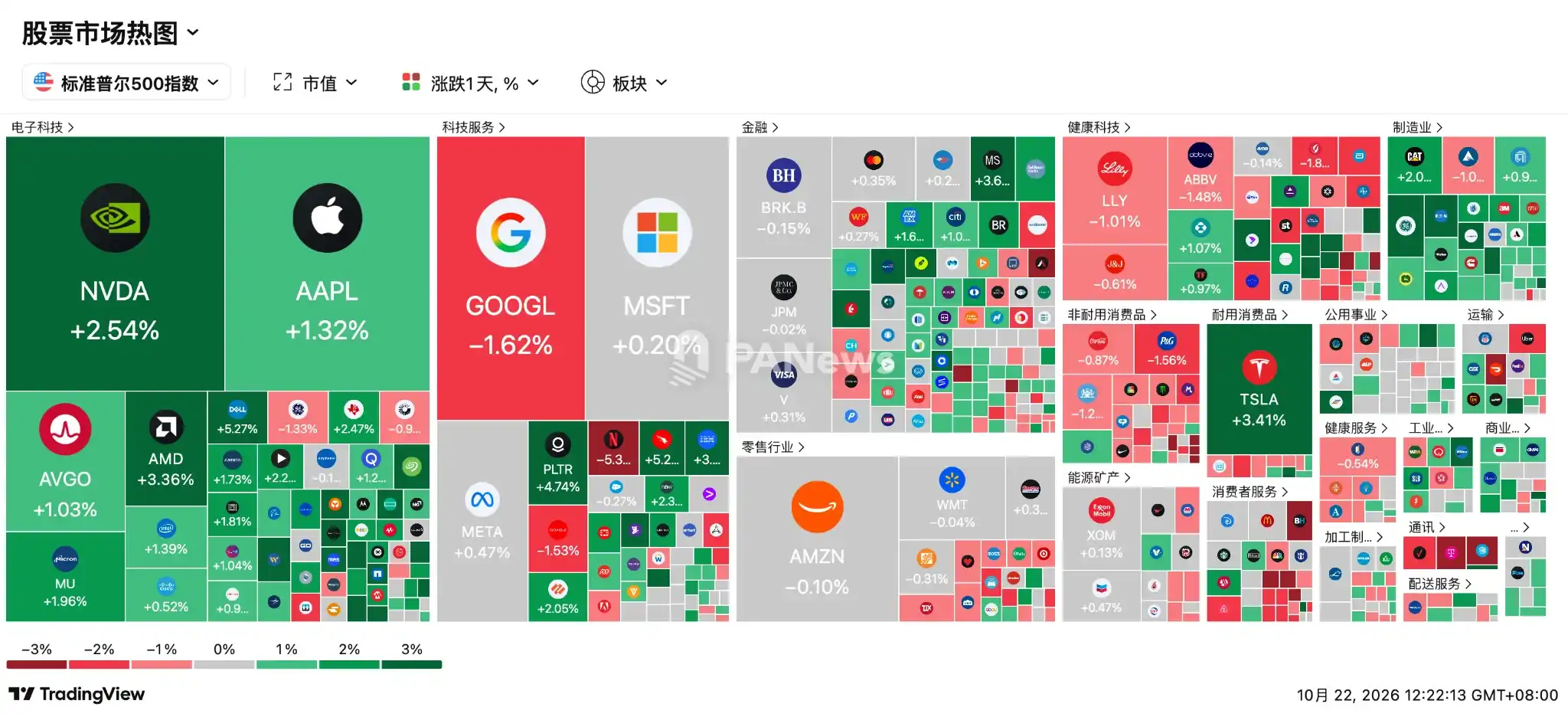
- SpaceX rose 7.79%. Third-quarter revenue jumped 161%, and net profit doubled from a year earlier to $4.4 billion. Revenue from its Super Intelligence, or SI, business surged 830% to $7.56 billion, overtaking Starlink as the company's largest revenue source. JPMorgan doubled its price target to $500 from $240. Elon Musk said on the earnings call that SpaceX and Tesla had each formed special committees to evaluate a possible merger. Firefly Aerospace gained 8.25%, and Rocket Lab rose 5.44%.
- Chips and semiconductors moved broadly higher. The Philadelphia Semiconductor Index rose 1.97%, with 29 components up and one down. The VanEck Semiconductor ETF (SMH) added 1.89%. AMD gained 3.36% after a Wedbush analyst gave it an outperform rating and a $600 target. ASML rose 2.81%, ARM 2.5%, Texas Instruments 2.47%, TSMC 1.6%, Intel 1.39%, Qualcomm 1.28% and Broadcom 1.03%.
- Memory stocks also advanced. The Roundhill Memory ETF (DRAM) rose 3.02%, and Micron Technology added 1.96%. Its chief technology and product officer said the company had decided against adopting 4F² memory technology after evaluating it for more than 20 years, calling it too complex and costly, and would instead focus on next-generation 3D DRAM. Western Digital rose 3.89%, Seagate 3.22%, SK Hynix 2.48% and SanDisk 0.94%.
- Optical communications recovered. The optical communications ETF (LYTE) gained 2.01%. Super Micro Computer surged nearly 9.6% after sharply lifting quarterly revenue guidance. CRDO rose 6.28%, Lumentum 3.43%, Coherent 2.47%, Corning 2.01% and Marvell Technology 1.81%.
- Cloudflare jumped more than 8% intraday. CTO Dane Knecht said the company had urgently deployed WAF blocking rules for all customers. CrowdStrike rose about 6% intraday, and Palo Alto Networks gained 3.5%.
- Netflix fell 5.31%. Third-quarter revenue rose 12% and net profit climbed 44%, but the company cut its full-year advertising revenue outlook and the midpoint of its full-year revenue forecast because some ad product features were launched more slowly than expected. It now expects 2026 revenue of about $51.1 billion. Fourth-quarter operating margin guidance of 26.0% was well below the third quarter's 34.6%.
- Berkshire Hathaway Class B touched a record intraday high and slipped 0.15% by the close. KBW analyst Meyer Shields said the company's large cash pile continues to benefit from elevated short-term U.S. rates.
- Microsoft edged up 0.20%. Its latest 10-K showed total headcount fell to 223,000, the first decline in a decade, while quarterly capital spending reached $41 billion.
- Nvidia rose 2.54%. Jensen Huang said the company and its core supply-chain partners would expand AI factory capacity globally and that capacity remains the only real constraint on what he called the largest infrastructure wave in human history.
- Apple gained 1.32%. The company said it would invest $100 million in Perryman to secure recycled titanium supply for more durable next-generation hardware, including iPhone Duo.
- Google and Amazon fell 1.62% and 0.10%, respectively. Google Cloud welcomed OpenAI models to Model Garden and said Google Cloud itself was not affected by the PHP vulnerability, but the company's search and agent ecosystem is facing pressure from both Meta Muse and OpenAI.
- Tesla rose 3.41% in regular trading and gained more than 4% after hours. Automotive gross margin excluding credits rebounded to 18.1%, free cash flow turned positive at $1.531 billion, and full-year capex guidance was cut to $20 billion from $25 billion. At the same time, total revenue was flat year over year, GAAP net income fell 43%, and investors worried that lower capex could signal slower progress in AI and Robotaxi.
- Meta Platforms rose 0.47% and added 2% after hours. Third-quarter revenue increased 26% from a year earlier to $64.6 billion, beating expectations. Its AI agent Muse reached more than 10 million users in a month and a half, and shopping transaction volume boosted payment limits. Meta raised the lower end of its capex range to $135 billion-$145 billion and said it would create non-voting Class C shares, effectively a 1-for-2 stock distribution, to fund AI. Mark Zuckerberg said compute cost efficiency would improve by more than 10x next year.
- Lam Research fell 1% in regular trading and dropped more than 8% after hours. Quarterly revenue rose 54% year over year and 22% sequentially to $8.219 billion, adjusted EPS came in at $2.20, and the midpoint of next quarter's revenue guidance was raised to $8.6 billion. CEO Tim Archer said AI-driven chip demand and rising device complexity continue to expand the opportunity set for manufacturing equipment.
What markets are watching next
Thursday, Oct. 22
- Bank of Korea rate decision: markets expect a pause after a run of rate increases. Another hike could support the won, but it may pressure chip stocks and companies with heavy financing needs.
- Earnings due from Nokia, Spotify, American Airlines and Procter & Gamble. After the close, investors will watch Bloom Energy, Western Digital and Newmont Mining.
Friday, Oct. 23
- 07:30 Japan September CPI: consensus is 2.1% year over year versus a prior reading of 1.9%. A hotter print could strengthen expectations for Bank of Japan tightening and affect the yen and global carry trades.