
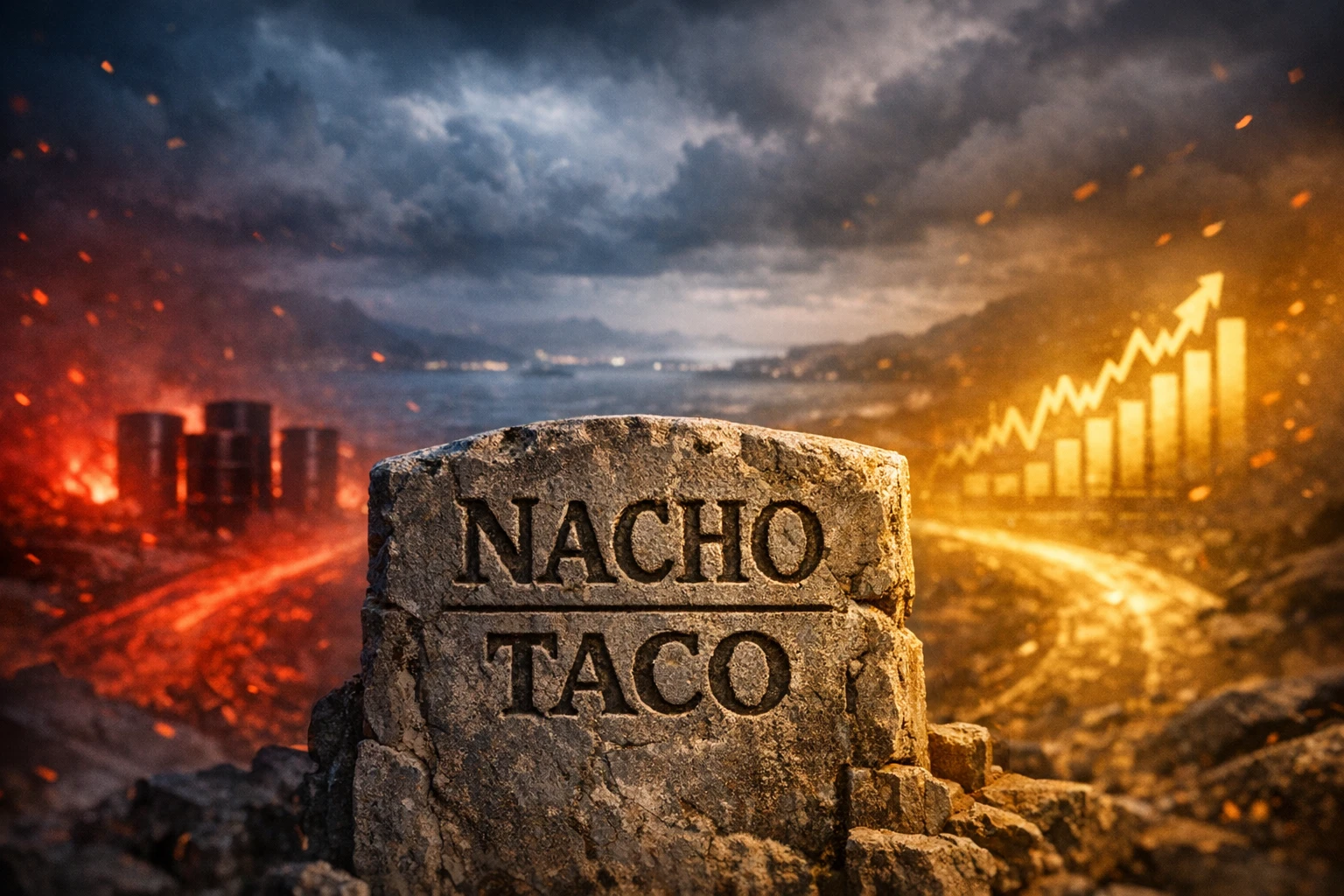
Wall Street traders are abandoning the TACO trade — betting that Trump would back down at the last minute — and embracing a new wager: NACHO, short for Not A Chance Hormuz Opens. Since the U.S.-Israeli airstrike on Iran on February 28, the Strait of Hormuz has not reopened. Oil prices have surged over 50% from pre-war levels, while the S&P 500 hit all-time highs and posted its longest weekly winning streak since 2024 — six consecutive weeks. The two assets have completely decoupled.
TACO had dominated markets for 14 months. A single Truth Social post would send oil plunging and stocks soaring. That changed on March 23. Trump announced a 'very constructive' conversation with Iran and ordered a five-day pause on strikes against Iranian energy facilities. S&P 500 futures jumped nearly 4% in minutes; Brent crude fell from $109 to $92. But Iran’s state media denied any talks existed. The rally was cut in half within two hours, the S&P closed up just 1.15%, and Brent bounced back to $99.94. TACO failed because the retreat required a partner that refused to cooperate.
Three Derivative Markets Bet in Unison
NACHO is not rhetoric — it is a bet backed by real money in three independent markets. First, insurance: war risk premiums for the Strait of Hormuz surged from a pre-crisis baseline of 0.125%-0.25% to 1% by early May, with some policies hitting 3%-8%. The cost of insuring a single Very Large Crude Carrier (VLCC) for one transit rose from $250,000 to $800,000–$8 million. If insurers refuse to price risk, shipowners won't sail — physical opening and actual navigation are two different things.
Second, oil futures: the spread between the front-month Brent contract and December 2026 is about $28.50, the steepest backwardation in five years. The curve tells a clear story — spot tightness is intense but will eventually ease, with far-end prices returning to the pre-war range of $60-70. But the window is long enough that traders won't bet on a sudden end.
Third, rate cuts: market expectations for Federal Reserve cuts in 2026 have fallen from two pre-war to zero. The CME FedWatch shows a 70% probability the Fed holds in June. Hedge fund legend Paul Tudor Jones told CNBC that even 'Warsh has no chance to make the Fed cut.'
Sector Divergence: Energy Soars, Transport Lags
As of May 7, the Energy Select Sector ETF (XLE) was up 31.63% year-to-date, the only major sector in positive territory for 2026. The iShares U.S. Transportation ETF (IYT) had gained just 8.79%, underperforming the S&P 500 by over 15 percentage points. RBC Capital Markets notes that fuel accounts for 40% of maritime operating costs, 25% for air freight, and 20% each for chemicals, couriers, and plastics. High oil hits transport directly, while energy has outperformed for eight straight weeks.
Inventory Deadline: Little Hope Before June 1
J.P. Morgan's commodities team estimates global commercial crude inventories at 8.4 billion barrels, but only about 800 million are 'effectively usable.' The crisis has already consumed 280 million, leaving roughly 520 million barrels. The bank warns that commercial inventories will approach operational stress levels in early June. Once that line is crossed, companies and governments face a choice: draw down minimum operational stocks (damaging infrastructure) or wait for new supply. European jet fuel inventories are expected to fall below the 23-day supply threshold in June. On Polymarket, the probability of the Strait of Hormuz returning to normal navigation by May 31 is just 28%, with $9.92 million in active positions betting NACHO holds through at least May. The market no longer trades Trump's next Truth Social post — it trades the early-June inventory data.