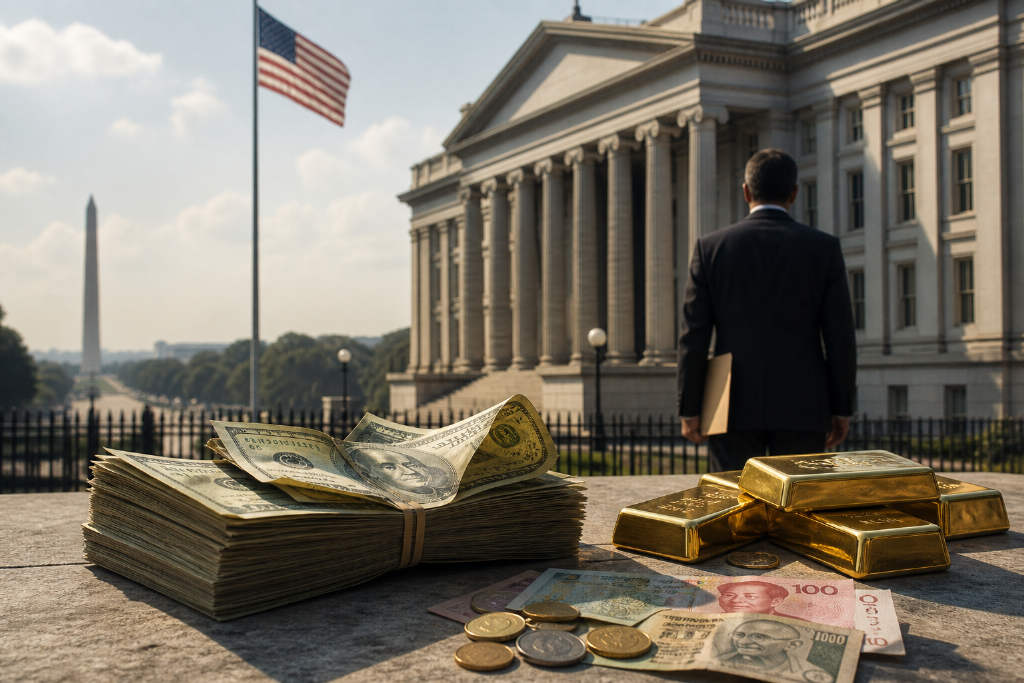
Wall Street is revisiting the weaker-dollar trade as concerns build over the U.S. fiscal outlook. According to BlockBeats, the shift has been driven by a widening U.S. budget deficit, government debt topping $40 trillion, and a Treasury buyback plan that has renewed debate over the dollar’s direction. Gold and emerging-market currencies have moved higher in recent weeks, while the U.S. Dollar Index fell to a three-month low last week.
Gold has already posted a fifth straight weekly gain, and its August advance is on track to be the largest monthly increase since 1999. At the same time, the U.S. Treasury last week raised the cap on long-dated bond buybacks from $2 billion to at least $4 billion and may use about $1 trillion from the Treasury General Account to support the program. Even so, the 30-year Treasury yield still briefly climbed to 5.34%, suggesting markets see the buybacks as insufficient to offset pressure from deficits, inflation, and debt supply.
Fed expectations are also shifting. Federal funds futures show the probability of a rate hike at the Federal Reserve’s October meeting has risen to about 56%, up more than 7 percentage points from a week earlier. Some institutions say the weaker-dollar trade may still struggle to become a firm trend unless the Fed aligns with fiscal policy.
Wall Street is reviving the weaker-dollar trade as investors grow more concerned about the U.S. fiscal outlook, BlockBeats reported on Aug. 25. The move follows a widening U.S. budget deficit, government debt surpassing $40 trillion, and the impact of the Treasury’s bond buyback plan.
Gold and emerging-market currencies have strengthened in recent weeks. Gold has already notched a fifth consecutive weekly gain, and its August rise is on track to mark its biggest monthly increase since 1999. The U.S. Dollar Index, meanwhile, fell to a three-month low last week.
Last week, the U.S. Treasury raised the cap on long-dated bond buybacks from $2 billion to at least $4 billion. It may also deploy about $1 trillion from the Treasury General Account, or TGA, to support the buybacks. Even so, the 30-year Treasury yield still briefly rose to 5.34%, a sign that markets do not see the program as enough to reverse longer-term pressure tied to fiscal deficits, inflation, and debt supply.
At the same time, traders have started pricing in a higher chance of another Federal Reserve rate increase. Federal funds futures show the probability of a hike at the Fed’s October meeting has climbed to about 56%, up more than 7 percentage points from a week earlier.
Some institutions believe the current weaker-dollar trade still lacks certainty unless the Fed moves in step with fiscal policy. In that setting, gold, commodity-linked emerging-market currencies, and commodities may be among the assets that benefit if pressure on the dollar persists. Analysts at Deutsche Bank have even said gold could break through a target of $4,800 per ounce.
This article was originally published by Bit.Fan. For more cryptocurrency news and market insights, visit www.bit.fan. Disclaimer:
The market information, project data, and third-party content displayed on this platform are for industry information sharing only and do not constitute any form of investment advice or return commitment.
Cryptocurrency trading carries high risks. Users should fully assess their risk tolerance and make independent decisions. All profits, losses, and legal responsibilities are borne by the users themselves.