

U.S. stocks jumped on Wednesday after Federal Reserve Governor Christopher Waller struck a dovish tone and hinted that rate hikes may come more slowly. The big indexes all moved higher. Tech growth names did the heavy lifting, while AI hardware shares trailed behind. Gold, silver, and Bitcoin climbed too. But the real driver sat underneath all that: macro sentiment got a lift as bond yields fell, not because the economy or industry trends suddenly improved. The FOMC meeting is getting close, and trade data plus geopolitical strain still point to inflation pressure. So the August CPI report coming up is the real test of whether this rebound has legs.
Market Recap: Broad Gains Mask Structural Divergence
By the close on September 3, the Dow Jones had added 580 points, or 1.08%, to 53,656. The Nasdaq Composite rose 1.2% to 26,572, and the S&P 500 gained 1.04% to 7,743. The Nasdaq 100 climbed more than 1%. The split under the hood was pretty obvious. Tesla and SpaceX-related stocks surged 6%, Oracle, Dell, and Meta each gained more than 4%, and Microsoft rose more than 3%. But the Philadelphia Semiconductor Index went nowhere, Broadcom sank 6%, and storage and optical communication names lagged. Snowflake jumped more than 20% after posting earnings that beat expectations, helped by AI product adoption. Gold and silver each rose 3%, Bitcoin broke above $80,000, the 10-year Treasury yield fell 5 basis points to 4.75%, and the dollar softened. Hong Kong futures gained nearly 1%, while FTSE China A50 futures added 0.3%.
Waller's Dovish Signal: Rate Hikes Slow, But Inflation Concerns Remain
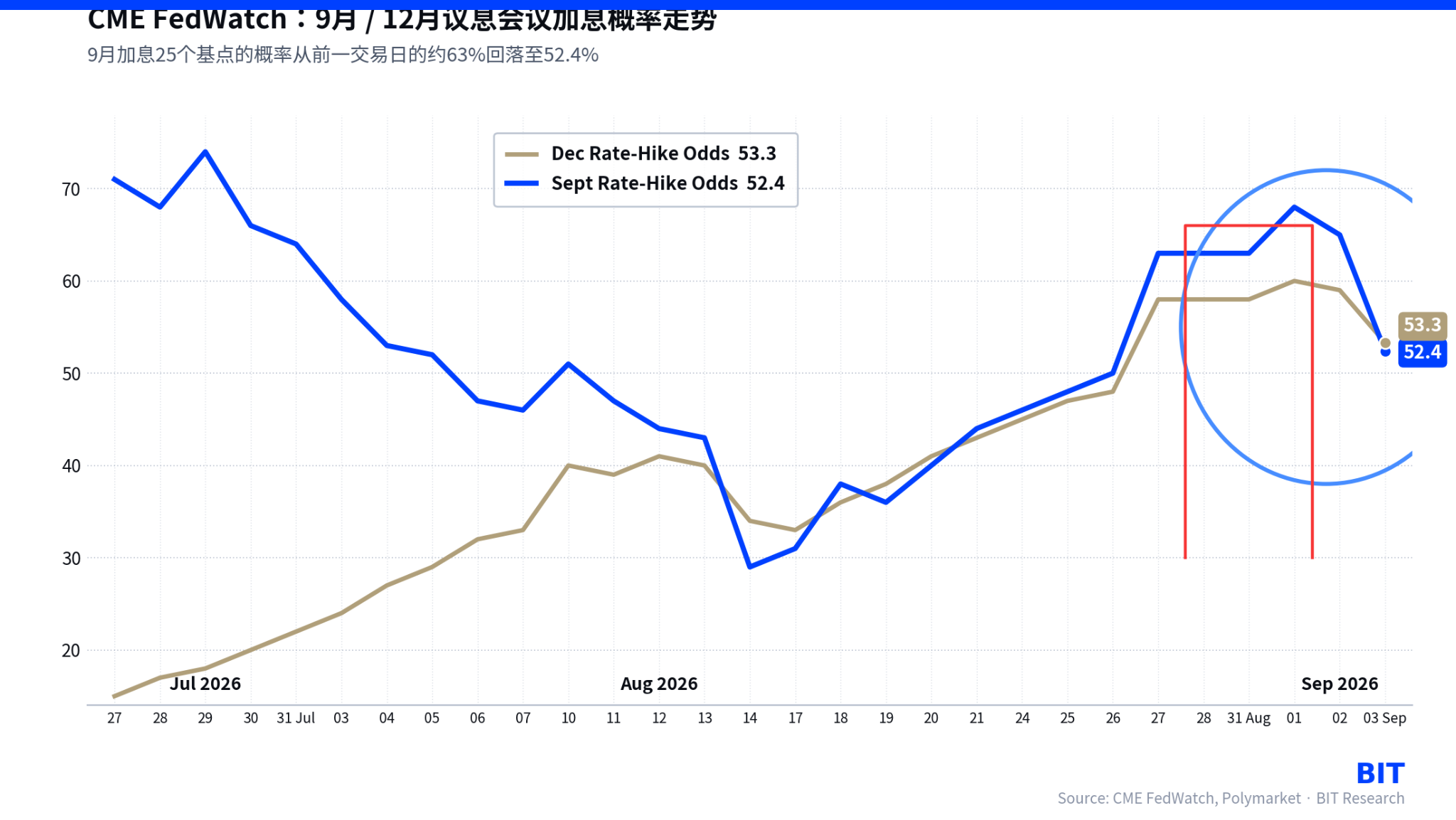
The immediate spark for the rally was Waller saying he would back keeping rates unchanged unless the next inflation data comes in as a surprise. After he spoke, traders on the CME FedWatch tool cut the odds of a rate hike from 63.2% to 50.4%—down more than 12 percentage points. Still, this was not some blanket dovish turn. More like a slight release of pressure. The basic setup has not changed: if the August CPI rebounds at all, the policy bias could swing back toward tightening. Waller directly linked the next rate call to CPI, while voicing careful optimism on recent inflation progress and employment data. The Fed's reaction function is the same as before. Inflation still comes first. But officials now seem a bit more willing to tolerate a data surprise. That means this sentiment bounce lives or dies on next week's numbers.
Structural Divergence: Valuation-Driven Macro Repair, Not Industry Logic
From a pricing angle, the leaders in this move—Tesla, SpaceX-related stocks, Oracle, Dell, Meta, and Microsoft—are long-duration, high-growth assets that react sharply to shifts in the risk-free rate. Lower bond yields improved the discount-rate math, and valuations bounced. Simple as that. This was a liquidity-and-rate-expectations rally, not a change in business fundamentals. AI hardware names are different. They track capital spending cycles and competitive pressure more closely, and they are less tied to short-term moves in rates. Broadcom dropped 6% to $346.49 even after strong Q3 earnings—revenue of $29.6 billion, up 86%; AI revenue of $16.7 billion, up 221%—because its Q4 revenue guidance of $34.8 billion came in below the $35.05 billion consensus. The market rethought its chances of replacing Nvidia in custom AI chips. Snowflake offered the opposite case: its rally came from earnings confirming AI monetization. A classic fundamentals trade. The AI story has moved into a phase where performance has to prove itself.
Inflation Pressures Persist: Trade Data and Geopolitical Oil Risks
Waller helped calm nerves around more rate hikes, yes. But the bigger picture still carries inflation risk. The U.S. trade deficit widened in July, pushed by strong import demand for capital goods and consumer goods, which suggests domestic demand is still holding up. Exports were weak, and the decline in import prices slowed. That points to a setup of strong domestic demand and weak outside demand, not a recession-style cooling. And that could mean a marginal rebound in CPI. Then there is oil. The U.S.-Iran ceasefire collapsed in mid-August, and military conflict in the Strait of Hormuz intensified. On August 31, the U.S. carried out strikes on Iran, sending oil prices higher. On September 1-2, the U.S. widened those strikes, destroying about 100 targets and hitting two Iranian government oil tankers. Iran answered with 25 ballistic missiles and drones aimed at U.S. bases near Jordan; most were intercepted. Brent crude briefly touched $97 a barrel, and WTI held above $90, though gains were limited because markets read the U.S. response as restrained and also looked to higher OPEC+ supply. Even so, oil is still elevated. That leaves August CPI exposed. Gold rose alongside oil, but that move was tied to the liquidity boost from Waller's remarks. Fragile stuff. If CPI shows energy-led inflation, the market's upbeat read on Waller will have to be repriced.
Outlook for Next Week's CPI: Three Scenarios and Asset Pricing Paths
The August CPI report due next week is the biggest data release before the Federal Reserve's September FOMC meeting. July CPI came in at 3.4% year-over-year, with core CPI at 2.5%, still well above the 2% target. Given the resilience in domestic demand and the oil risk coming from geopolitics, the market will probably respond in three broad ways:
CPI Above Expectations
The slowdown in inflation stalls, which would push up the odds of a September rate hike and maybe more after that. The recent rally, built on repaired expectations, could reverse hard. Long-duration growth stocks, precious metals, and crypto assets would be the most exposed.
CPI In Line With Expectations
The Fed will probably stay put, but officials are still likely to sound cautious. The November meeting would remain a possible policy window, and risk assets would probably stay range-bound.
CPI Below Expectations
The disinflation trend gets confirmed, reinforcing the view that the conditions for more rate hikes have eased. That could start a conversation about a more accommodative policy path later this year and give the current rally real support, with room for it to run further and longer.
One thing needs to be said plainly: this is a phase of expectation repair, not the start of a rate-cut cycle. The Fed is still tight. Until the CPI report lands, overseas markets are dealing with heavy uncertainty and high implied volatility, and short-term pullbacks or downside swings should not be brushed aside. Disclaimer: This article is for informational purposes only and does not constitute investment advice. Data as of September 3, 2026, U.S. market close (ET), from public sources. The author does not guarantee accuracy or completeness. Forward-looking statements involve risks. Investment in AI subscription group: https://t.me/Odaily_News, Discussion group: https://t.me/Odaily_GoldenApe, Official account: https://twitter.com/OdailyChina, Discussion group: https://t.me/Odaily_CryptoPunk.