Wallet V said its quantitative trading strategy scans perpetual futures markets, scores and ranks potential opportunities, and then executes trades automatically based on a user’s strategy settings.
At present, users can choose between two signal models: OI Pulse and Momentum. The first focuses on changes in market positioning, while the second focuses on price action. Wallet V said neither strategy is meant to predict future prices. Both are designed to compare trading markets horizontally and filter for potential opportunities.
OI Pulse tracks changes in open interest and trading activity
In perpetual futures, open interest, or OI, is a key metric that does not exist in spot markets in the same way. It refers to the total number of contracts that remain open.
According to Wallet V, OI Pulse monitors unusual changes in open interest and trading activity to identify markets where capital and positions are starting to concentrate. In some cases, those shifts can appear before price shows a clear move.
The article gave one example: if a token’s price stays range-bound while open interest and trading activity continue to rise, OI Pulse may flag that market as a potential trading opportunity.
Wallet V said this approach is better suited to choppy or mildly bullish conditions, especially when capital starts rotating into specific tokens. In execution terms, OI Pulse usually uses a longer holding period and wider take-profit targets, leaving more room for a later move to develop.
Momentum looks for established price trends
Momentum measures the size of price moves across markets, adjusts those moves based on each market’s own historical volatility, and then compares them against other markets.
Wallet V said a larger price gain does not automatically mean a stronger signal. For a relatively stable token, a 5% move may be more unusual than a 10% move in a token that is already highly volatile.
The article used SOL as an example. If SOL rises much faster than its own recent behavior and also outperforms other tokens, the Momentum model may identify a potential long setup. The same logic can work on the downside: when price falls sharply and with strength, Momentum may also identify a potential short opportunity.
This strategy is presented as a better fit for clearly trending bull or bear markets, where the goal is to trade in the direction of an already established move. In practice, Momentum usually uses shorter holding periods and tighter take-profit targets.
Backtest data showed Momentum ahead over the full period
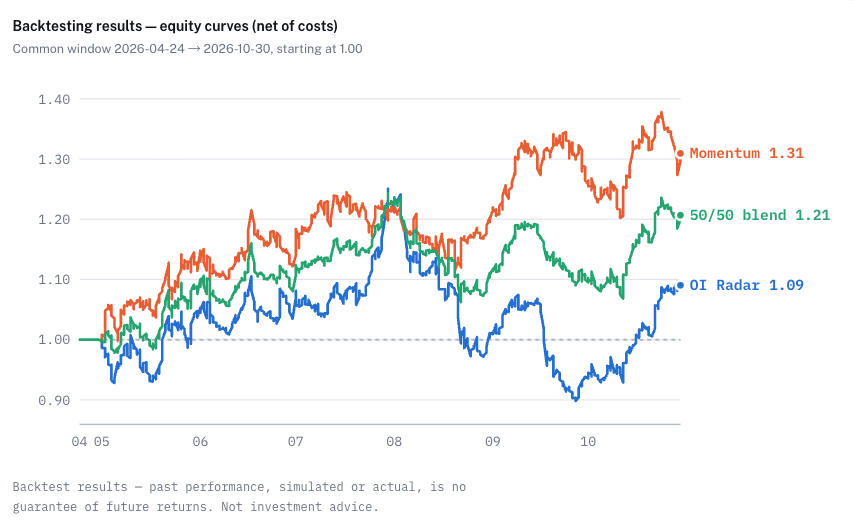
Wallet V shared historical backtest data for April 24, 2026 through October 30, 2026. After related costs, the simulated returns were:
- Momentum: about +31%
- OI Pulse: about +9%
- 50/50 combined strategy: about +21%
The company also noted that OI Pulse is labeled as “OI Radar” in the chart.
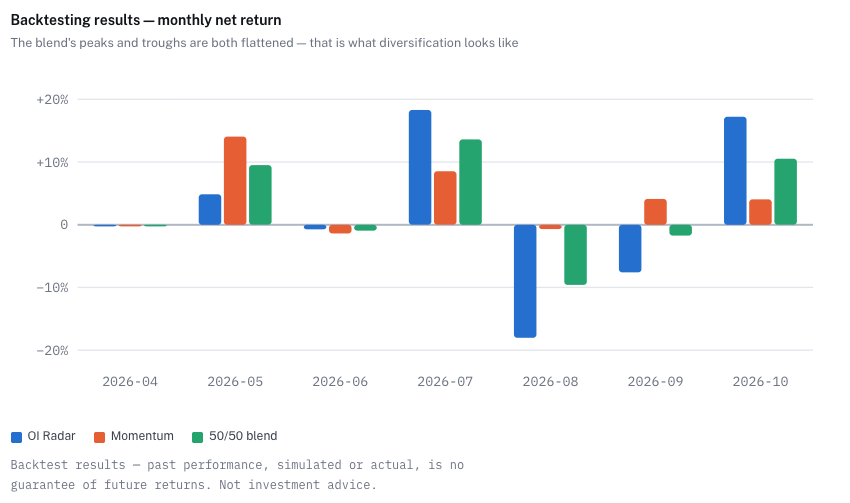
Over the full backtest window, Momentum led on overall performance. Monthly returns, however, showed clear differences between the two signal models.
In July, OI Pulse outperformed Momentum. In August, OI Pulse posted a drawdown of about 18%, while Momentum recorded only a modest decline. The 50/50 combined strategy smoothed some of the month-to-month volatility, but it still had losing months.
Wallet V said combining the two signals can help balance their respective strengths and weaknesses. It also said that does not mean the combined strategy will necessarily produce higher returns, nor does it guarantee protection from losses. The backtest was based on simulated trading and does not represent future real-world returns or any promise of profit.
How the strategy executes after a signal is triggered
Once a market signal reaches the user’s entry conditions, the strategy executes automatically under preset rules. Wallet V listed three core steps:
- Automatic entry: opens positions within the trading limits set by the user.
- Automatic exit: manages positions through take-profit targets, time-based exits, and optional stop-loss conditions.
- Re-entry limits: after exiting a market, the strategy applies a 24-hour cooldown period before it can enter that same market again.
If both long and short sides have enough valid signals, the strategy can hold long and short positions at the same time. Wallet V said that can reduce exposure to the market’s overall direction, but it does not remove trading risk or prevent losses.
The selectivity of trades, the number of positions, and the timing of exits are all determined by the user’s strategy parameters. For example, raising the entry threshold usually means stricter filtering and fewer trades. Setting a wider take-profit target means waiting for a larger price move before closing the position.
The two models are aimed at different market conditions
Wallet V described OI Pulse as a strategy that focuses on changes in market positioning and looks for signs of capital and positions building before price forms a clear trend. It said the model is especially suited to conditions where funds rotate into individual tokens.
Momentum, by contrast, is built to follow an established price trend and look for opportunities in markets where upward or downward direction is already clear.
The company said each strategy has its own strengths, and users can choose based on market conditions and personal trading preferences. It pointed users to Wallet V → AI Trading → Quantitative Strategy to explore the logic behind both models.
Wallet V also warned that perpetual futures trading carries high risk, and automated trading strategies can also generate losses. Users should set parameters carefully based on their own risk tolerance.
The article included a disclaimer stating that markets involve risk and the content does not constitute investment advice. Readers should decide whether the opinions, views, or conclusions in the article fit their own circumstances and bear responsibility for their own investment decisions.