
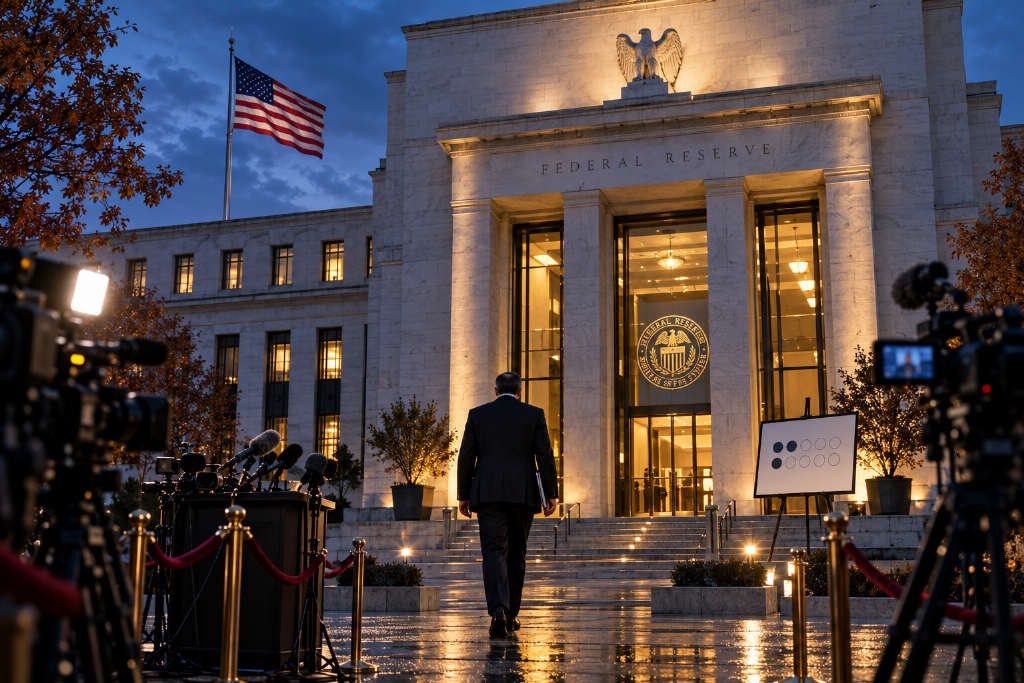
Federal Reserve Chair Kevin Warsh said inflation is still too high and declined to provide explicit forward guidance after the Federal Open Market Committee kept interest rates unchanged on Wednesday. He also announced a change to the Fed's meeting structure: beginning in 2027, the FOMC will reduce the number of meetings that include a vote on interest rates.
The press conference followed the Fed's decision on Oct. 28 Eastern Time and lasted about 35 minutes, ending at roughly 3 a.m. Taipei time on Oct. 29. A New York Times live blog noted that Warsh used the event to unveil the procedural change.
FOMC holds rates at 3.75% to 4.00% in a 10-2 vote
The FOMC voted 10-2 to keep the federal funds rate unchanged at 3.75% to 4.00%. Governor Lisa Cook and Cleveland Federal Reserve Bank President Beth Hammack supported another 25-basis-point rate increase, showing that officials remain divided over whether policy should be tightened further.
Warsh gives an upbeat economic assessment but says inflation is still elevated
Warsh opened the press conference with a relatively positive view of the economy. He said labor market conditions remain quite favorable and growth momentum has strengthened. Within the Fed's dual-mandate framework, he said the committee's discussion is now weighted more toward price stability.
He acknowledged that the Fed has not yet achieved its price-stability goal and repeated that policymakers will act to bring inflation back to 2%. He did not directly explain why the committee chose not to raise rates at this meeting.
Asked whether the economy is overheating, Warsh said most of his colleagues do not believe growth is so strong that it must lead to higher inflation. He added that rising productivity can allow the economy to grow faster without necessarily lifting prices.
On inflation expectations, he said near-term survey measures are running high, while longer-term expectations remain relatively anchored.
AI investment is one factor behind economic strength, not the only one
Warsh said the current wave of artificial intelligence investment is an important reason for the economy's strength, but not the only one. He pushed back on the idea that AI investment is detached from interest rates, saying rates work their way into the cracks of the economy and directly or indirectly affect almost everything.
He rejects clear forward guidance, except in crisis conditions
Warsh said again that he does not believe in forward guidance. He added one exception: in a crisis like 2008, guidance still has a place. That leaves markets to interpret his inflation-first tone on their own rather than rely on a direct commitment about the next step in the rate path.
Fed to add strategy-focused meetings and cut rate-vote sessions
The biggest structural announcement from the press conference was the planned change to the FOMC calendar. In 2027, the committee will still meet eight times, but one meeting will be dedicated to discussing "broad monetary policy strategy" and will not include a vote on rates. Starting in 2028, the Fed expects to shift to two strategy meetings and six rate-vote meetings.
Axios reported that Warsh said the committee needs time and space for longer-horizon strategic discussions. He has also argued that fewer voting meetings would allow more data to accumulate between decisions.
Warsh added that working groups on Fed communications and inflation models could deliver recommendations by year-end, though only "some but not all" of those proposals may be ready by then.
Warsh says politics are not part of the decision-making process
Asked about the midterm elections, Warsh said monetary policy decisions are unrelated to politics. When asked whether the Fed had any role in the White House hearing involving Cook, he said not to his knowledge.
The same policy decision also featured Cook's first dissent on the setting of monetary policy, while Hammack maintained her hawkish stance. Together, those votes highlighted the lack of consensus inside the committee over whether another round of tightening is needed.
Market attention shifts to the December meeting
By acknowledging that inflation remains high, holding rates steady, and refusing to map out the path ahead, Warsh effectively left the timing of any future hike to incoming data and market pricing. The source article said that for bond yields, mortgages, and other rate-sensitive assets, the December path matters more than this week's hold.
If inflation data stay sticky, market bets on another year-end hike could rise. If expectations remain anchored and productivity absorbs stronger growth, the new structure of fewer meetings and fewer rate votes could also reshape how traders think about the policy cycle, with rate-sensitive positions repriced more often during the gaps between meetings.



