
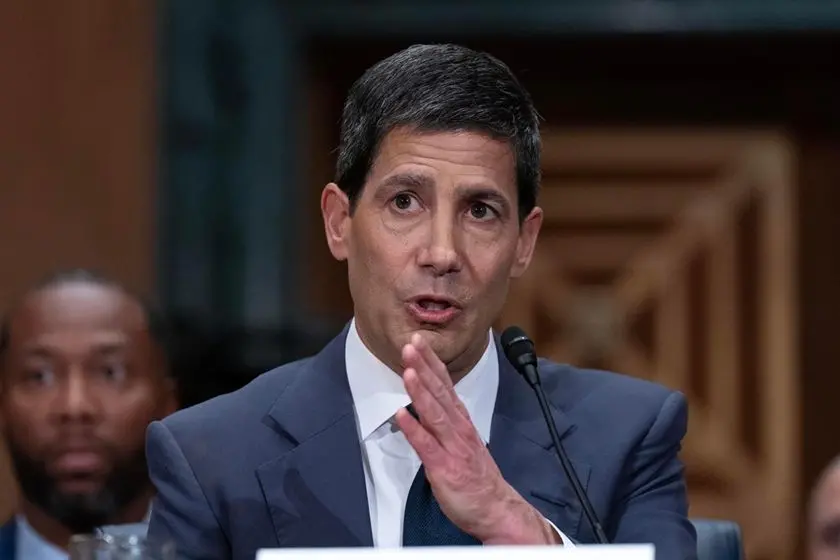
Federal Reserve Chair Warsh is confronting a policy question with a strong historical echo: raising rates may, paradoxically, help pull longer-term yields lower and move closer to the Trump administration’s goal of reducing mortgage rates.
Heading into this week’s Federal Reserve meeting, the bond market has priced the probability of an increase in the federal funds target rate at 38%, a sharp jump from less than 10% before Warsh appeared before the Senate Banking Committee. A Bloomberg Economics sentiment index tracking Fed officials’ remarks shows policymakers as a group have turned their most hawkish since the 2023 rate-hike cycle, with a clear hawkish lean among the seven voting members.
A hike is still not the base case. Even so, a chain of reasoning has begun circulating in markets: if Warsh uses a rate increase to strengthen his anti-inflation credibility, that could squeeze the inflation premium embedded in long-dated yields, pulling down borrowing costs tied to the real economy, including mortgage rates and auto-loan rates. That is the outcome the White House is said to want most.
A policy lesson from the “Greenspan conundrum”
The logic has a historical reference point. In 2004, former Fed Chair Alan Greenspan encountered a similar pattern. The Fed lifted its federal funds target from 1% to 4.75% by early 2006, yet longer-dated Treasury yields did not rise in tandem and instead moved lower. Thirty-year mortgage rates fell from a mid-2004 high of 6.34% to a low of 5.47% a year later. The episode later became known as the “Greenspan conundrum.”
Robert Burgess, executive editor for Bloomberg Opinion, argued that this was less a conundrum than an example of forward-looking market pricing. In that reading, each rate increase reinforced investor confidence in the central bank’s commitment to fighting inflation, and longer-term yields came under downward pressure as a result.
Treasury Secretary Bessent is familiar with that framework. Early last year, he said clearly that his and Trump’s policy focus was on lowering long-term rates rather than pushing the Fed to cut short-term policy rates. Tom Porcelli, chief U.S. economist at Wells Fargo Securities, made the same point in a note to clients last week:
“We frequently hear from people who believe the Fed will raise rates soon that Warsh, by hiking, can get the outcome he and Bessent really want — lower long-term rates. The logic is that a hike would reinforce Warsh’s anti-inflation credibility and compress the inflation premium embedded in the long end of the rates market.”
Warsh’s hawkish posture and his message on independence
Since taking over from Jerome Powell in May, Warsh has consistently projected a tough stance. At a July 15 Senate Banking Committee hearing, when pressed on whether he remained in contact with Trump, Warsh answered:
“I have repeatedly told the president and the Treasury secretary the same thing: they chose an independent person to do an independent job, and that is exactly my plan.”
Bloomberg Economics, in its assessment of the hearing, said Warsh “made no effort to hide his hawkish stance.” The firm argued that after inflation ran above the Fed’s 2% target for 63 straight months, the price-stability side of the mandate looked more difficult than the full-employment side. Warsh also said investment in artificial-intelligence infrastructure was adding to inflation pressure because demand-side shocks were showing up faster than supply could respond.
Right after those comments, the 10-year Treasury yield moved lower and posted its biggest one-day decline in three weeks, creating a miniature replay of the Greenspan episode: hawkish rhetoric coincided with lower long-term yields.
The new-chair hiking pattern and the current constraints
History offers another point of comparison. Research from TS Lombard strategist Dario Perkins shows that Paul Volcker began raising rates less than two months after becoming Fed chair. Greenspan, Ben Bernanke and Powell all moved within a month of taking office. Janet Yellen was the exception, waiting 22 months before her first rate increase.
Perkins wrote in a client note:
“Newcomers usually start from a hawkish position, and that helps establish anti-inflation credibility. Volcker captured the mood in one line when he welcomed Greenspan’s first rate hike: ‘Congratulations — now you are a real central banker.’”
Still, the current setting imposes limits. The latest inflation data show price pressures have eased. Warsh has announced five working groups to conduct a broad review of how the Fed operates, with results expected before year-end. Tightening policy abruptly before those findings are released would be a delicate move. Warsh also has only one vote on the Federal Open Market Committee, and changing the policy rate requires seven votes.
Even so, that hurdle may be less forbidding than it looks on the surface, given that several officials have already hinted that further tightening may be needed. Whether or not the Fed hikes this week, the prevailing market view is that Warsh is systematically building anti-inflation credibility, and that alone may already be the strongest precondition for lower long-term rates.