
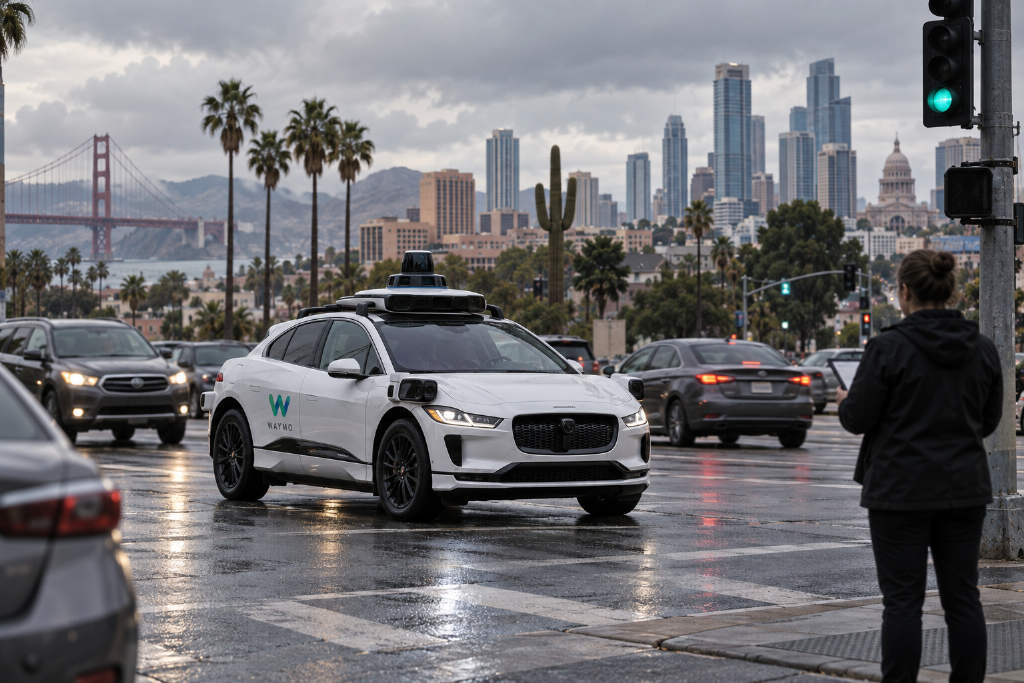
A July study by the Insurance Institute for Highway Safety, or IIHS, found that Waymo’s overall crash rate was 68% lower than that of human drivers across four U.S. cities: San Francisco, Phoenix, Los Angeles, and Austin. The comparison covered 222 billion miles of human driving and 50 million miles driven by Waymo’s autonomous vehicles over the same period.
Put simply, the study suggests Waymo’s crash rate was roughly two-thirds lower than the human benchmark. The result offers some of the clearest direct evidence yet in the long-running debate over whether self-driving systems are safer than people behind the wheel. At the same time, the researchers said the current crash-reporting system is incomplete, which leaves major gaps in any side-by-side comparison.
Safety data has been building for years
The article places the Waymo findings in a broader safety context. IIHS research has previously shown that automatic emergency braking systems capable of detecting pedestrians can cut pedestrian crashes by 27%. Rear-end crashes fall by 50%, while injuries resulting from those rear-end collisions drop 56%.
Claims data from the Highway Loss Data Institute, or HLDI, points in the same direction. Vehicles equipped only with automatic braking saw property-damage claims fall 13%. When a full advanced driver-assistance system, or ADAS, package is installed, including pedestrian braking, adaptive cruise control, and lane-departure warning, the reduction in claims can reach 39%.
Federal policy is also moving in that direction. Automatic emergency braking is expected to become mandatory on light vehicles starting in 2029. According to the article, more than 90% of new vehicle models already meet that standard under voluntary commitments from automakers.
Waymo’s own numbers and the independent IIHS comparison
Waymo has completed 20 million paid passenger trips and driven 220 million miles in total, according to the report. It describes that distance as roughly equal to 250 people driving over a lifetime.
Waymo’s own safety report says fatal or serious-injury crashes are down 92% versus human drivers and are 13 times lower in comparable urban environments. It also says pedestrian injury crashes are down 92%, airbag-deployment crashes are down 83%, and injury crashes at the highest-risk intersections are down 96%.
Still, the article makes clear that those figures should not be accepted without qualification. One major problem is underreporting on the human-driver side. Researchers estimate that about half of human crashes are never reported at all. For injury crashes, as many as one-third may be missing from the record, in part because drivers do not want higher insurance premiums. Waymo, by contrast, is required by regulators to report even minor collisions to the National Highway Traffic Safety Administration, or NHTSA.
Operating scope is another source of distortion. Waymo currently runs only in a small number of U.S. cities and mainly under favorable weather conditions. Human drivers, meanwhile, also drive in heavy rain, snow, mountain roads, and rural areas. Comparing robots in mild urban settings with people driving everywhere is not an even match.
City-by-city results were not uniform
Eric Teoh, director of statistical services at IIHS, tried to tighten the comparison in the July study by using police-reportable crashes as the baseline category. That approach was intended to reduce some of the noise created by inconsistent reporting practices.
Even after accounting for operating conditions and the large gap in mileage samples, Waymo still showed 68% fewer crashes overall. By city, the crash rate was 76% lower in Phoenix, 71% lower in Los Angeles, and 35% lower in San Francisco. Austin was the outlier: Waymo’s crash rate there was 4% higher. The researchers said that result was likely due to a sample that was too small.
Measured per mile, Waymo’s injury-crash rate remained 81% lower than the human-driver benchmark. Teoh said the results were “encouraging signs” for the future of autonomous vehicles, while adding that crash-data collection systems still need to be fixed before long-term safety performance can be evaluated with confidence.
The debate is also being framed as a public health issue
The article says some physicians and medical professionals argue that policymakers should stop viewing autonomous driving as a moonshot-style technology project and start treating it as a public health intervention.
Neurosurgeon Jonathan Slotkin has written about the medical and social benefits of self-driving vehicles. Researchers at the Johns Hopkins Bloomberg School of Public Health have also argued that making the social value of autonomous vehicles clear is important for public trust and adoption.
Road-death figures remain central to the argument
World Health Organization data cited in the article shows that about 1.16 million people die in road crashes globally each year, making traffic injury the leading cause of death for children and young people aged 5 to 29. In the United States, about 40,000 people die on the roads each year, including more than 7,000 pedestrians.
The article says that if autonomous vehicles could cut the global death toll by 50%, that would mean 580,000 lives saved each year. Some studies, it adds, estimate reductions of as much as 90%.
Even so, favorable Waymo data does not mean self-driving technology is already beyond question. The sample is still limited, weather conditions have been relatively favorable, and the number of cities remains small. Those gaps have not been closed.