
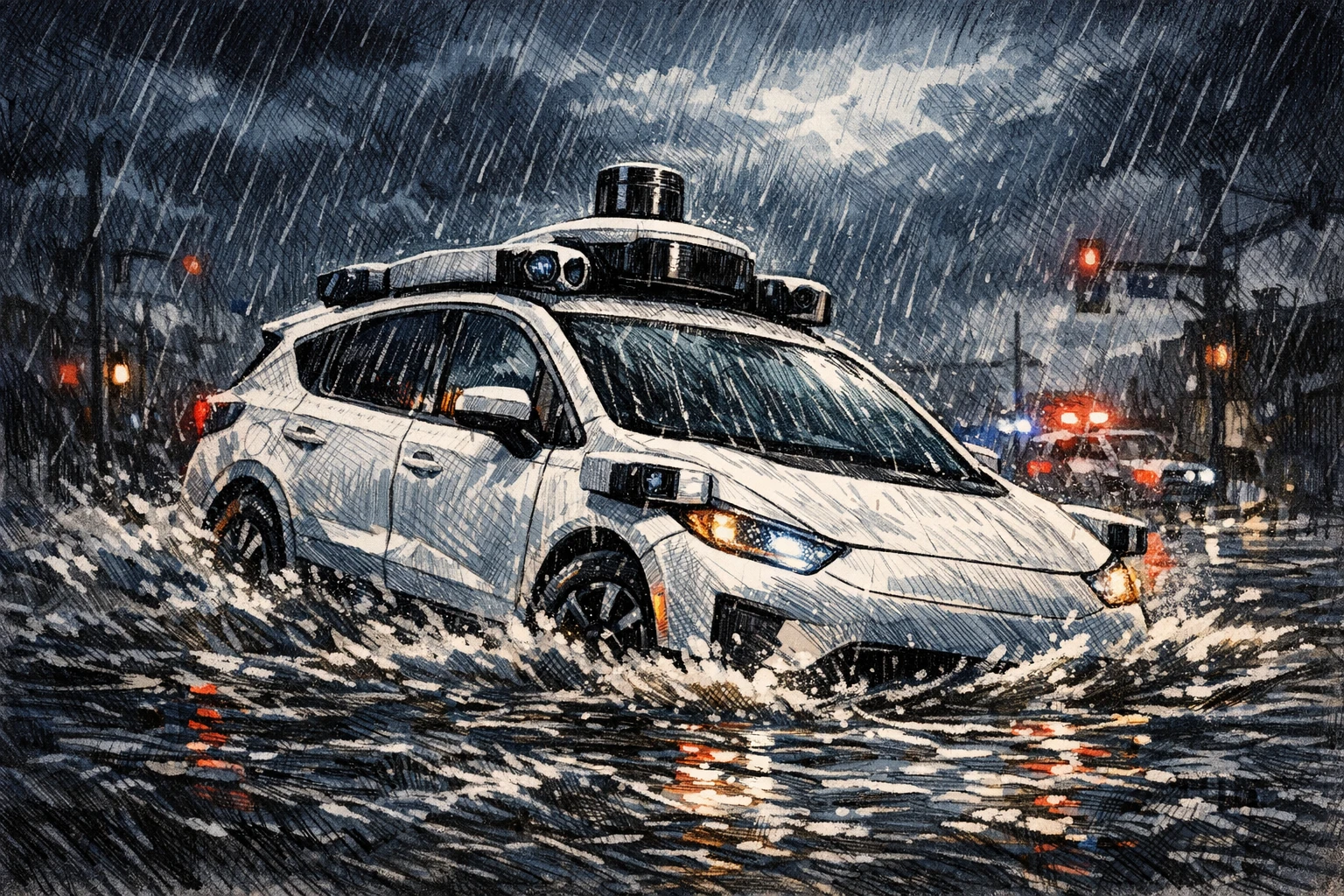
Waymo has recalled 3,791 robotaxis and suspended service in Atlanta, San Antonio, Dallas, and Houston after repeated incidents involving flooded roads. The core issue is software: the vehicles were unable to reliably identify dangerous standing water. On April 20, a Waymo robotaxi in San Antonio drove into a flooded area and was swept into a creek. On May 21, another unmanned Waymo vehicle in Atlanta entered a flooded street, remained stuck for nearly an hour, and had to be removed by a tow truck.
Two similar flooding incidents in two months
After the San Antonio crash, Waymo launched a recall on May 12. This was not a conventional repair campaign requiring vehicles to return to a facility. Instead, the company pushed an over-the-air software update. Waymo said the update was only an interim fix, limiting vehicle operations in flood-prone areas and during certain periods, while a final solution had not yet been completed.
The Atlanta case on May 21 showed the limits of that approach. Heavy rain had already caused visible street flooding, but the National Weather Service had not yet issued a flood warning. That meant Waymo’s existing controls, built around high-risk time windows and geofencing logic, did not activate in time.
Edge-case weakness in the perception stack
Robotaxi perception systems depend on large labeled datasets to distinguish drivable surfaces, obstacles, and lane boundaries. Most urban road data reflects normal dry conditions. Flooded streets are rare edge cases, which means they may be underrepresented in training. The problem is not just a bad decision in a hard moment; the system may not have been fully trained to treat that visual pattern as a hazard requiring braking or avoidance.
According to the source material, cameras and LiDAR can struggle because the reflective properties of standing water can resemble wet asphalt. Waymo’s temporary fix tried to work around that with geofencing and time-based restrictions. That only works if warnings arrive faster than changing weather conditions. The Atlanta incident showed that localized storms can outpace those triggers.
Waymo currently operates commercially in 11 U.S. cities. With four cities now paused, more than one-third of that operating footprint has been affected. Because the fleet relies on shared software logic, one defect can scale across markets very quickly.
Regulatory pressure extends beyond the flooding recall
The flooding cases have already drawn the attention of NHTSA. At the same time, Waymo is also facing other investigations. The report says NHTSA and the NTSB are jointly examining repeated incidents in which Waymo robotaxis illegally passed stopped school buses. State rules require vehicles to stop and wait when a school bus has its stop arm extended, but Waymo vehicles in Austin reportedly violated that requirement multiple times. After earlier fixes failed to resolve the issue, NHTSA sent a second round of information requests on May 15.
Another case occurred on January 23 this year, when a Waymo robotaxi in Santa Monica, Los Angeles, traveling at about 10 kilometers per hour, struck a child and caused minor injuries near an elementary school. NHTSA said it would take action on the flooding matter if necessary. What is already clear is that Waymo is dealing with more than a single software flaw: it is facing a widening gap between system performance, commercial deployment, and regulatory scrutiny.