
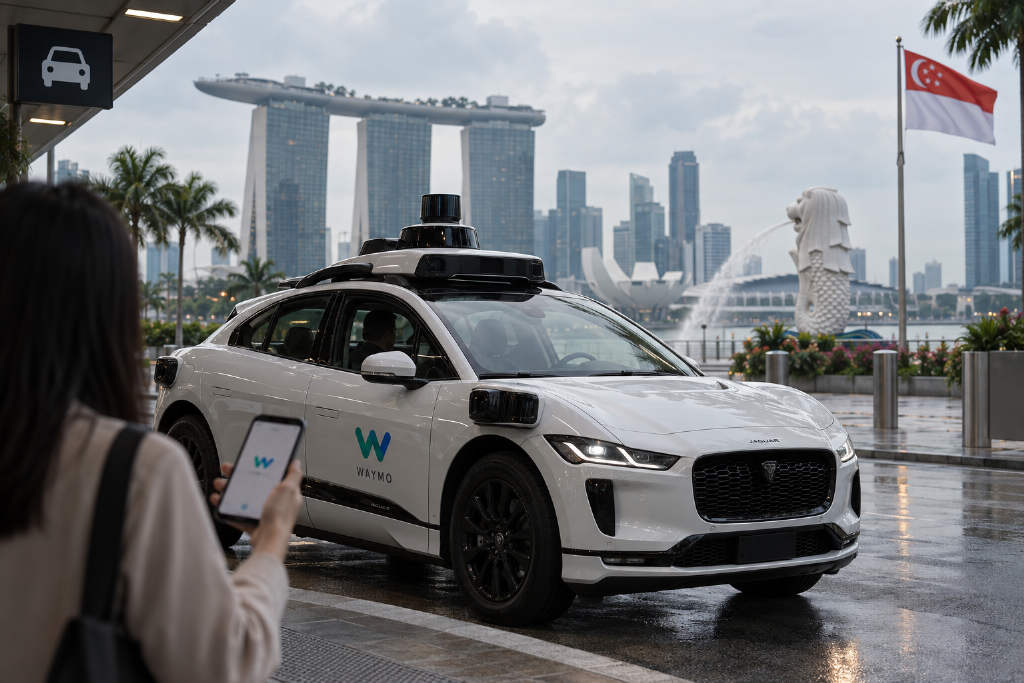
Waymo said it will enter Singapore’s autonomous mobility market and plans to launch a fully autonomous, all-electric commercial ride-hailing service in 2028 through the Waymo app. The company said it will work with Singapore’s Ministry of Transport and the Land Transport Authority. The move marks Waymo’s first expansion into Southeast Asia and makes it the third autonomous vehicle operator in Singapore after Grab and ComfortDelGro.
First Jaguar I-PACE fleet due in coming months
In an official announcement released earlier this week, Waymo said the first batch of all-electric Jaguar I-PACE vehicles will arrive in Singapore in the coming months as it sets up local operations. The company said 2027 will serve as a readiness phase.
During that stage, trained autonomous driving specialists will sit in the driver’s seat and manually operate the vehicles so the system can learn Singapore’s road geometry, intersection design, and monsoon weather patterns. The company will also collect data and apply to the Land Transport Authority for approval of its autonomous driving system. Singapore users are not expected to be able to hail a truly driverless vehicle through the app until 2028.
Waymo cites global operating record
Waymo said it has completed more than 20 million fully autonomous trips globally and logged more than 300 million kilometers on public roads. In U.S. cities where it operates, the company said crashes causing injuries were 94% lower than those involving human drivers.
According to the report, those figures helped give Singapore’s government confidence to allow the rollout.
Singapore minister welcomes the entry
Singapore Transport Minister and Second Minister for Finance Chee Hong Tat publicly welcomed Waymo as the country’s newest autonomous vehicle operator. He said the company’s arrival would bring world-class technology and operating experience to Singapore and create new job opportunities.
Singapore’s current autonomous fleet remains limited
Before Waymo’s entry, Singapore’s autonomous vehicle market was relatively small. Grab and ComfortDelGro are currently the only two operators, with 11 and 5 autonomous vehicles respectively. Those vehicles run on three fixed shuttle routes in the Punggol area.
Two-year gap centers on regulation and trust
The report said the period between the 2026 announcement and the 2028 commercial launch is not mainly about solving technical issues. Instead, it is about building trust with regulators and the public, including collecting local road-test data, mapping the territory, applying for approval from the Land Transport Authority, and complying with Singapore’s Personal Data Protection Act.
The report said the bottleneck for autonomous vehicle companies expanding overseas is not whether the algorithm can run, but that each new city requires a fresh regulatory trust-building process.
Expansion model built around in-house lidar
Waymo’s fleet relies on its in-house lidar system. The report described it as a sensor suite that uses lasers to scan the surrounding environment and can detect and predict the movements of pedestrians and cyclists across a 360-degree field at distances of up to 300 meters.
The report said this system supports a safety-first expansion framework that Waymo is also replicating in Tokyo, London, and Munich. In the report’s framing, technology determines entry capability, while regulatory trust determines whether commercial deployment can actually happen.