

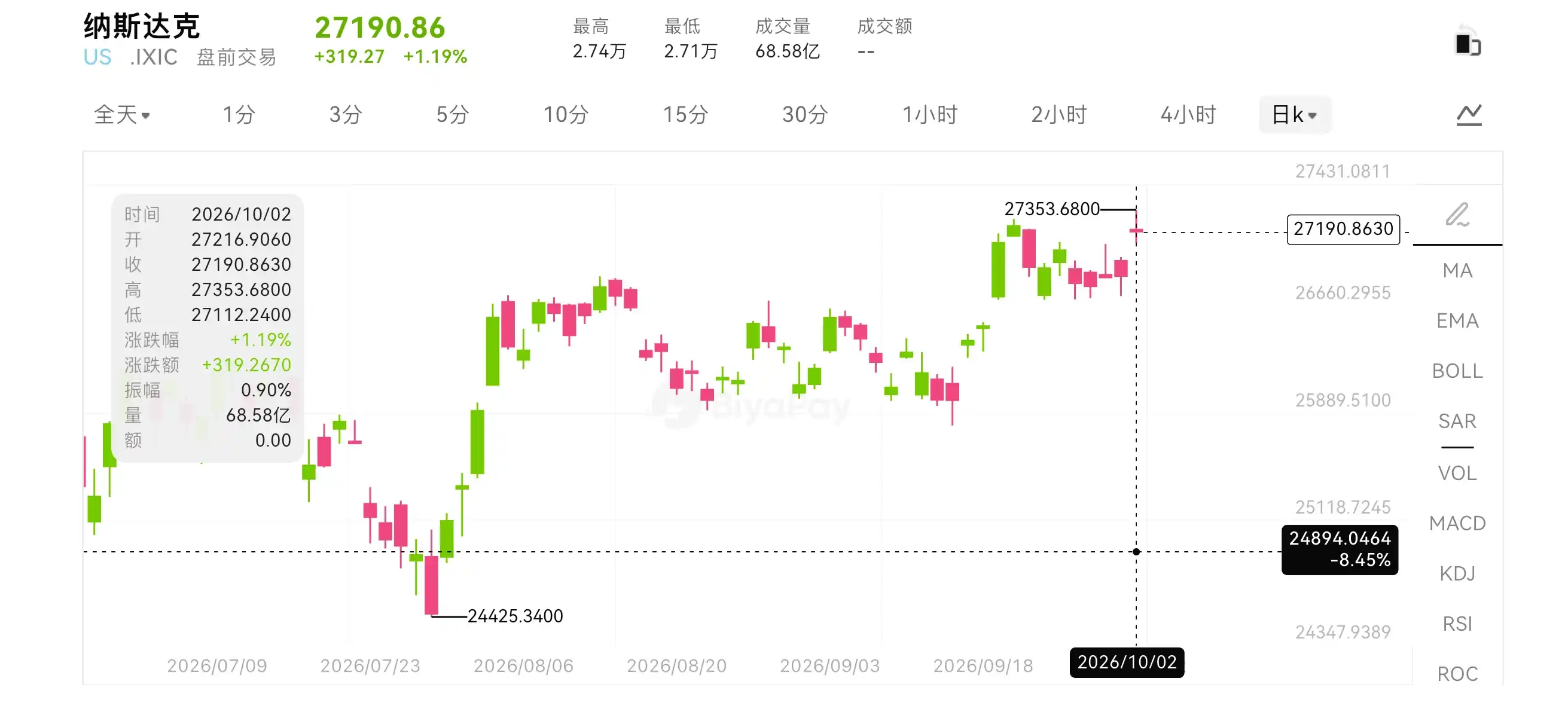
U.S. equities advanced on Oct. 2 after a softer labor report, but long-dated Treasury yields did not stay down. BiyaPay market data showed the Nasdaq Composite rising 1.2%, the S&P 500 gaining 0.7%, and the Dow Jones Industrial Average up 0.5%. On the same day, the 10-year U.S. Treasury yield closed at 5.279% and the 30-year yield finished at 5.628%. Stocks and long-end yields moved higher together, a sign that the market was not offering one clear answer on growth, inflation, and the cost of capital.
The payroll miss was real, but the signal was mixed
The report said U.S. nonfarm payrolls increased by 29,000 in September, below the revised 133,000 in August. July was revised to a decline of 10,000. The unemployment rate rose to 4.2%, but it has remained within a 4.1% to 4.3% range since March. Over the past three months, payroll growth averaged about 51,000 a month, slightly above the 45,000 monthly average over the previous 12 months.
As framed in the article, the better reading of the report is that what had looked like labor-market reacceleration was weakened by revisions, while hiring itself remained slow. The numbers did not provide enough evidence to say the economy was suddenly rolling over. They also did not support a strong-growth call. That middle ground gave investors room to reset expectations for the rate path.
Wages and hours also mattered. Average hourly earnings rose 0.1% month over month and 3% year over year in September, while the average workweek stood at 34.4 hours. Those measures did not show a clear reacceleration in wage growth, but they also could not stand in for consumption or inflation data. The jobs report speaks to labor conditions; the Federal Reserve and corporate earnings still have to deal with a broader set of inputs.
The article also notes that BiyaPay, described as a global one-stop asset allocation platform, lets users track U.S. stocks, Hong Kong stocks, BTC, and ETH in one place, and supports converting digital assets into U.S. dollars and Hong Kong dollars for real-time stock trading without applying for an offshore account. Combined with public Treasury and macro data, that setup can make cross-market comparisons easier when one headline hits several asset classes at once.
Why weak data can still lift equities
After the softer payroll print, the market cut back its bets on another Fed rate increase. The report cited Oct. 2 pricing that implied a 22.7% probability of a 25-basis-point hike at the October meeting, down from 64.2% a week earlier. That figure comes from rate futures pricing and changes over time. It should not be treated as a confirmed meeting outcome.
Equity prices reflect both future cash flows and the return investors demand. If weaker macro data only reduces the pressure for more tightening, while leaving corporate revenue expectations largely intact, valuation support can outweigh the downside from the data itself. That is why disappointing economic releases can sometimes push stocks higher instead of lower.
Still, the article draws a clear line around that logic. If labor weakness keeps building and starts to feed into household income, consumption, and corporate orders, earnings expectations would have to move down. At that point, even if investors begin to price lower rates ahead, weaker cash flow and a higher risk premium could offset any valuation benefit. In that sense, the idea that "bad news is good news" for stocks depends on how much the economy slows, not on a fixed rule.
Long-end yields kept the market from getting too comfortable
The most important signal in bonds, according to the article, was that the post-payroll decline in yields did not last. Short-dated yields are more closely tied to expectations for the next few Fed meetings. Long-dated yields also reflect long-run inflation expectations, term premium, and the market's broader view on Treasury supply and the economic outlook. Cutting the odds of one additional hike is not enough to remove all of the pressure at the long end.

That is also why the federal funds rate cannot simply be used as the discount rate for equities. Corporate funding costs also include credit spreads, while the return equity investors require also includes a risk premium. A softer Fed outlook may help valuations, but if long-dated Treasury yields and broader market compensation for risk remain elevated, companies may not see meaningfully cheaper financing right away.
The article adds that nominal rates and real rates should not be treated as the same thing. A rise in the 10-year yield does not automatically mean real yields rose by the same amount, because inflation expectations are shifting too. For U.S. stocks, the valuation impact comes from the combined effect of these forces on the cost of capital, not from one yield in isolation.
AI trades still had support, but stock selection mattered
The article said Nvidia hit a new high on the day, while HPE got a lift from expectations tied to data-center network demand. That suggested investors were still focused on AI infrastructure. But in a high-rate environment, growth narratives face tougher financial tests. Gaps between orders, margins, and cash flow can become a major driver of divergence between individual names.
Chipmakers still need to convert orders into shipments and profit. Cloud service providers need to show that added compute capacity can generate revenue. Software companies need to prove that users will pay for AI features. Two firms can post similar top-line growth, yet receive very different valuations if one must keep pouring in capital while the other already produces more stable cash flow.
Large technology companies also retain advantages in cash reserves and financing capacity. Changes in rates may not hit them the same way they hit faster cash-burning growth companies. Treating all tech stocks as a single "rates down, stocks up" trade misses differences in business mix, balance-sheet structure, and competitive position. A stronger Nasdaq does not automatically mean the whole growth complex improved at the same time.
After the rebound, earnings still have to do the work
To judge whether the move can last, the article says investors need to look beyond index gains. The key questions are whether the rally broadens across more sectors, whether earnings expectations improve, and whether company guidance supports current prices. If a handful of heavyweight stocks are doing most of the lifting while revenue and profit forecasts for many others are still being revised down, the base of the rally remains narrow.
Several paths remain open. If employment cools in an orderly way, inflation eases as well, and corporate earnings hold up, valuations may have more room. If growth weakens more sharply, investors are likely to worry about earnings instead. If inflation stays sticky and long-end yields remain high, valuation pressure could reappear. The article stresses that one payroll report is not enough to choose among those outcomes. More data will be needed.
The Oct. 2 rally showed that the market was willing to reprice for lower hiking pressure. The Treasury close showed that capital costs had not disappeared. Whether the rebound in U.S. stocks can continue will depend on whether companies deliver the growth already embedded in prices, and whether the rate backdrop leaves enough room for that growth to support valuations.




