

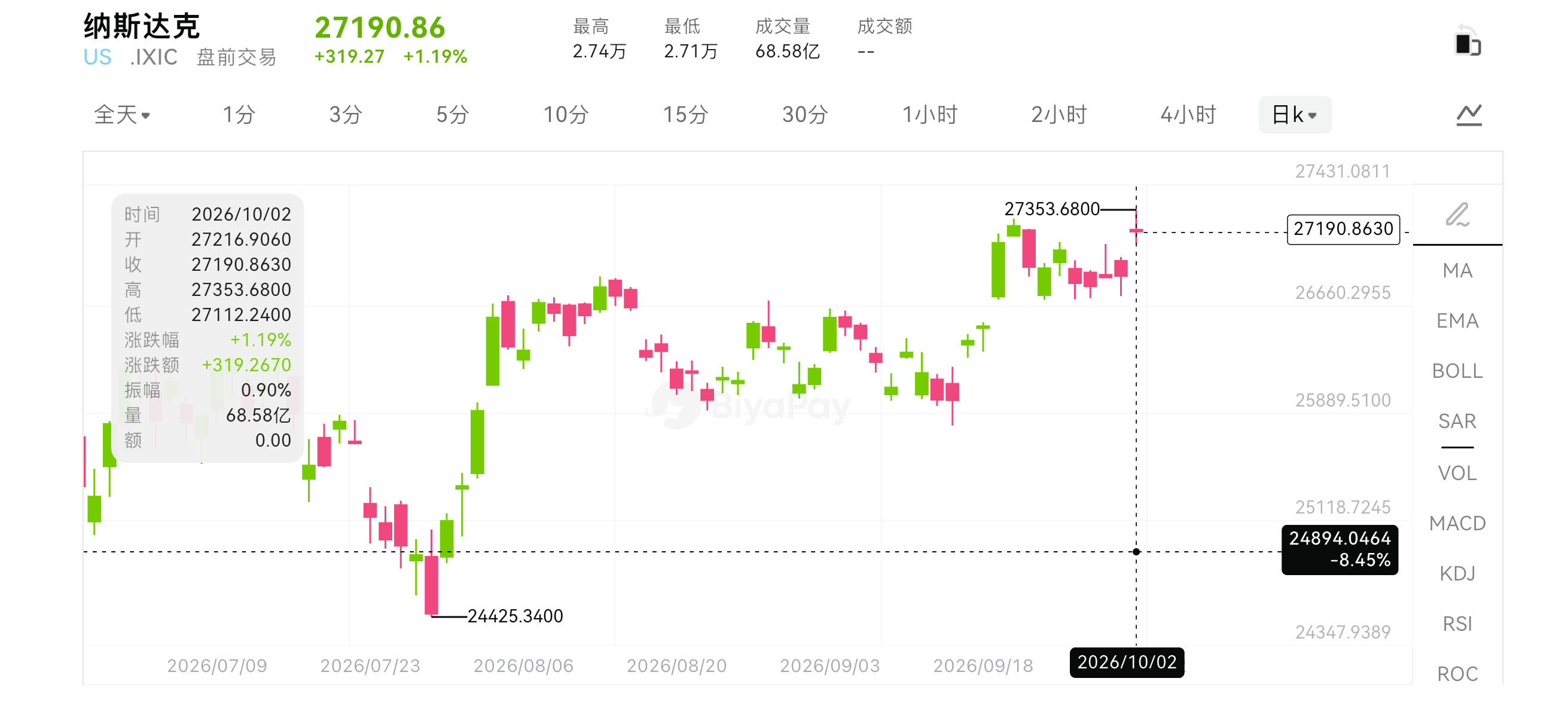
U.S. stocks rose on Oct. 2 after a weaker-than-expected employment report, but the move in Treasuries made the session harder to explain with a single narrative. BiyaPay market data showed the Nasdaq Composite gained 1.2%, the S&P 500 rose 0.7%, and the Dow Jones Industrial Average added 0.5%. On the same day, the 10-year U.S. Treasury yield closed at 5.279% and the 30-year yield at 5.628%. With equities and long-end yields both moving higher, the market did not deliver one clear answer on growth, inflation, or the cost of capital.
What was weak in the jobs report
September nonfarm payrolls increased by 29,000, below August’s revised 133,000. July was revised to a decline of 10,000. The unemployment rate rose to 4.2%, though it has stayed in a 4.1% to 4.3% range since March. Over the past three months, payroll growth averaged about 51,000 a month, slightly above the 12-month average of 45,000.
The article’s reading is that earlier signs of faster hiring were weakened by revisions, while the labor market itself remained in a low-growth state. The report did not provide enough evidence to show the economy was slipping quickly, nor did it support a strong-growth case. That middle ground gave investors room to reset rate expectations.
Wages and hours also mattered. Average hourly earnings rose 0.1% month over month and 3% year over year in September, while the average workweek stood at 34.4 hours. Those figures did not show a clear reacceleration in wage growth, but they also could not stand in for consumer spending or inflation data. The report answered questions about labor conditions, not the full set of inputs facing the Federal Reserve or corporate earnings.
BiyaPay said that, as a global one-stop asset allocation platform, it allows users to track U.S. stocks, Hong Kong stocks, BTC, and ETH in one place, and supports converting digital assets into U.S. dollars and Hong Kong dollars. The article said users can take part in stock trading in real time without applying for an offshore account, while comparing reactions across markets with public Treasury and macro data.
Why weak data can still lift stocks
After the soft employment data, the market reduced its bets on another Fed hike. A report cited in the article showed the implied probability of a 25-basis-point increase at the October meeting was 22.7% on Oct. 2, down from 64.2% a week earlier. The piece noted that this figure comes from rate futures pricing and changes over time, so it should not be treated as a fixed meeting outcome.
Stock prices reflect both future cash flows and the return investors demand. If weaker data only reduce the pressure for more tightening without doing obvious damage to company revenue, valuation expansion can outweigh the downside. That is why some economic releases that miss expectations can still push equities higher.
But the article also drew a line around that logic. If labor conditions keep weakening and the slowdown spreads to household income, consumption, and corporate orders, earnings expectations would likely be revised lower. In that case, even if investors expect lower rates later on, weaker cash flows and a higher risk premium could offset any valuation support. Whether “bad news is good news” works for stocks depends on how far the economy slows, not on a fixed rule.
Long-end yields stayed a constraint
The more important bond-market signal, according to the article, was that the post-report drop in yields did not last. Short-dated yields more directly reflect expectations for the next few Fed meetings. Long-dated yields also include long-term inflation expectations, term premium, and the market’s broader view on Treasury supply and the economic outlook. Cutting the odds of one additional hike does not remove all of the pressure at the long end.
That is also why the federal funds rate cannot be used as a direct substitute for the discount rate in equity valuation. Corporate funding costs also include credit spreads, and the return demanded by shareholders includes a risk premium. Easier Fed expectations may help valuations, but if long-end yields and market risk compensation remain high, companies may not see cheaper financing right away.
The article also said nominal and real rates should not be treated as the same thing. A rise in the 10-year yield does not automatically mean real yields rose by the same amount, because inflation expectations move as well. For U.S. equities, what matters is the combined effect of those factors on the cost of capital, not one yield number in isolation.
The AI trade still had support, but stock selection mattered more
The article said Nvidia hit a fresh high on the day, while HPE was supported by expectations for data-center networking demand. That suggested capital was still focused on AI infrastructure. Even so, in a high-rate environment, growth expectations face tighter financial scrutiny. Gaps between orders, margins, and cash flow can become a source of divergence across individual names.
Chip companies still need to turn orders into shipments and profit. Cloud providers need to show that added computing capacity can generate revenue. Software companies need to prove there is paid demand for AI features. Two companies may post similar revenue growth, but if one still requires heavy capital spending while the other already has steadier cash flow, the market may not assign them the same valuation.
Large technology companies also have advantages in cash reserves and financing capacity. Rate changes may not affect them in the same way they affect faster cash-burning growth companies. Treating all technology stocks as a simple “rates down, stocks up” trade misses differences in business mix, balance sheets, and competitive position. A gain in the Nasdaq may reflect strength in a small number of heavyweight names rather than a broad improvement across the whole growth segment.
After the rebound, earnings still have to do the work
To judge the rebound, the article said investors should look beyond the index move itself and watch whether gains spread to more sectors, whether earnings expectations improve, and whether company guidance supports current prices. If the index is being driven mainly by a handful of large constituents while revenue and profit expectations for more companies are still being revised down, the foundation of the rally is narrow.
Several paths remain possible. If employment cools gradually, inflation eases at the same time, and corporate earnings hold up, valuations may get more room. If growth weakens more clearly, the market may shift its focus to earnings risk. If inflation proves sticky and long-end yields stay high, valuation pressure could return. The article said later data will be needed to sort between those paths, and one payroll report alone is not enough to decide the outcome.
The Oct. 2 rally showed that investors were willing to reprice equities for less rate-hike pressure. The close in Treasuries, though, was a reminder that the cost of capital had not disappeared. Whether the rebound in U.S. stocks can continue will still depend on whether companies can deliver the growth already embedded in prices, and whether the rate backdrop leaves enough valuation room for that growth.




