
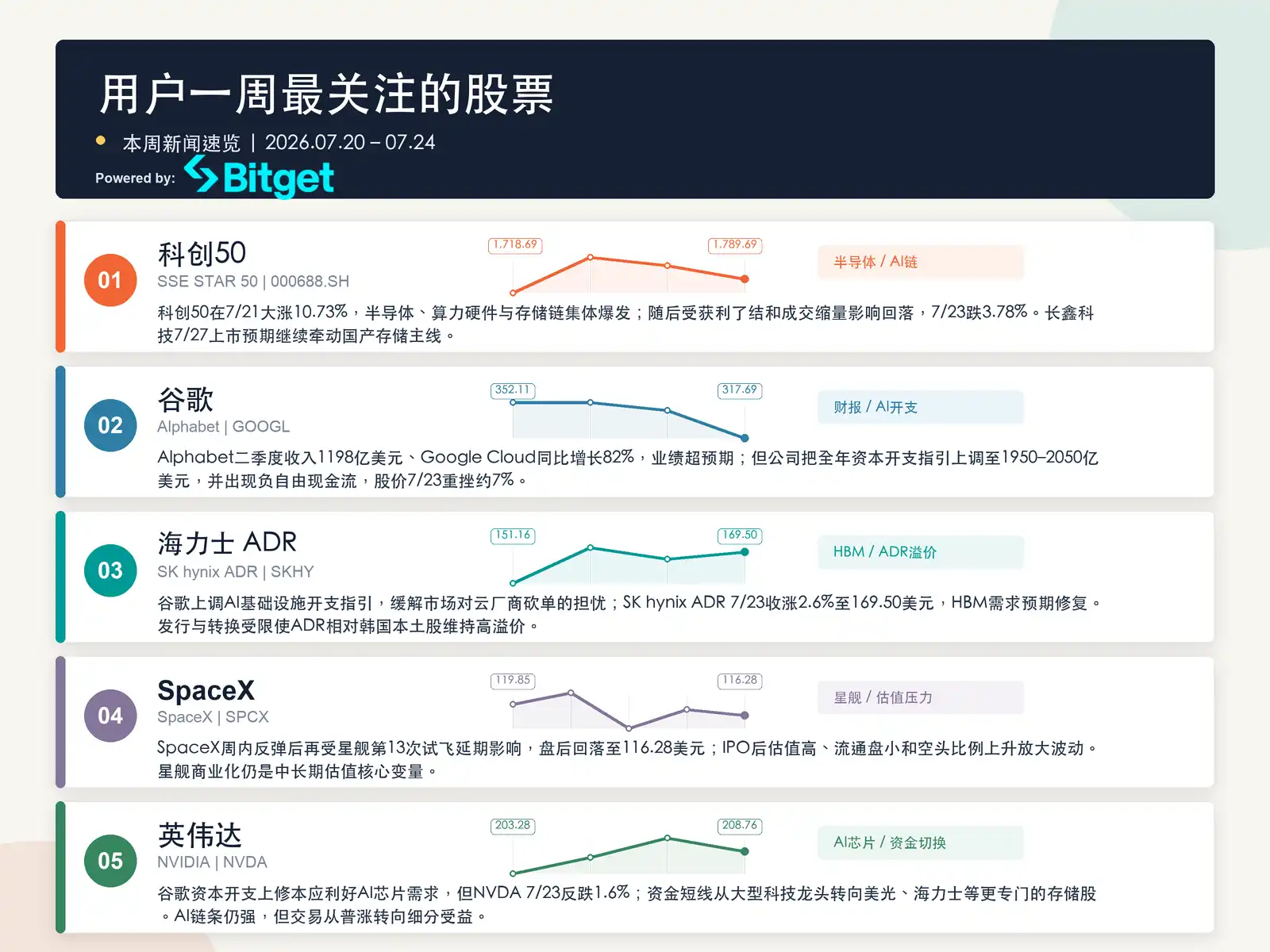
U.S. stocks pulled back from recent highs this week as earnings season put the AI trade into what BlockBeats described as an “audit” phase. As of the July 23 close in New York, the S&P 500 had fallen about 0.7% for the week and the Nasdaq was down roughly 1.5%, with large technology stocks leading the decline.
Google beat expectations in its earnings report, but its decision to raise full-year capital expenditure guidance to $195 billion-$205 billion triggered concern about returns on AI investment. At the same time, Nvidia, SK hynix ADRs and China’s STAR Market semiconductor names continued to find support from demand for AI computing power. Capital began rotating out of mega-cap tech leaders and into narrower segments such as HBM, memory and domestic DRAM. SpaceX remained under pressure as delays to another Starship test flight and valuation concerns kept post-IPO volatility elevated.
According to BlockBeats, the stocks drawing the most investor attention this week clustered around AI capital spending, the memory chain, Chinese semiconductor plays and commercial space valuations.
STAR 50 jumped, then gave back part of the move
The STAR 50 rose about 4.13% for the week. On July 21, the index surged 10.73% as semiconductor names, AI computing hardware and memory-related stocks rallied together. That momentum later cooled as profit-taking emerged and trading volume fell, and the index dropped 3.78% on July 23.
BlockBeats said expectations around the July 27 listing of ChangXin Technology continued to influence the domestic DRAM theme, with funds repeatedly repricing both AI supply-chain names and localization trades.
Google beat on earnings, but capex became the issue
Google fell about 9.78% for the week. Alphabet reported second-quarter revenue of $119.8 billion, while Google Cloud grew 82% year over year, both ahead of expectations.
Still, the company raised full-year capital expenditure guidance to $195 billion-$205 billion and posted negative free cash flow. That shifted market attention to the payback period for AI spending. On July 23, the stock dropped about 7%.
SK hynix ADR climbed as HBM demand expectations improved
SK hynix ADR gained about 12.13% over the week. Google’s higher AI infrastructure spending outlook eased fears that cloud providers could cut orders. On July 23, SK hynix ADR rose 2.6% to close at $169.50, as expectations for HBM demand improved.
BlockBeats also noted that issuance and conversion restrictions have kept the ADR trading at a sizable premium to the company’s Korea-listed shares.
SpaceX stayed volatile on Starship delay and valuation pressure
SpaceX lost about 2.98% for the week. The stock rebounded during the week, then slipped again in after-hours trading to $116.28 after another delay to Starship’s 13th test flight.
Post-IPO volatility remained amplified by its high valuation, limited float and a rising short-interest ratio. BlockBeats said the commercialization path for Starship is still the central variable in SpaceX’s medium- to long-term valuation, while near-term trading continues to track test-flight progress closely.
Nvidia held up for the week, but money shifted elsewhere
Nvidia gained about 2.70% for the week. Higher capex from Google would normally support demand for AI chips, yet NVDA still fell 1.6% on July 23 along with the broader large-cap tech complex.
In the near term, capital shifted out of major tech leaders and into more specialized memory beneficiaries such as Micron and SK hynix. The AI supply chain remained firm, but trading moved away from broad-based gains and toward profit realization in narrower segments.