

Western Digital said in its FY2026 Q4 earnings release that revenue reached $3.747 billion for the quarter. Under U.S. GAAP, earnings per share came in at $8.21. The company also recorded gains from the market-value remeasurement of its SanDisk holdings, which means the quarter’s profit figures carry two distinct readings: the HDD business improved on its own after the flash spinoff, and the retained SanDisk stake added a separate boost to GAAP earnings.
Core HDD revenue has risen for five straight quarters
From FY2025 Q4 through FY2026 Q4, Western Digital’s revenue climbed from $2.605 billion to $3.747 billion, with no quarter-over-quarter break in that upward path across the five reported quarters.
That trend matters because the reporting basis changed. Western Digital completed the spinoff of its flash business in February 2025, and the newly independent SanDisk is no longer included in continuing operations. In its latest earnings release, the company also recast prior comparable periods on an HDD continuing-operations basis. In other words, the growth line does not reflect SSD revenue being folded back in. It reflects a larger hard drive business on a cleaner basis.
According to the company’s presentation released the same day, cloud accounted for 89% of Q4 revenue. That end-market label is not the same thing as booked AI revenue, but it does show where Western Digital’s business is concentrated: hyperscale cloud operators and cloud service providers. In that chain, hard drives are there for high-capacity data storage, not compute.
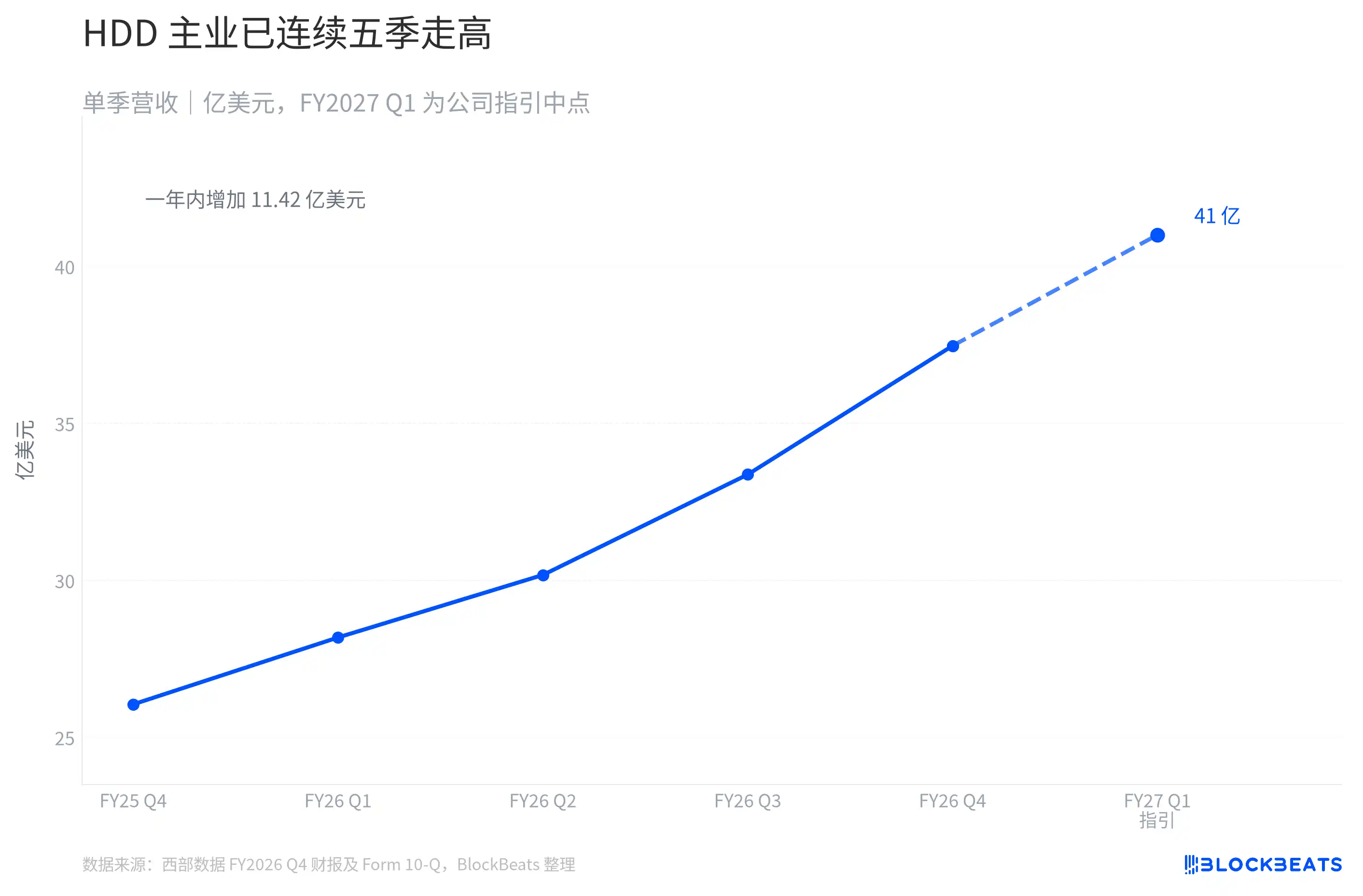
Western Digital’s FY2026 Q4 earnings release put the midpoint of its FY2027 Q1 revenue guidance at $4.1 billion. That guidance is still management’s current view, not a confirmed result for the next quarter.
Margins expanded alongside sales
Higher revenue does not automatically mean a stronger business, especially in hard drives, where shipments, pricing, inventory, and factory utilization can all move through the income statement at the same time during an upswing. A simpler test is how much of every $100 in revenue remains after direct production costs.
For FY2026 Q4, Western Digital reported a GAAP gross margin of 54.1%. Put plainly, the company kept more than half of every $100 in storage-product revenue after direct manufacturing costs.
Compared with a year earlier, gross profit per $100 of revenue was roughly $13 higher. A separate operating-margin line in the chart moved up at a similar slope, showing that added gross profit was not erased by research, sales, and administrative costs.
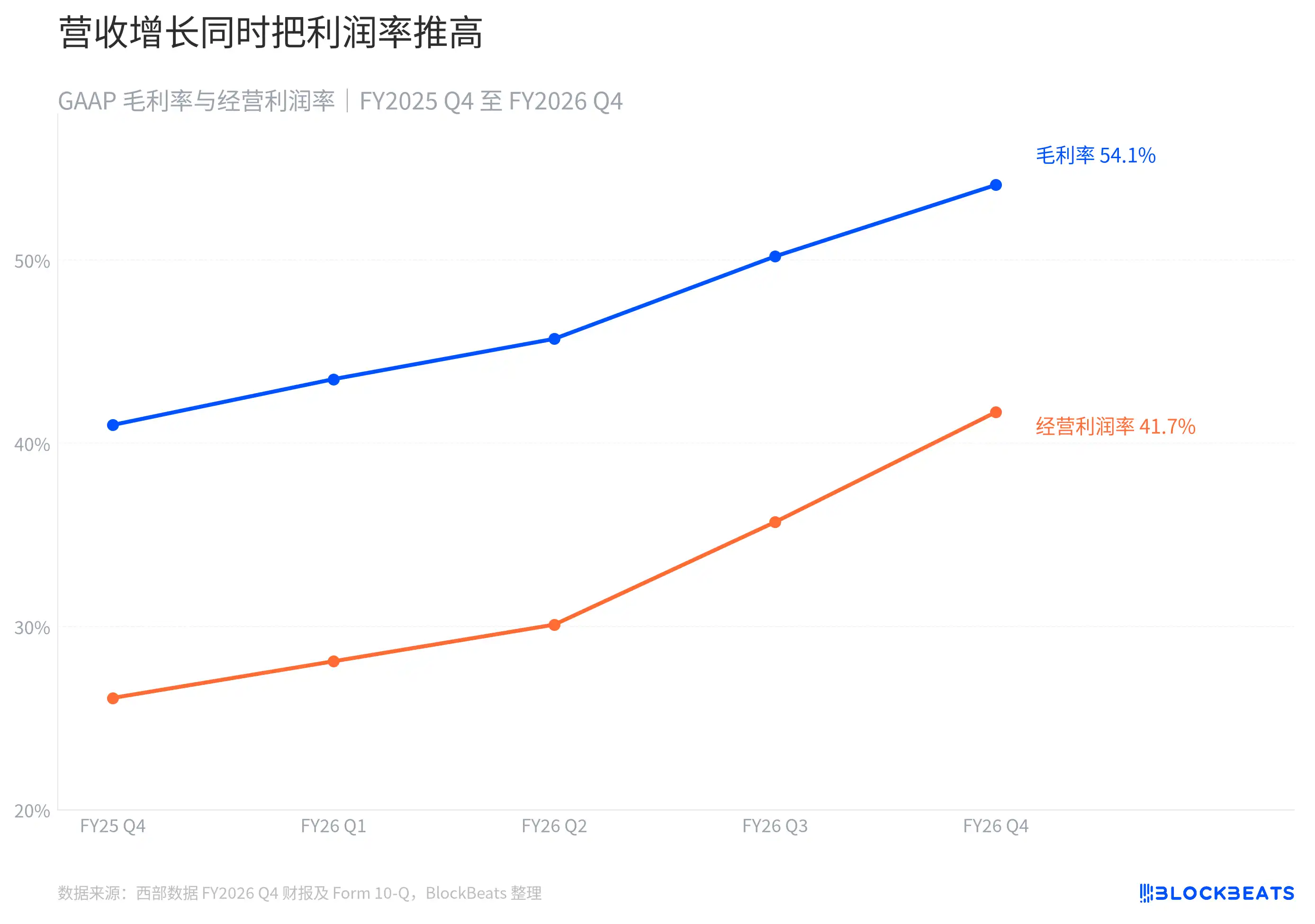
The earnings release did not tie that improvement to one product or one customer. What the company said was narrower: demand for Western Digital products increased as cloud and other data-intensive workloads expanded. It did not break out “AI” as a separate, auditable revenue line. What is clear from the reported numbers is that revenue growth and margin expansion took place at the same time over the five-quarter stretch, and the added revenue flowed through to operating margin.
Cash flow backed up the quarter’s profit improvement
Cash generation added another check on the numbers. Free cash flow for FY2026 Q4 was $1.281 billion, and cash flow from operations was $1.389 billion.
Hard drives remain a manufacturing business that depends on equipment, materials, and inventory turnover. When cash keeps pace with profit, it gives a fuller view of the quarter’s operating result. It does not prove the trend will last indefinitely, but it is a more direct measure of funds the business can actually use than the income statement alone.
Why GAAP EPS looked far stronger than the core business alone
Western Digital reported GAAP net income from continuing operations attributable to shareholders of $3.195 billion in FY2026 Q4. On the company’s Non-GAAP basis, that figure was $1.382 billion. The gap was not an accounting error. It reflected items the company excludes when comparing day-to-day operating performance.
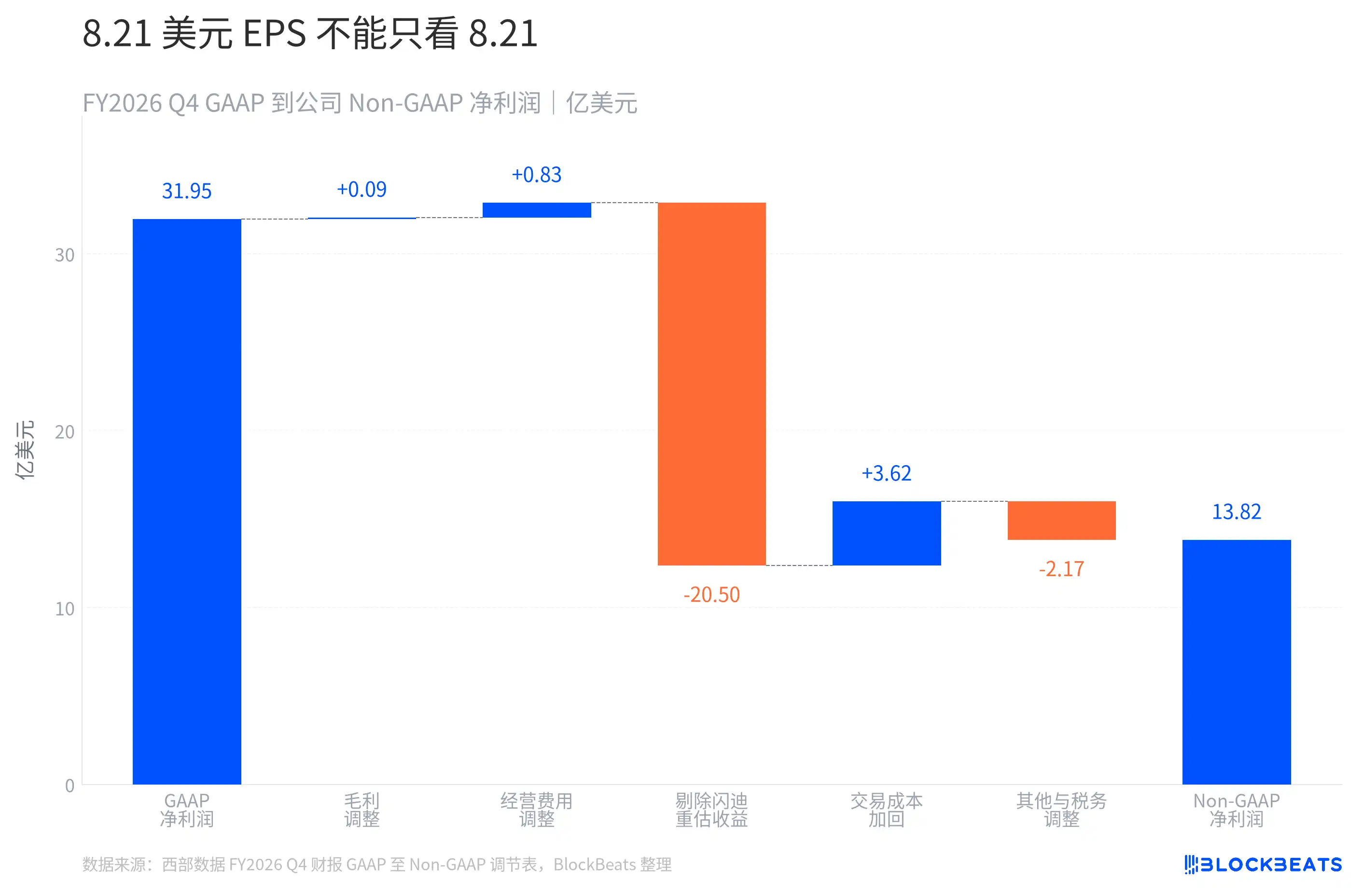
The largest item was a $2.050 billion gain tied to Western Digital’s retained interest in SanDisk. That gain came from marking the SanDisk stake to market, not from selling more hard drives in the quarter. In the same reconciliation, the company also added back costs related to debt and equity transactions and adjusted for tax items, stock-based compensation, and restructuring.
That does not make Non-GAAP the only valid way to read profit. It remains a company-defined comparison measure and needs to be read alongside GAAP. Its use here is more limited and more practical: it separates equity-value changes from the operating results generated by making and selling hard drives. Look only at the $8.21 in GAAP EPS, and two very different kinds of gains can easily appear to be the same thing.
The quarter’s key takeaway is not that a hard drive suddenly deserves a chip-style valuation story. It is that after the flash spinoff, Western Digital’s HDD business has shown thicker revenue and thicker margins at the same time. The SanDisk stake made GAAP profit look brighter, but even without that market-value effect, the hard drive operation itself no longer looks like it did in the previous cycle.