
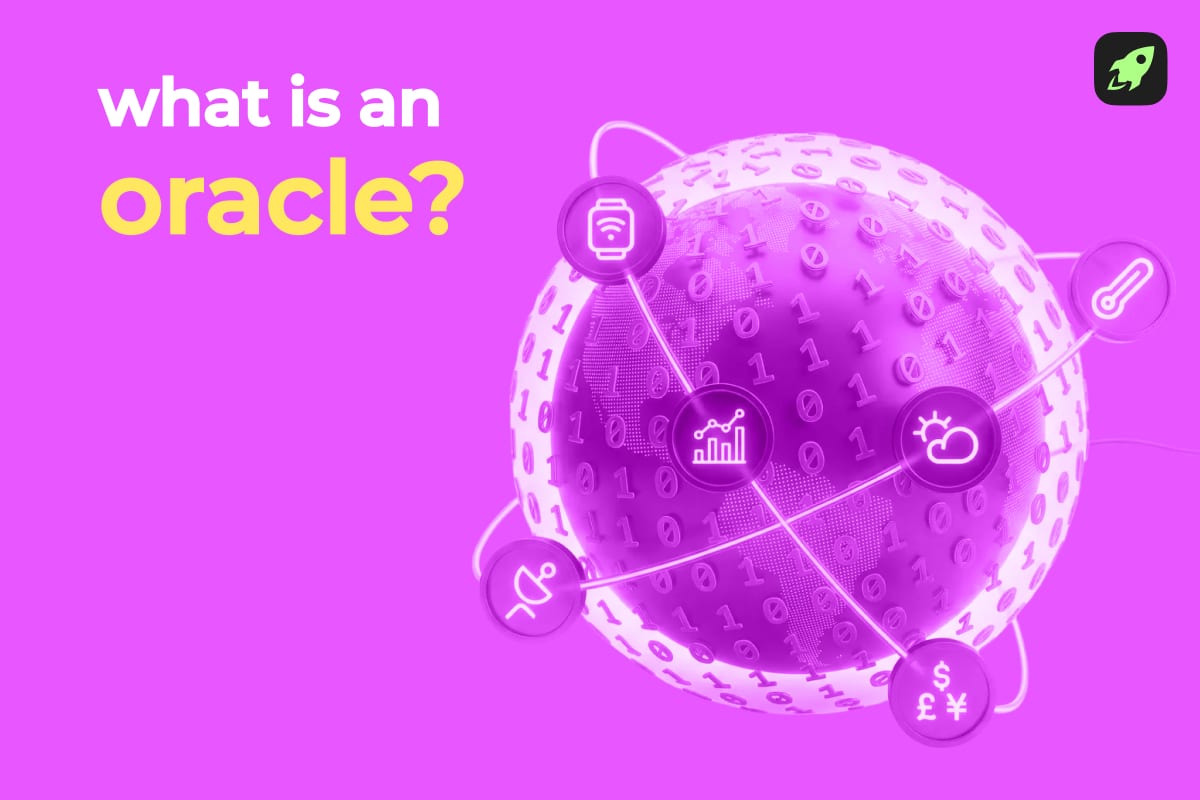
Crypto oracles are the infrastructure that connects blockchains with data outside the chain. A smart contract can read on-chain state, but it cannot directly access asset prices, exchange rates, weather conditions, flight delays, or sensor readings. An oracle fills that gap by sourcing external data, checking it, and delivering it on-chain in a format a contract can use.
That function is central to most real smart contract applications. DeFi protocols depend on price feeds to value collateral and determine liquidations. Insurance contracts need confirmation that a real-world event actually happened. Supply chain systems rely on logistics updates and hardware sensors. Without oracle infrastructure, smart contracts remain limited to what already exists on their native chain.
How an oracle request becomes an on-chain action
The workflow usually starts with a smart contract asking for data through a dedicated oracle contract. That request defines what information is needed and how it should be returned. A lending protocol may ask for the current market price of an asset; an insurance contract may ask whether a certain external event took place.
An oracle node then picks up the request and goes off-chain to collect the answer. Typical sources include web APIs, exchanges, data vendors, and enterprise databases. Source quality matters. If a node relies on a weak or compromised source, the result can be wrong, which is why many oracle services compare multiple external feeds instead of trusting a single one.
After data collection comes verification, signing, and attestation. The node signs its response so others can check who submitted it and whether the data changed in transit. Decentralized oracle networks often require several nodes to fetch the same information and compare outputs before a final value is accepted. Some systems also use cryptoeconomic penalties to discourage bad submissions.
Once prepared, the response is submitted on-chain and recorded through normal blockchain transactions. If the oracle network aggregates answers, the contract may receive a final figure such as a median rather than raw inputs. The smart contract can then act on that result: a liquidation may fire, a payout may be released, a position may rebalance, or game logic may update.
Oracle designs vary by trust model, data source, and delivery method
Centralized oracles depend on one provider to fetch and deliver off-chain data. That approach is simpler and often faster, but it creates a single point of failure. If the provider goes offline, gets hacked, or submits manipulated data, every contract that depends on it is exposed. A decentralized oracle network spreads this task across multiple independent nodes to reduce trust assumptions and improve uptime.
Oracles can also be grouped by direction. Inbound oracles bring outside information into the blockchain, which covers most DeFi price feeds, weather data, and event confirmations. Outbound oracles move blockchain data to external systems, such as payment rails, backend databases, or enterprise software after a contract executes.
By source, software oracles pull from APIs, exchanges, and databases, making them the standard choice for market data and public information. Hardware oracles rely on IoT sensors and tools such as radio-frequency identification, which makes them useful for environmental monitoring, logistics, and supply chain tracking. By update pattern, pull oracles answer specific contract requests, while push oracles continuously publish updates on-chain; price feeds are the clearest example of the push model.
Some architectures are more specialized. Hybrid oracles handle complex computation off-chain and post only final results on-chain to reduce cost and complexity. Optimistic oracles, including UMA’s model, treat data as correct by default and trigger verification only if someone disputes the submission during a challenge window. Cross-chain and bridge oracles pass data and messages between separate blockchains, though they require stronger security because failures can affect more than one network.
How major oracle projects differ
The source material highlights Chainlink as one of the most widely used decentralized oracle networks, covering price feeds, randomness, automation, and cross-chain messaging. It also notes that Mastercard and UBS have tested Chainlink services for on-chain financial workflows. Band Protocol, built on the Cosmos SDK, focuses on high-throughput cross-chain data aggregation across networks including Ethereum, Solana, and BNB Chain.
Pyth Network centers on low-latency market data and sources prices from first-party providers such as exchanges and trading firms, with a focus on decentralized exchanges and trading protocols. UMA’s Optimistic Oracle takes a dispute-based approach, delaying heavy verification unless a submitted answer is challenged.
Why oracles matter beyond price feeds
An oracle is not a prediction engine. It is a data delivery and verification layer for smart contracts. Its purpose is to answer questions the blockchain cannot answer by itself: what an asset costs off-chain, whether a real-world event occurred, or what happened on another chain. Once that missing context arrives on-chain, smart contracts can support lending, insurance, gaming, NFTs, and cross-chain interactions with much broader scope.