
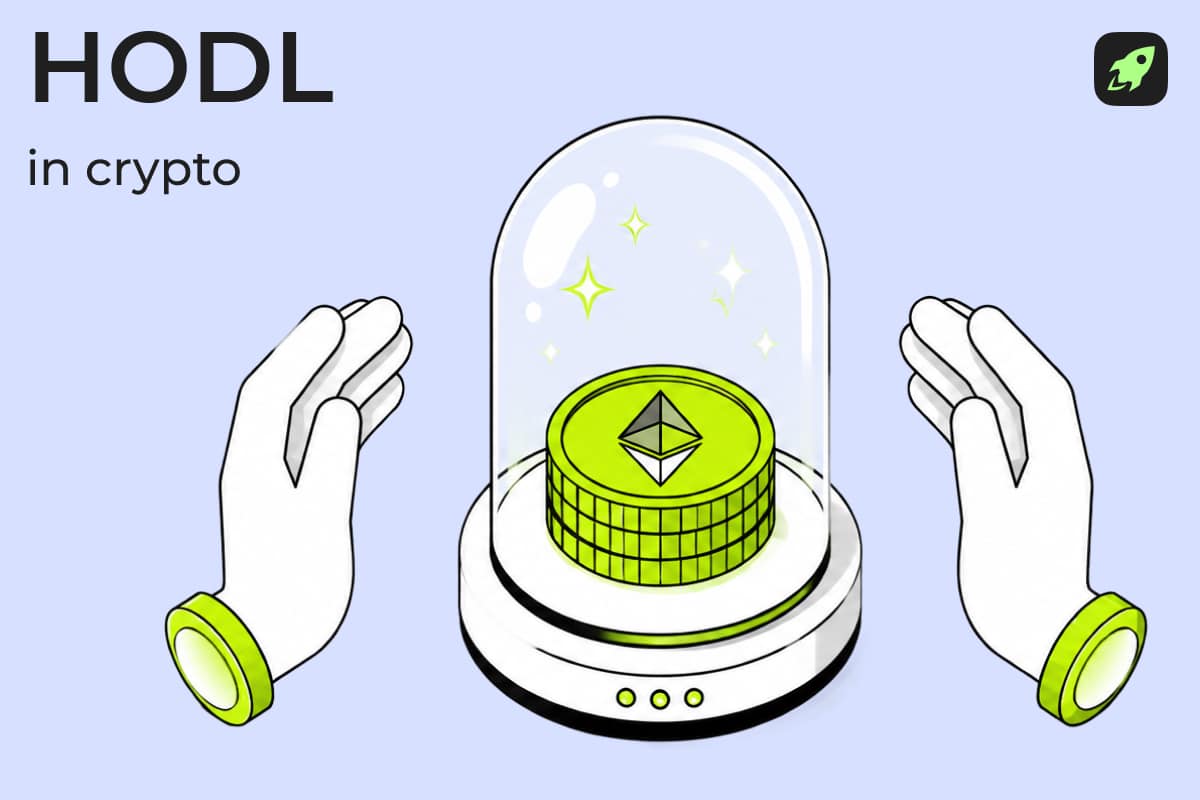
HODL in crypto means keeping a position instead of selling because of short-term price swings. The term usually comes up when markets drop hard. At its core, it describes the choice to stay invested through volatility because the holder is focused on a longer time horizon, not the next chart move.
In practice, HODL points to a few ideas at once: long-term holding instead of reacting to every move, refusing to sell during crashes or periods of FUD, and maintaining conviction in Bitcoin, Ethereum, or another crypto asset over time. It resembles a buy-and-hold approach, but adapted to a market where price moves can be extreme. It is not a promise that holding will work. It is a behavior and a framework.
It started with a forum post in 2013
The origin of HODL is simple and very specific. On December 18, 2013, BitcoinTalk user GameKyuubi posted a thread titled “I AM HODLING” during a period of sharp Bitcoin volatility. The user meant to write “holding,” but the typo spread through the crypto community and became one of the best-known pieces of Bitcoin slang.
The post resonated because it captured a familiar problem. The writer described being bad at short-term trading and choosing to hold rather than keep trying to time the market. For people who had already seen violent swings in Bitcoin, that decision felt recognizable.
“Hold On for Dear Life” came later
Many market participants now explain HODL as “Hold On for Dear Life.” According to the source material, that was not the original meaning. HODL first appeared as a misspelling of “hold,” and the expanded phrase was attached later as a backronym created after the word had already become popular.
The phrase stuck because it matched the experience. When Bitcoin or Ethereum falls quickly, holding can feel exactly like that. In a bear market, headlines and sentiment can make panic selling look reasonable even when the long-term plan has not changed.
Why investors use HODL in crypto markets
The appeal of HODL comes from avoiding costly emotional decisions. A fast selloff can push investors to lock in losses before they have thought clearly. A fast rally can produce the opposite problem: overtrading, chasing price, or selling too early while trying to call every top.
Crypto culture built its own language around this behavior. People who keep holding through drawdowns are often praised for having “diamond hands,” while those who sell quickly under pressure get labeled “paper hands.” The source also makes a clear point here: memes should not replace risk management.
HODLing works best as a plan, not as a reflex
The article frames HODLing as something that should be decided before buying, not improvised after a drop. That means knowing what asset is being bought, why it is being bought, how much risk is acceptable, and how long the position is meant to stay open. Without those pieces, long-term holding can collapse under the first major drawdown.
A practical HODL approach usually includes five steps: choose the asset, set the time horizon, define risk tolerance, decide how to accumulate, and plan storage. Position size matters just as much as conviction. If the exposure is larger than a person can handle emotionally or financially, the odds of panic selling rise sharply during a bear market.
How a HODLer differs from an active trader
A HODLer is generally someone who keeps holding crypto through market fluctuations instead of exiting at the first sign of stress. That person may hold Bitcoin, Ethereum, or another asset, but the common trait is the same: long-term holding takes priority over constant reaction. Some HODLers also use dollar-cost averaging, building exposure over time instead of focusing on daily charts.
That is different from active trading. Day trading, swing trading, and scalping all rely on timing, chart work, risk controls, and repeated decisions. HODL reduces the need for constant action. The holder accepts that corrections, breakouts, and fakeouts are part of the cycle and does not try to trade every one of them. Trading offers flexibility, but it also creates more chances to make mistakes.
Dollar-cost averaging often supports the strategy
The source presents DCA as a common tool that fits naturally with HODL. The method is straightforward: buy a fixed amount on a regular schedule whether the market is rising or falling. The interval might be weekly, monthly, or tied to each paycheck. The point is not to remove risk. It is to reduce the pressure of finding a perfect entry.
For long-term holders, DCA can add structure during a bear market, limit emotional buying during a rally, and make accumulation easier to maintain over time. The source is also explicit about the limits. DCA does not guarantee profits, and it does not ensure a better average entry than a lump-sum purchase. If the asset keeps falling or never recovers, losses can still happen.
Holding long term still carries real risk
One of the biggest risks in HODLing is that not every cryptocurrency survives. The article notes that Bitcoin has a long history and broad market recognition, but many crypto assets have disappeared, lost liquidity, or failed to reclaim earlier highs. Survivorship bias can make HODL stories look cleaner than they are because markets remember the winners and forget the projects that collapsed.
The source also mentions sentiment tools such as the Fear and Greed Index. They may help describe the market mood, but checking them constantly can become a distraction. A HODL plan should come from research and risk tolerance, not from a daily sentiment reading.
Safer HODLing depends on rules and storage discipline
The article’s safety advice is practical. Use money that can stay invested through volatility. If a 50% or 70% drawdown would force a panic sale, the position is probably too large. HODLing is easier when the size of the position matches the holder’s ability to tolerate losses on paper without being pushed into an urgent exit.
A safer plan should define the thesis for owning the asset, the rules for selling or reducing exposure, the position size, the storage setup, and the schedule for reviewing whether the original thesis still holds. Patience matters. Ignoring major changes forever is not the same thing as discipline.
HODL is not the same as staking, lending, or DeFi
The source separates HODLing from staking, lending, and DeFi. HODLing simply means holding a crypto asset for the long term. Staking involves locking or delegating certain assets to support a proof-of-stake network and possibly earn rewards. Lending means supplying assets to a platform or protocol for yield. Those activities can overlap with long-term holding, but they add different layers of risk.
Once assets are used for staking, lending, or DeFi, the holder may face smart-contract risk, platform risk, lockup periods, slashing risk, liquidity risk, and changing reward rates. The article also notes that some product names and tickers use the word HODL, including specific tokens or an ETF ticker, but those are branded products rather than the general strategy itself.