
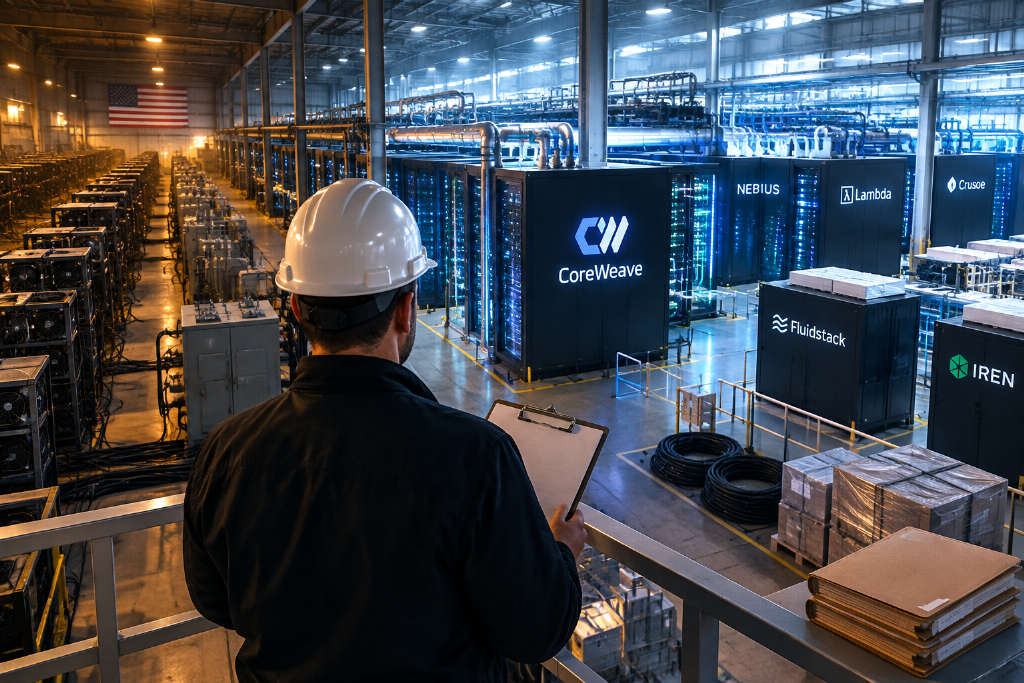
Training and running modern AI models requires enormous computing power, and almost all of it comes from graphics processing units, or GPUs. For most of the last decade, companies looking to rent servers usually went to the hyperscalers: Amazon Web Services, Microsoft Azure, or Google Cloud. After the ChatGPT boom triggered a rush for GPUs, a new class of provider stepped in to absorb that demand. Those companies are known as neoclouds.
Decrypt’s guide explains what neoclouds are, how they operate, who the main players are, and why the sector’s stocks were hit hard in October 2026.
What a neocloud is
A neocloud is an artificial intelligence-focused infrastructure-as-a-service, or IaaS, provider. A hyperscaler sells a broad menu of products, from databases to email hosting. A neocloud mostly sells access to large clusters of high-end GPUs, along with the networking, storage, and software needed to run AI workloads. CNBC describes them as businesses that offer access to the GPUs powering artificial intelligence as a service.
The best-known neocloud companies include:
- CoreWeave (Nasdaq: CRWV), backed by Nvidia and the largest pure-play neocloud. It went public in March 2025.
- Nebius Group (Nasdaq: NBIS), based in Amsterdam and formed from the international business of Russian tech giant Yandex.
- Lambda, Crusoe, and Fluidstack, privately held GPU cloud providers. Lambda is raising a final funding round ahead of a planned IPO.
- IREN, a Bitcoin miner that shifted into AI hosting and now operates its own AI cloud.
Neoclouds are companies, not blockchains, so they do not issue native tokens. Their shares trade on traditional stock exchanges.
CoreWeave began in 2017 as an Ethereum mining business using GPUs. When Ethereum switched to proof of stake in 2022, GPU mining on the network came to an end, and CoreWeave redirected its hardware toward AI and cloud workloads.
How the neocloud model works
The model rests on three scarce inputs: chips, power, and capital.
Chips
Neoclouds buy large volumes of Nvidia GPUs and connect them into clusters designed for AI. Early access to new Nvidia systems is a major selling point.
Power and space
AI clusters need hundreds of megawatts of electricity as well as liquid cooling. Neoclouds either build their own data centers or lease powered shells from site owners, including Bitcoin miners that have shifted into AI hosting.
Capital
GPUs are expensive and they depreciate quickly. Neoclouds usually finance those purchases with debt, often secured by the chips themselves and by long-term customer contracts.
Customers such as AI labs, large technology companies, and startups sign multiyear agreements for reserved capacity or pay by the hour on demand. A neocloud makes money on the spread between what the GPUs earn and what it costs to buy, power, and finance them.
The weak point is depreciation. In its second-quarter 2026 results, CoreWeave reported nearly $1.4 billion in depreciation and amortization against about $2.6 billion in revenue. Nebius reported about $260 million in depreciation and amortization against $582 million in revenue.
Why neoclouds stand out
Neoclouds compete on speed and focus. Hyperscalers divide GPU supply across many services, including their own AI products. Neoclouds can deliver large dedicated clusters quickly, and they tune their software for AI rather than general-purpose computing.
Some of their biggest customers are the hyperscalers themselves. When their own data centers cannot keep up, they rent neocloud capacity.
The sector has also opened a second path for Bitcoin miners. According to Bernstein, in the two years through July 2026, miners contracted roughly 7 gigawatts of power capacity across 19 deals worth more than $135 billion with hyperscalers, neoclouds, and chipmakers. That is less than one-quarter of the 30 GW in miners’ planned power pipeline. The key asset is power: miners already had land, grid connections, and permits, all of which can take years to secure.
TeraWulf signed a 20-year lease with Anthropic for its Kentucky campus. The deal is expected to generate about $19 billion, more than TeraWulf’s entire market value at the time.
Who is working with neoclouds
- Microsoft: a major buyer of neocloud capacity, including a roughly $9.7 billion, five-year GPU cloud contract with IREN.
- Amazon Web Services: signed a 15-year lease worth roughly $5.5 billion with Cipher, a Bitcoin miner turned AI host, for AI capacity.
- Google: guarantees Fluidstack’s lease payments on sites operated by TeraWulf and Cipher.
- Anthropic: leases capacity from TeraWulf and, through Fluidstack, from Hut 8.
- Nvidia: the main chip supplier to neoclouds and an investor in CoreWeave.
Is there a neocloud token?
No. Neoclouds are conventional companies. The closest crypto parallel is decentralized physical infrastructure networks, or DePIN, such as Render, Akash, and io.net. These networks use tokens to pay for GPU compute and to reward the people supplying it. They target the same market, but they run on a peer-to-peer model rather than company-owned data centers.
Where investors can buy neocloud-related stocks
CoreWeave (CRWV), Nebius (NBIS), and IREN (IREN) trade on the Nasdaq and are available through mainstream brokerages. Several other listed Bitcoin miners that shifted into AI hosting, including TeraWulf, Cipher, Hut 8, and Core Scientific, also provide exposure to the AI hosting side of the business. Crypto-native compute tokens such as Render (RENDER) trade on major exchanges. Decrypt says all of these should be treated as high-risk, volatile assets.
The pressure on the sector
The industry is facing heavy strain. On October 14, 2026, Gartner predicted that more than 80% of neocloud providers would stop operating independently by 2030 because of “cost pressure and a lack of a differentiating business model.” Gartner also estimated that more than $3.5 trillion in AI infrastructure spending could face impairment by the end of 2030 if AI providers keep spending at the current pace.
Credit markets have also become more cautious. By October 21, 2026, CoreWeave’s unsecured debt was yielding about 15%, and the cost of insuring its bonds against default had risen 30% in a month. Its shares were down 29% for October, leaving the company valued at about $34 billion, versus a peak of about $90 billion in 2025. Nebius fell 27% over the same period even though it carries much less net debt, and IREN fell 32%.
The bullish argument has not disappeared. CoreWeave co-founder Brannin McBee said nearly all of the company’s 2027 capacity had already been sold, with contracts extending into 2028 and beyond. Whether neoclouds remain independent or end up owned by larger players, demand for AI compute is still high. The unresolved question is whether these companies can earn enough from that demand to repay their debts.
This article is for informational purposes only and is not financial advice.



