
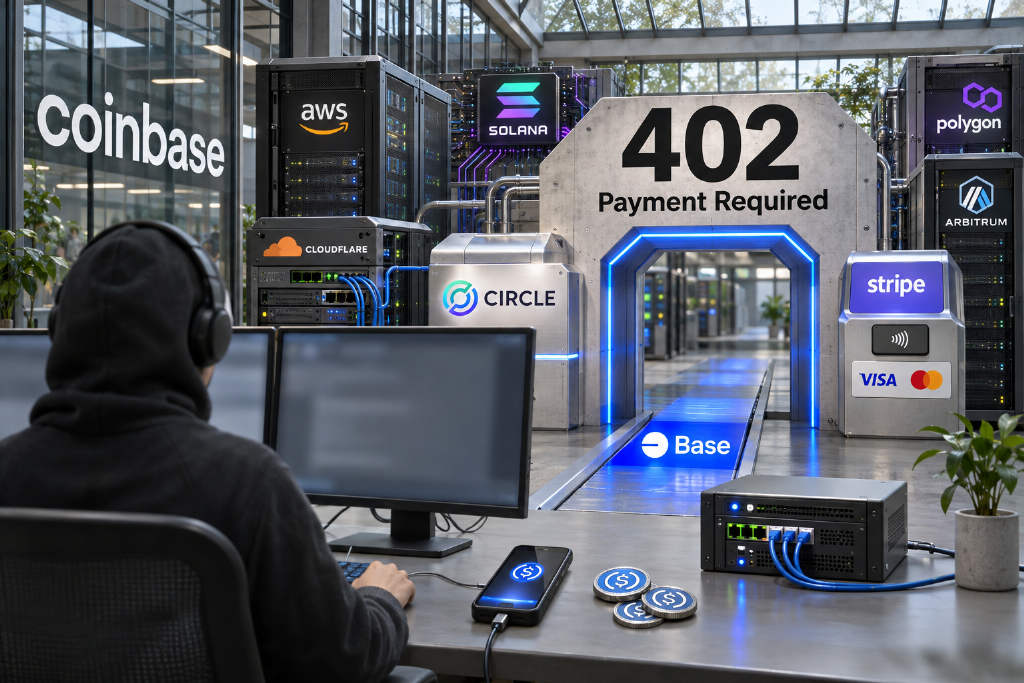
The web was never really built with payments at its core. Early HTTP specifications included status code 402, "Payment Required," as a placeholder for a future online payment system. Then it sat there for roughly 30 years without meaningful use. Traditional payments were slow, costly, and dependent on accounts, card details, and intermediaries that could reverse charges. That setup does not fit tiny payments made by software.
The gap matters more now because AI agents are starting to browse the web, call APIs, and buy services on behalf of users. An agent cannot fill out a checkout form or sign up for a monthly plan every time it needs a tool. Cloudflare says more than half of internet traffic is now non-human, and the company reports seeing 1 billion HTTP 402 responses on its network each day.
x402 is an attempt to give the internet a native payment method at the protocol level. Here is what it is, how it works, who is backing it, and whether any token is attached to it.
What x402 is
The 402 "Payment Required" code has been part of the HTTP standard since the 1990s. It was reserved "for future use," and x402 is the first major push to put it to work.
x402 is an open payment standard built on top of HTTP, the protocol that moves data across the web. Coinbase launched it in May 2025 with partners including AWS, Anthropic, Circle, and NEAR. The idea is to let APIs, apps, and AI agents pay for services in stablecoins as part of an ordinary web request.
x402 is not a blockchain, and it is not a coin. It is a ruleset: message formats, headers, and a request-response flow that servers and clients can follow. Payments are mostly made in USDC, Circle’s dollar-backed stablecoin, with Coinbase’s Ethereum layer-2 network Base serving as the main settlement chain. The protocol is chain-agnostic, though, and now supports Solana, Polygon, Arbitrum, and other networks, along with traditional card payments.
On April 2, 2026, the Linux Foundation announced that it was launching the x402 Foundation. Coinbase contributed the protocol, and companies including Microsoft, Google, Visa, and Mastercard expressed initial support. The x402 Foundation became fully operational on July 14, 2026, and now stewards the protocol under vendor-neutral governance.
In a May 6, 2025 post, Coinbase Developer Platform wrote: "We are excited to introduce x402–a new open source payments protocol built on HTTP rails."
How x402 works
x402 runs through a short handshake inside a standard web request.
- Request: An AI agent or app asks a server for something, such as an API call, a dataset, or an article.
- 402 response: The server replies with "402 Payment Required" and includes machine-readable terms: the price, the accepted tokens, and the wallet address for payment.
- Payment: The client signs a payment authorization with its wallet and sends the request again, this time attaching the signature in a header.
- Delivery: The server verifies the payment, settles it onchain, and returns the requested content or service.
Most of the onchain work is handled by a facilitator, a service that verifies payments and settles them on the blockchain so sellers do not need to run their own crypto payment stack. On EVM chains, x402 uses EIP-3009, a standard that lets someone transfer tokens by signing a permission instead of sending a transaction directly. That means the buyer does not need to hold ETH for gas.
Why x402 stands out
The main pitch is machine-driven micropayments. Settlement on Base takes seconds and costs well under a cent, which makes it practical to pay fractions of a cent for a single API call. There is no sign-up, no API key, and no subscription. The agent pays and receives what it asked for.
Adoption has moved quickly. Coinbase released x402 V2 in December 2025, adding wallet-based identity so agents would not need to pay again on every call. The update also introduced automatic service discovery and support for more chains. In May 2026, x402 added batch settlement, allowing agents to hand sellers signed vouchers that can later be settled in bulk.
According to Fireblocks, citing data from tracker agenteconomy.to, x402 had processed more than 196 million transactions across 12 chains and settled more than $42 million as of Nov. 1, 2026. Coinbase says more than 97% of onchain agent transactions in Q2 2026 used x402.
That said, Fireblocks also noted that more than half of x402’s lifetime transactions came during a two-month burst in late 2025, when traders ran automated scripts to mint and sell PING, a token issued through x402. Activity has since cooled sharply. In October 2026, x402 processed 5.1 million transactions worth about $274,000.
Who is building with x402
- Cloudflare: A co-developer of the x402 Foundation with Coinbase and Stripe. It supports x402 in its Agents SDK and offers a monetization gateway that runs at the network edge.
- Stripe: A co-developer of the x402 Foundation and a premier member. It converts x402 payments into its standard PaymentIntents so merchants can keep familiar reporting and payouts in regular currency.
- Agentic.Market: Coinbase’s public marketplace, launched in April 2026, for discovering and comparing x402 services with live pricing and volume data.
- CoinGecko: Offers crypto market data API endpoints that agents pay for on a per-call basis.
- AWS: Its AgentCore service manages agent payments, budgets, and permissions on the buyer side.
- Google: Its agent-to-agent, or A2A, x402 extension is part of the Agent Payments Protocol, or AP2. Built with Coinbase, the Ethereum Foundation, and MetaMask, it uses x402 for crypto settlement between agents.
Does x402 have a token?
No. x402 is a protocol, not a cryptocurrency, and it has no official native token. Payments use existing stablecoins, mainly USDC. Speculative tokens using the x402 name have appeared on various chains, but none of them is issued or backed by Coinbase or the x402 Foundation. Any token claiming to be the official x402 coin should be treated with caution.
How users get USDC for x402 payments
To use x402, an agent or app needs a wallet holding a supported stablecoin on a supported network, usually USDC on Base. USDC is widely available on major exchanges including Coinbase, Kraken, and Binance. Coinbase also lets users send USDC directly to Base.
Developers can fund agents through Coinbase Developer Platform wallets or Circle Wallets and set spending limits to keep those agents under control.
What comes next
The x402 Foundation has expanded quickly. It had 40 member organizations when it became operational in July 2026, and that list has since grown to 57. Members include Visa, Mastercard, American Express, PayPal, Google, Shopify, Circle, Stripe, and AWS. Michael Hursta became the foundation’s executive director on Oct. 1, 2026.
x402 is not alone in this market. The Agentic Commerce Protocol, an open standard developed by Stripe and OpenAI, and Visa’s Trusted Agent Protocol are also competing for a place in agent payments, even though Stripe and Visa are both premier members of the x402 Foundation.
Stripe has also co-developed the Machine Payments Protocol with payments blockchain Tempo. Like x402, MPP uses the HTTP 402 code to let agents pay for services, but it adds session-based billing so agents can pay as they go instead of settling every request onchain.
Since June 2026, MPP has also supported x402 payments. The open question is whether x402’s large transaction counts will turn into steady, real commerce. If that happens, the payment code that sat unused for 30 years could end up carrying a meaningful share of payments in the AI economy.



