


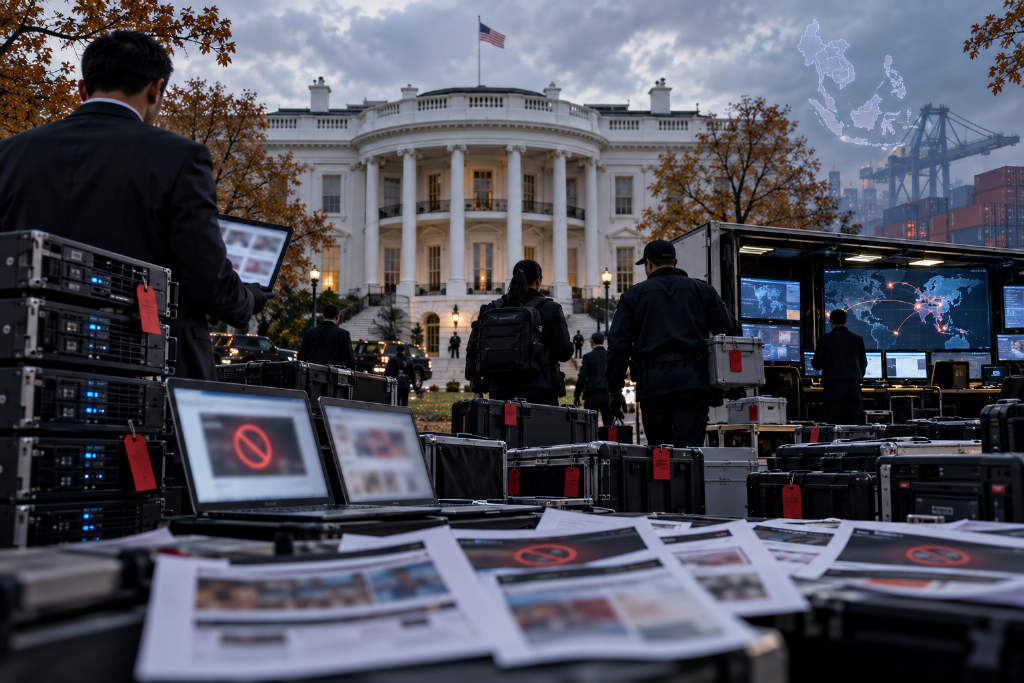
U.S. President Donald Trump held a White House event on cybercrime prevention on Oct. 21, Taipei time, with overseas crypto investment fraud and transnational criminal groups at the center of the discussion. According to White House briefings obtained by CoinDesk and Reuters, law enforcement agencies have blocked about $833 million in related crypto funds, seized 503 fake investment websites, and warned nearly 9,000 Americans.
White House event focused on fake crypto investment schemes
The event highlighted foreign criminal networks accused of luring Americans into sham crypto investments, as well as enforcement actions such as seizing scam websites and disrupting online impersonation tactics.
Reuters, citing White House officials, said those expected to attend included Homeland Security Secretary Markwayne Mullin, Federal Bureau of Investigation Director Kash Patel, Defense Secretary Pete Hegseth, and Attorney General Todd Blanche. The discussion was set to cover the seizure of fake crypto investment sites and efforts to curb online impersonation fraud.
CoinDesk, also citing officials, reported that transnational criminal groups have used romance scams, phishing, and ransomware to run scam centers. Authorities said they had blocked about $833 million in related crypto funds and seized 503 fake investment websites under the supervision of the Homeland Security Task Force. Officials also said nearly 9,000 Americans had been notified that they were being targeted. The same briefing said those warnings were estimated to have prevented about $562 million in losses.
Southeast Asia scam compounds remain a key enforcement target
The latest figures connect to a broader U.S. campaign aimed at scam operations in Southeast Asia. In November 2025, the Department of Justice and the U.S. Attorney’s Office for the District of Columbia announced the creation of the Scam Center Strike Force, targeting crypto investment fraud operations in Myanmar, Cambodia, and Laos that used pig-butchering tactics. On the same day, the Treasury Department’s Office of Foreign Assets Control sanctioned the Myanmar armed group DKBA and related companies and individuals.
In April 2026, the strike force announced charges against managers of scam compounds in Myanmar and the seizure of 503 domains posing as investment platforms. At that time, officials said more than $700 million had been blocked. They also said the FBI and Secret Service operation known as Operation Level Up had notified 8,935 victims as of March 2026.
On the policy side, Trump signed an executive order on March 6, 2026, titled Combating Cybercrime, Fraud, and Predatory Schemes Against American Citizens. The order called for prioritizing prosecutions of online fraud, producing an action plan against scam centers, and evaluating mechanisms to recover funds for victims.
Midterm politics and Trump family crypto interests appear in the same frame
Reuters said the FBI received more than 1 million cyber fraud complaints last year, up 17% from 2024. At the same time, the Trump family has been deeply involved in crypto fundraising. A Reuters investigation said the president and his children’s main crypto ventures had added at least $2.3 billion to the family’s wealth, while related investors were sitting on about $2.3 billion in paper losses.
Responding to questions around conflicts of interest, White House spokesperson Anna Kelly said the president and his administration act in the best interests of the American people.
CoinDesk also said that as the midterm elections draw closer, digital assets have become a focal point in disputes over alleged self-dealing. For the industry, the overseas crackdown may help separate legitimate, compliant businesses from cross-border criminal money flows and could raise compliance demand for exchanges, custodians, and on-chain analytics firms. But if political attacks return to the Trump family’s crypto interests, policy uncertainty could also rise.
Crypto scam enforcement moves onto a national security and election stage
The White House event pushed overseas crypto scams beyond the level of individual enforcement cases and into a broader national security and election narrative. The publicly disclosed facts remain centered on seizures, sanctions, prosecutions, and cross-border coordination: 503 fake investment websites, about $833 million in related crypto funds blocked, and nearly 9,000 Americans warned.