
WuBlockchain’s WhiteLine Daily said demand for AI-related capacity expansion remains in place, but companies are still dealing with the timing gap between orders, financing tenors, capital spending, and cash collection.
Nvidia and Tesla reportedly plan about $2.8 billion to secure Samsung Electro-Mechanics substrate capacity
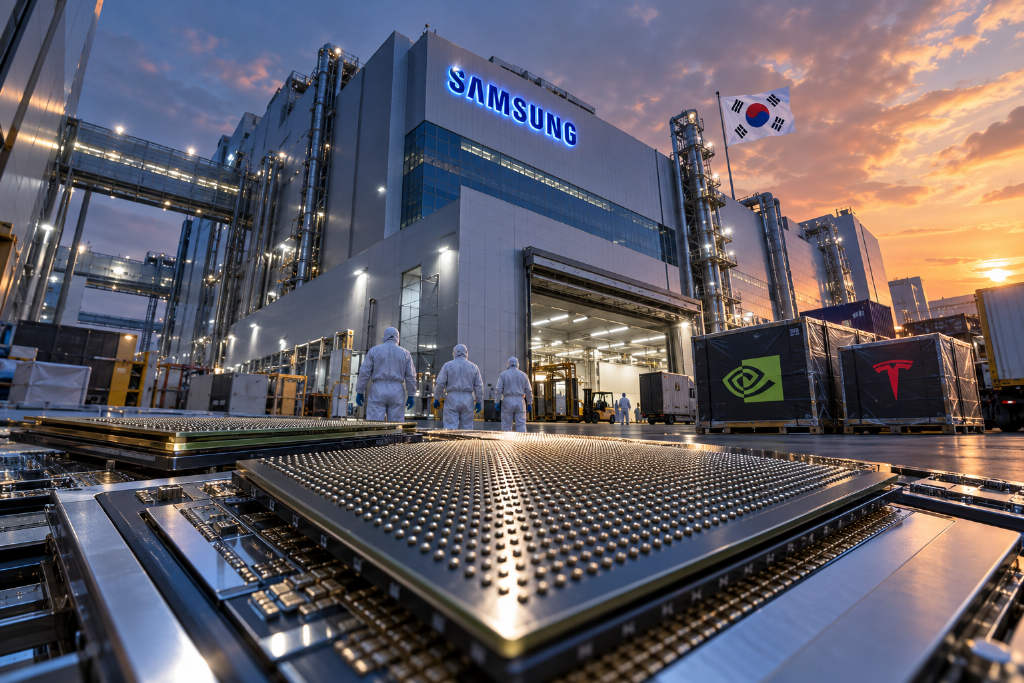
Reuters, citing South Korea’s Maeil Business Newspaper, reported that Samsung Electro-Mechanics is set to receive a combined KRW 3.7 trillion, or about $2.8 billion, from Nvidia and Tesla to build production lines for high-end FC-BGA packaging substrates used in AI chips.
Of that total, Nvidia is said to contribute about KRW 2.6 trillion and Tesla about KRW 1.1 trillion. The lines would be located in Sejong, South Korea, with long-term supply arrangements designed to secure output for both customers.
Korean media said Tesla’s supply agreement would cover 2029 through 2033, and the substrates would be used for AI chips in self-driving vehicles and the Optimus humanoid robot. The new lines are expected to begin mass production in the second half of 2028, with shipments to Tesla starting in 2029.
The report added that the investment amounts and contract details remain based on media reporting. WhiteLine Daily said the combination of customer funding and long-term supply agreements could ease Samsung Electro-Mechanics’ expansion burden while tying new substrate capacity to clearer purchase demand.
Nebius secures a $3.5 billion Citigroup financing facility with a 364-day tenor
AI cloud provider Nebius said it has signed a $3.5 billion senior secured financing facility with Citigroup. The proceeds are intended for data center development, GPU purchases, and general corporate purposes.
The facility has a 364-day tenor. Its initial pricing is term SOFR plus 2.75 percentage points, with the spread later able to rise to as much as 3.50 percentage points, subject to other terms and adjustments.
Nebius said the financing will support near-term global capacity buildout, supplement existing customer prepayments and operating cash flow, and preserve flexibility on the timing and structure of longer-term financing.
The company also said it still has multiple funding options for the next stage, including asset-backed financing based on more than $40 billion in long-term contracts signed with investment-grade customers. WhiteLine Daily said the sub-one-year facility gives Nebius near-term construction support, but longer-duration spending for data centers and GPU expansion will still require follow-on financing.
Solidigm stops evaluating an IPO and keeps reviewing financing for U.S. expansion
SK hynix said Solidigm, its NAND flash and SSD business, has stopped evaluating potential pre-IPO financing and an IPO.
The company said the decision reflected recent capital market conditions, semiconductor share-price trends, and whether a listing would benefit SK hynix and existing shareholders. Earlier, SK hynix had considered direct investment from the parent company and raising outside capital through an IPO to fund a new Solidigm plant in the United States.
SK hynix said AI-driven growth in storage demand makes it necessary for Solidigm to expand production facilities in the U.S. The company added that its growth outlook and investment needs have not changed, and that it will continue to assess the timing, scale, and financing structure of the investment while exploring other options that support business growth and increase value for existing shareholders.
WhiteLine Daily said that after the IPO review was halted, the pace and scale of Solidigm’s U.S. expansion will depend on parent-company funding and alternative financing arrangements.
Bloom Energy lifts guidance after 138.1% revenue growth, but operating cash flow turns negative
On Oct. 22 Eastern Time, fuel-cell equipment maker Bloom Energy reported third-quarter results. Revenue reached $1.236 billion, up 138.1% from a year earlier. Net income attributable to common stockholders was about $250 million, compared with a loss in the same period last year.
Bloom Energy raised its full-year 2026 revenue guidance to $4.4 billion to $4.6 billion, marking the third increase this year. Management said year-to-date performance and customer demand supported the higher outlook, and that the company is still committing resources to expand business capacity and output.
Still, operating cash flow for the quarter was a net outflow of about $27.15 million, versus a net inflow of about $226 million in the previous quarter. The cash flow statement showed that increases in accounts receivable, contract assets, and inventory all used cash. Capital expenditures for property purchases were about $153 million during the same period.
WhiteLine Daily said the rise in contract assets, receivables, and inventory means expansion is consuming cash upfront, and profit growth still needs to be converted into operating cash through project settlement and customer payments.
Main takeaway: demand is there, but funding continuity and cash conversion remain key
WhiteLine Daily said orders and customer commitments are still supporting new AI-related capacity, but the time gap between long construction cycles, financing maturities, and operating cash collection has not gone away.
Production lines, GPU procurement, and inventory buildup all require cash before revenue is realized. Short-term financing also needs to be followed by additional funding. In some cases, even after delivery, companies still need to wait for settlement and payment collection, which means revenue and profit growth do not automatically translate into more deployable cash.
For the companies involved, the report said investors need to look beyond order books, capacity plans, and revenue growth. The durability of financing channels, the pace of customer payments, and how much cash remains after capital expenditures will shape the next round of investment and shareholder returns.



